If you spend any time around Korean speakers, you will hear 원래 (wol-lae) constantly. Learners often look up the wollae meaning after seeing it translated as simply “originally.” That translation is not wrong, but it misses how often Koreans use this word to explain habits, defend choices, or just shrug off a strange rule. In my own daily life, 원래 shows up so often that I barely notice I am saying it.
What Wollae Actually Means Day to Day
Honestly, I use it a lot more than I expected. It comes out almost like a habit, without me really thinking about it. A recent example from my own week: 나 원래 아침에 커피 안 마셔 (na wol-lae a-chim-e keo-pi an ma-syeo — I just don’t drink coffee in the morning). Nothing dramatic was happening when I said it. It wasn’t tied to some big story about my past. It just popped out while I was explaining a small personal habit to a friend.
That’s the part textbooks tend to skip. 원래 doesn’t always point back to history. A lot of the time, it just marks “this is my normal, don’t read too much into it.”

Explaining a Habit at a Company Dinner
Say a coworker is surprised you don’t drink at a hoesik, a work dinner. You’re not making a one-time choice, you’re explaining how you’ve always been. Casually, you could say 나 원래 술 못 마셔 (na wol-lae sul mot ma-syeo — I’ve just never been able to drink alcohol). Politely, it becomes 저는 원래 술을 못 마셔요 (jeo-neun wol-lae sul-eul mot ma-syeo-yo).
In real life, at a hoesik, I usually keep it simple and polite: 저 원래 술을 잘 못 마셔서요 (jeo wol-lae sul-eul jal mot ma-syeo-seo-yo — I’ve just never been able to drink well, so…). With close friends I loosen up a bit and say 나 원래 술 못 마셔ㅋㅋ 체질이 그래 (na wol-lae sul mot ma-syeo, che-jil-i geu-rae — I just can’t drink, it’s my constitution). I’ve noticed I often add 체질 (che-jil — physical constitution) right after 원래, like the reason lives in my body rather than in some personal decision I made.
When Something Is Just “How It Is”
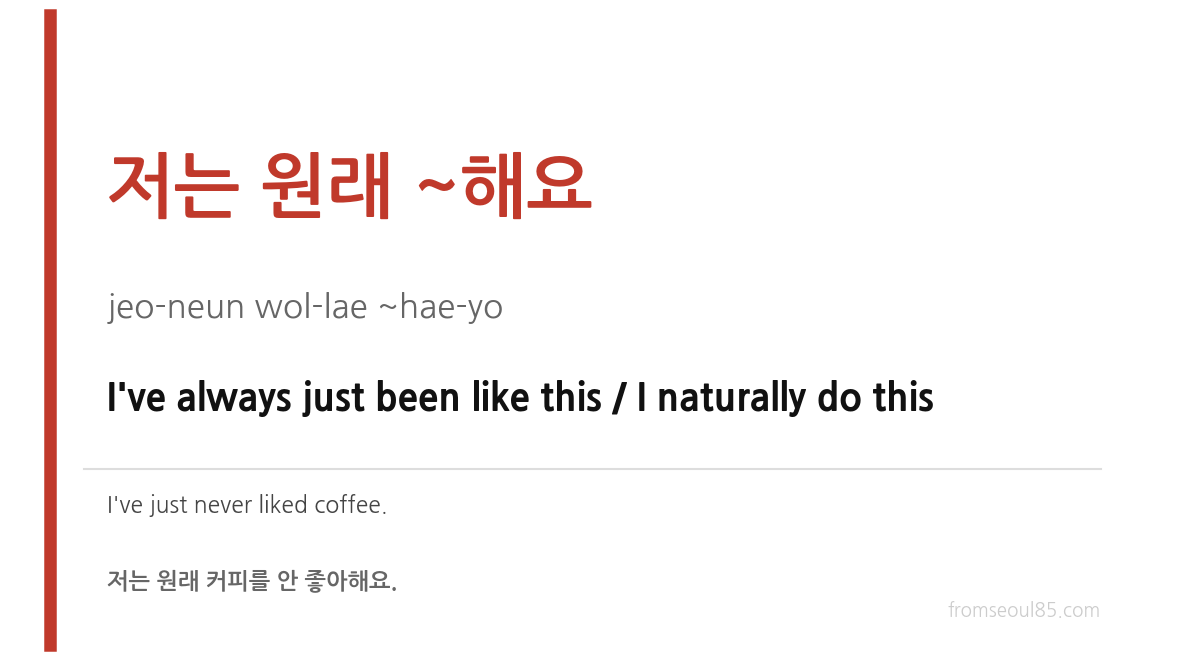
A friend complains that Korean age counting is confusing. Instead of explaining the history behind it, you might just say it has always been this way. Casual: 몰라, 원래 그런 거야 (mol-la, wol-lae geu-reon geo-ya — I don’t know, that’s just how it is). Polite: 원래 그런 거예요 (wol-lae geu-reon geo-ye-yo).
When a friend grumbles about a weird rule like this, I usually brush it off with 몰라 원래 그래ㅋㅋ (mol-la wol-lae geu-rae — I don’t know, that’s just how it is). If I want to sound a little kinder about it, I might say 음… 원래 그런 거 같아, 나도 잘은 몰라 (eum… wol-lae geu-reon geo ga-ta, na-do jal-eun mol-la — hmm, I think that’s just how it’s always been, I don’t really know either). In more polite situations, I’d probably say 원래 그런 것 같더라고요 (wol-lae geu-reon geot ga-tteo-ra-go-yo — it seems like that’s just how it’s always been).
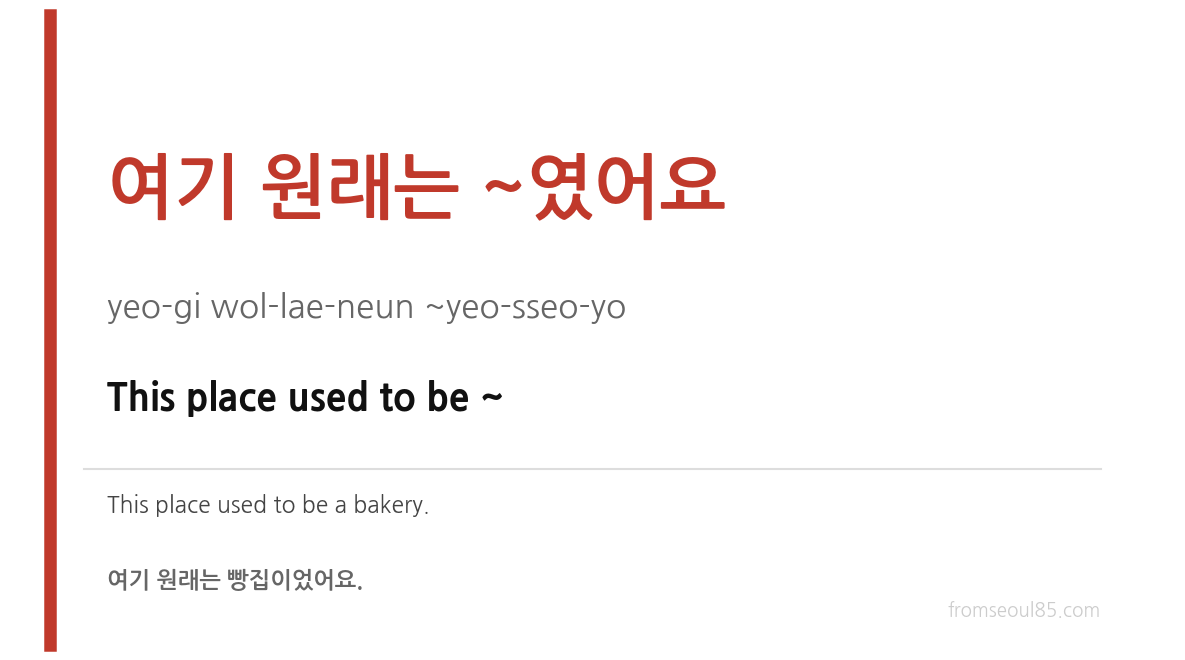
Pointing Out a Place That Used to Be Something Else
You walk past a shop that used to be something different, and you point it out to a friend using 원래 to mark the past state. In my own neighborhood, this happens all the time. I’d say 여기 원래 빵집이었는데 갑자기 편의점 됐더라 (yeo-gi wol-lae ppang-jib-i-eot-neun-de gap-ja-gi pyeon-ui-jeom dwaet-deo-ra — this used to be a bakery, but it suddenly turned into a convenience store). If I’m being more polite, I’d say 여기 원래는 빵집이었어요, 근데 얼마 전에 바뀌었더라고요 (yeo-gi wol-lae-neun ppang-jib-i-eo-sseo-yo, geun-de eol-ma jeon-e ba-kkui-eot-deo-ra-go-yo — this place used to be a bakery, but it changed not long ago).
Notice how 원래 sits right at the start, before the old identity of the place. That word order is pretty typical whenever you’re contrasting how something used to be with how it is now.
Explaining Canceled Plans
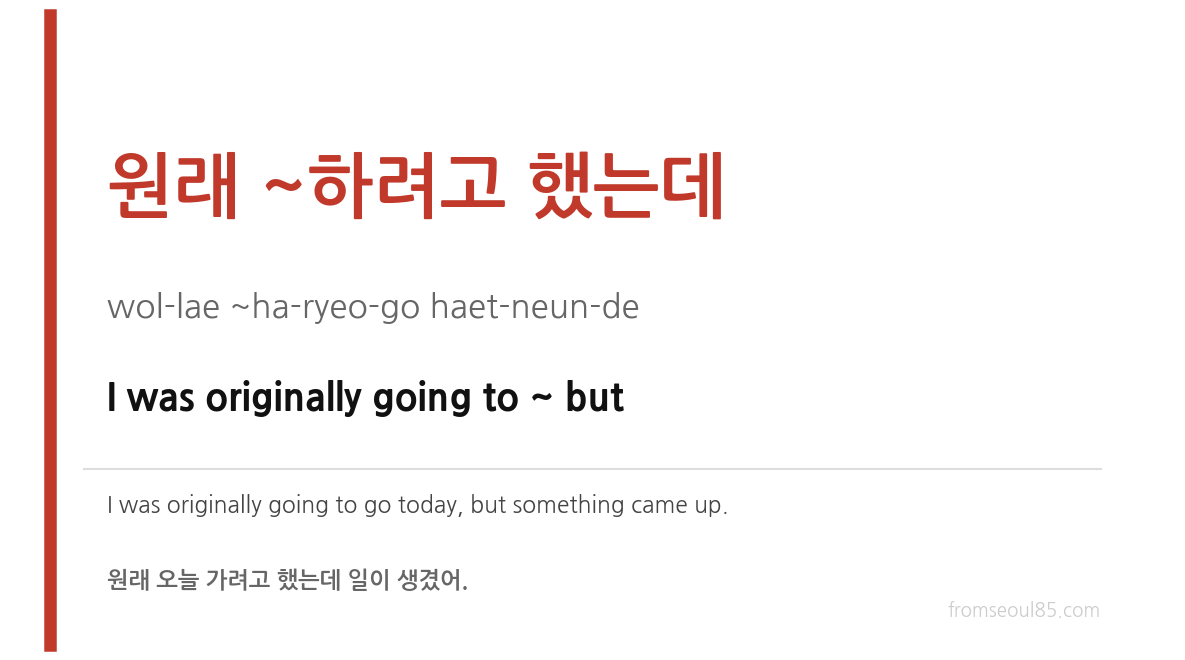
Sometimes you have to cancel plans and explain what you originally intended to do. Casual: 원래 오늘 갈려고 했는데 못 갈 것 같아 (wol-lae o-neul gal-lyeo-go haet-neun-de mot gal geot ga-ta — I was going to go today but I don’t think I can). Polite: 원래는 오늘 가려고 했는데 어려울 것 같아요 (wol-lae-neun o-neul ga-ryeo-go haet-neun-de eo-ryeo-ul geot ga-ta-yo).
By text, I usually write something like 미안 원래 오늘 가려고 했는데 갑자기 일이 생겨서 못 갈 것 같아ㅠㅠ (mi-an, wol-lae o-neul ga-ryeo-go haet-neun-de gap-ja-gi il-i saeng-gyeo-seo mot gal geot ga-ta — sorry, I was originally planning to go today, but something suddenly came up and I don’t think I can make it). If I want to be more careful with my wording, I’d write 원래는 오늘 뵈려고 했는데 사정이 생겨서 어려울 것 같습니다 (wol-lae-neun o-neul boe-ryeo-go haet-neun-de sa-jeong-i saeng-gyeo-seo eo-ryeo-ul geot gat-seum-ni-da — I had originally planned to see you today, but something came up and it looks difficult).
Wollae vs Sasil: Two Words That Both Sound Like “Actually”
Learners sometimes ask me about wollae vs sasil, since both can get translated into English as “actually.” The way I see it, 원래 points at a default state, something that has always been true or a habit that never really changed. 사실 (sa-sil — actually, the truth is) works differently. It usually introduces a fact you’re revealing, often something the listener didn’t already know or expect.
You can even combine them in one sentence, like 사실 나 원래 커피 안 마셔 (sa-sil na wol-lae keo-pi an ma-syeo — actually, I just don’t drink coffee). Here 사실 signals “here’s something you might not know about me,” while 원래 explains that it’s a long-standing habit, not a one-time thing. This is just how I understand the difference from daily use, not something I picked up from a textbook, so other Koreans might explain the line between them a bit differently. As Wikipedia’s overview of Korean grammar notes, adverbs like these often carry nuance that a single English word can’t fully capture.
When Wollae Can Sound Stubborn
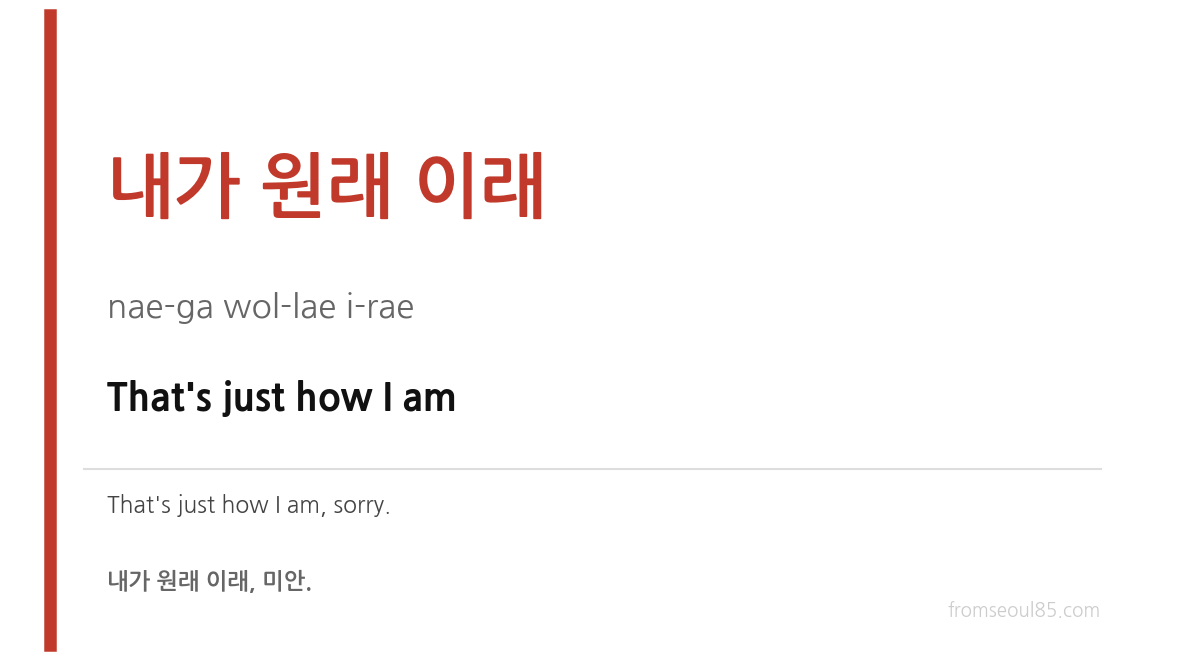
One thing to watch is leaning on 원래 to shut down a conversation instead of explaining yourself. 내가 원래 이래 (nae-ga wol-lae i-rae — I’m just like this) can come across as closing the topic rather than actually addressing it. I’m not sure how younger speakers use it these days, but for me, tone matters more than the word itself.
If someone points out something annoying about me and I brush it off with a careless 나 원래 이래ㅋㅋ, it does sound a bit stubborn, even to my own ears. So instead I try to soften it a little: 아 미안, 내가 원래 좀 이런 편이라 고치려고 노력 중이야 (a mi-an, nae-ga wol-lae jom i-reon pyeon-i-ra go-chi-ryeo-go no-ryeok jung-i-ya — oh sorry, I’m just kind of like this, but I’m trying to work on it). Adding that last bit, that I’m trying to change, seems to make a real difference in how the whole sentence lands.
A Couple of Practical Tips
Match your politeness level to the person you’re talking to. 원래 itself doesn’t change form, but everything around it does, so 저는 원래 ~해요 works for coworkers and strangers, while 나 원래 ~해 fits close friends.
Pair 원래 with a softener when you’re explaining something about your own personality. Words like 체질 (che-jil — constitution) or a line about trying to improve keep the sentence sounding open, not closed off. If you want to see how another everyday word carries a similar habitual feel in daily speech, check out this look at how Koreans use ildan constantly.
Key Expressions
- 원래 그래 (wol-lae geu-rae) — That’s just how it is.
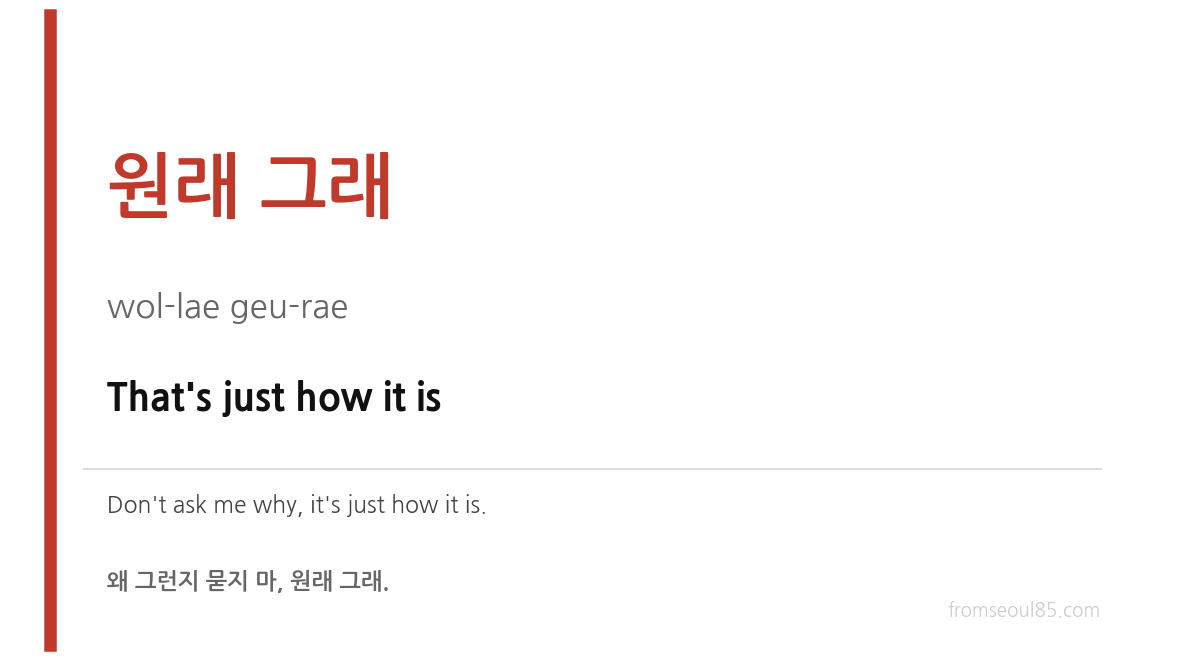
Example: 왜 그런지 묻지 마, 원래 그래. (Don’t ask me why, it’s just how it is.) - 저는 원래 ~해요 (jeo-neun wol-lae ~hae-yo) — I’ve always just been like this / I naturally do this.
Example: 저는 원래 커피를 안 좋아해요. (I’ve just never liked coffee.) - 여기 원래는 ~였어요 (yeo-gi wol-lae-neun ~yeo-sseo-yo) — This place used to be ~.
Example: 여기 원래는 빵집이었어요. (This place used to be a bakery.) - 원래 ~하려고 했는데 (wol-lae ~ha-ryeo-go haet-neun-de) — I was originally going to ~ but.
Example: 원래 오늘 가려고 했는데 일이 생겼어. (I was originally going to go today, but something came up.) - 내가 원래 이래 (nae-ga wol-lae i-rae) — That’s just how I am.
Example: 내가 원래 이래, 미안. (That’s just how I am, sorry.)
Written by a native Korean speaker born in Seoul in 1985. This is my personal experience. Other Koreans may see things differently.