Kkeungi meaning confuses a lot of Korean learners, because 끈기 (kkeun-gi — perseverance, grit, stick-to-itiveness) doesn’t line up with just one English word. Koreans use it constantly, in gyms, offices, and casual chats with friends. The root word 끈 (kkeun) means a string or something sticky, so 끈기 carries a feeling of “sticking to something” rather than quietly enduring pain. That’s why the same word can feel like “grit” in one sentence and “not giving up” in the next.
When I hear the word 끈기, I think of a specific kind of person, not an abstract idea. I picture someone who has been going to the gym for months without skipping. When I see someone like that, I say 와 저 사람 진짜 끈기 있다 (wa jeo sa-ram jin-jja kkeun-gi it-da — wow, that person really has perseverance). On the other hand, I’ve quit the gym after three days more than once myself, so I say about my own case, 나는 끈기가 진짜 없나 봐 (na-neun kkeun-gi-ga jin-jja eop-na bwa — I guess I really have no perseverance). That contrast, the person who sticks with something versus the person who quits fast, is basically what this word is about.
How Koreans Compliment Someone’s Kkeungi
Picture a coworker who has studied for a certification test every night for two years. Around close friends, I’d just say 와 너 진짜 끈기 있네ㅋㅋ (wa neo jin-jja kkeun-gi it-ne — wow you really have perseverance, haha). Sometimes I say 독하다 독해 (dok-ha-da dok-hae — you’re tough, really tough) instead, which sounds more impressed than warm. If the situation calls for more respect, I’d say something like 정말 대단하시네요, 끈기가 있으셔야 가능한 일 같아요 (jeong-mal dae-dan-ha-si-ne-yo, kkeun-gi-ga i-sseo-sya ga-neung-han il ga-ta-yo — that’s really impressive, it seems like something only possible with perseverance). For example, you could say 6개월 동안 매일 운동하다니 끈기가 진짜 좋다 (yuk-gae-wol dong-an mae-il un-dong-ha-da-ni kkeun-gi-ga jin-jja jo-ta — working out every day for six months, that’s real perseverance).

When You Run Out of Kkeungi
Now the flip side. You signed up for the gym in January and stopped going by week two. When that happens to me, I laugh it off with 아 나 진짜 끈기 없다ㅋㅋㅋ (a na jin-jja kkeun-gi eop-da — ugh I really have no perseverance, haha) or 역시 3일이 한계였음 (yeok-si sam-il-i han-gye-yeo-sseum — as expected, three days was my limit). If I want to sound a bit more serious about it, I’ll say 나는 뭘 꾸준히 못하는 것 같아 (na-neun mwol kku-jun-hi mo-ta-neun geot ga-ta — I don’t think I can stick with things). Talking with a friend about the same situation, you might hear 나 끈기가 없어서 금방 그만뒀어 (na kkeun-gi-ga eop-seo-seo geum-bang geu-man-dwo-sseo — I have no perseverance so I quit fast), or more simply, 역시 나는 끈기가 부족해 (yeok-si na-neun kkeun-gi-ga bu-jok-hae — as expected, I lack perseverance).

Using Kkeungi to Encourage Someone
Say a friend wants to quit learning Korean because it feels too hard. Honestly, in that moment I probably reach for 조금만 더 버텨봐 (jo-geum-man deo beo-ti-bwa — just hold on a little longer) more often than the word 끈기 itself. But I do use 끈기를 갖고 해봐 (kkeun-gi-reul gat-go hae-bwa — try to keep your perseverance) too, especially when I want to name the quality directly instead of just telling someone to hang in there. In a more formal setting, I’d soften it into 끈기 있게 하시면 분명 잘 되실 거예요 (kkeun-gi it-ge ha-si-myeon bun-myeong jal doe-sil geo-ye-yo — if you keep at it with perseverance, I’m sure it’ll work out). To someone you’re close with, 끈기 있게 해봐, 금방 익숙해질 거야 (kkeun-gi it-ge hae-bwa, geum-bang ik-suk-hae-jil geo-ya — stick with it, you’ll get used to it soon) works well too.
Jobs and Tasks That Demand Kkeungi
끈기 also comes up when people describe what a job or task requires. At my company, I’ve watched the sales team up close, and honestly, I don’t think anyone survives there without kkeungi. When that topic comes up, I say 영업은 끈기 없으면 진짜 못 해 (yeong-eop-eun kkeun-gi eop-seu-myeon jin-jja mot hae — you really can’t do sales without perseverance). I also have a friend who runs his own small shop, and when I talk about how long he’s kept it going, I say 가게 오래 하는 거 보면 끈기가 진짜 중요한 것 같아 (ga-ge o-rae ha-neun geo bo-myeon kkeun-gi-ga jin-jja jung-yo-han geot ga-ta — watching him run that shop for so long, perseverance really seems important). The same logic comes up with farming: 농사는 끈기 없으면 못 해 (nong-sa-neun kkeun-gi eop-seu-myeon mot hae — you can’t do farming without perseverance).
Kkeungi vs Innae vs Gojip: Don’t Mix These Up
Learners often confuse 끈기 with 인내 (in-nae — patience, enduring hardship, a more formal word) and 고집 (go-jip — stubbornness, insisting on your own way). These three words are not interchangeable, and picking the wrong one can send the wrong message. 끈기 있다 (kkeun-gi it-da — to have perseverance) is a compliment. 고집 있다 (go-jip it-da — to be stubborn) usually is not.
When I say 저 사람 고집 있어 (jeo sa-ram go-jip i-sseo — that person is stubborn), I mean someone who only pushes their own opinion, no matter what anyone else says. But when I say 저 사람 끈기 있어 (jeo sa-ram kkeun-gi i-sseo — that person has perseverance), I mean someone who keeps going even when things get hard. So if you want to compliment someone, use 끈기, not 고집. Calling someone 고집 있다 instead of 끈기 있다 can come across as an insult dressed up as praise, which is an awkward mix-up in front of the person you’re trying to compliment. This is my personal experience. Other Koreans may see it differently.
The English idea of “grit,” studied by psychologist Angela Duckworth in her research on grit as a personality trait, overlaps with 끈기 but isn’t a perfect match. Grit in that research combines passion and perseverance toward a long-term goal, while 끈기 in daily Korean speech is more about the simple act of not quitting, with or without a big goal attached. If you want to see how other single Korean words carry this kind of everyday nuance, take a look at our other word breakdowns in the intermediate section of this blog.
Key Expressions
- 끈기가 있다 (kkeun-gi-ga it-da) — to have perseverance / grit
Example: 그는 끈기가 있어서 결국 목표를 이뤘다. (He has real perseverance, so he finally reached his goal.)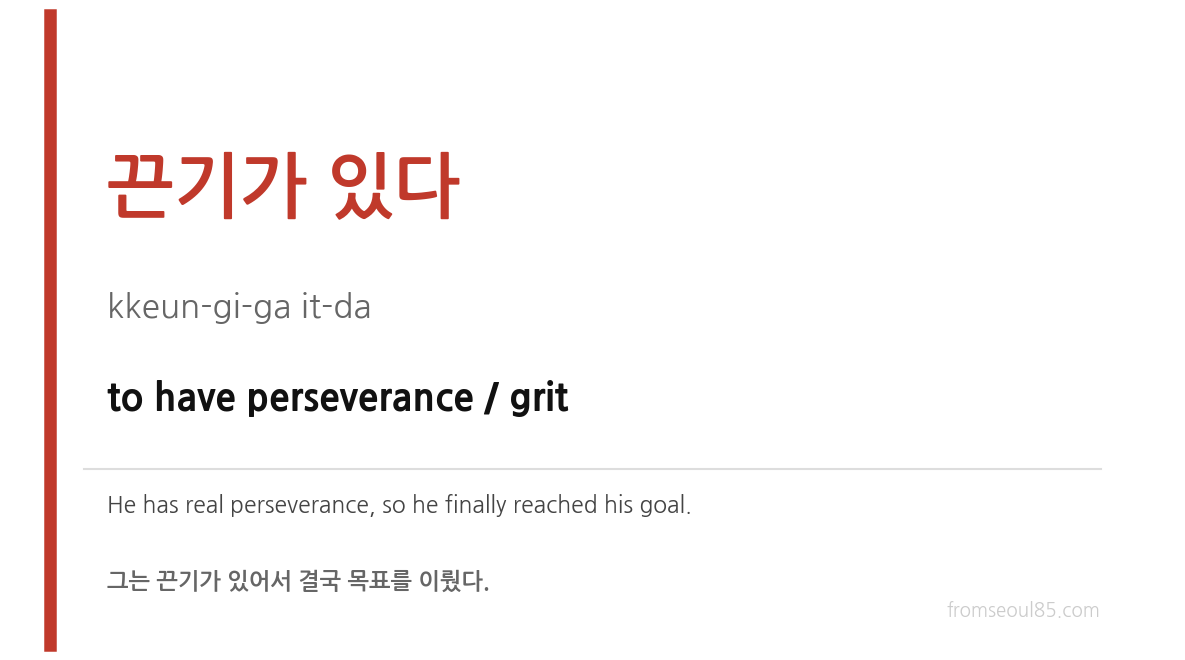
- 끈기가 없다 (kkeun-gi-ga eop-da) — to lack perseverance
Example: 나는 끈기가 없어서 다이어트를 자주 실패한다. (I lack perseverance, so I often fail at dieting.)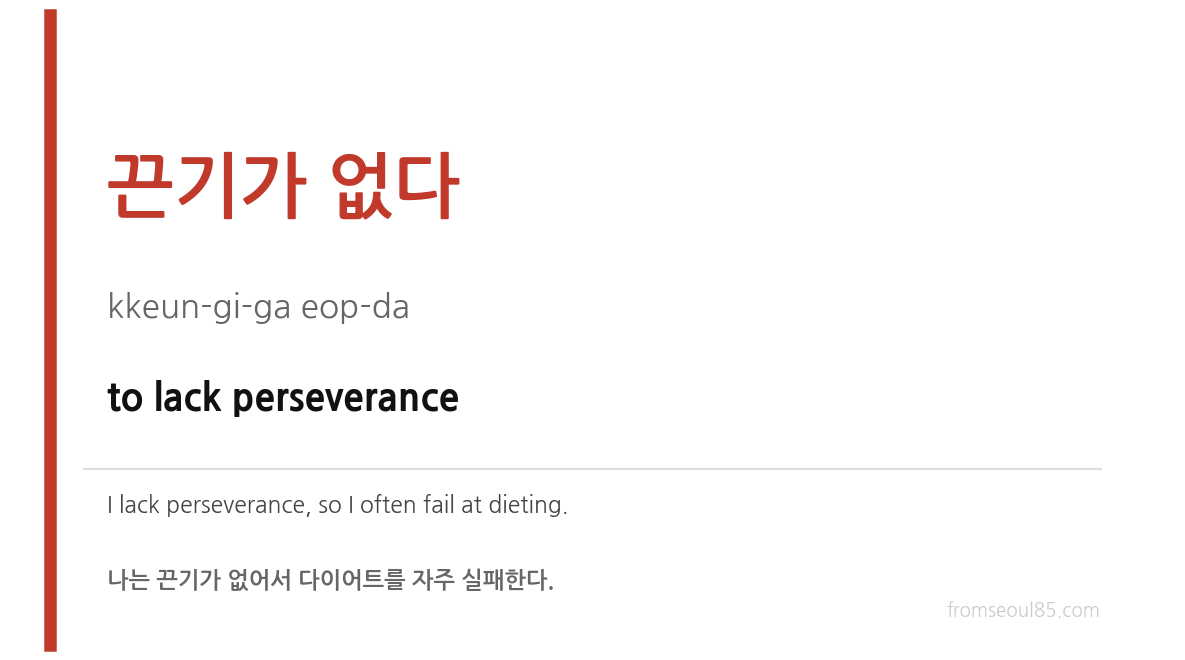
- 끈기 있게 (kkeun-gi it-ge) — persistently, with perseverance
Example: 끈기 있게 노력하면 언젠가 될 거야. (If you keep trying persistently, it’ll happen someday.)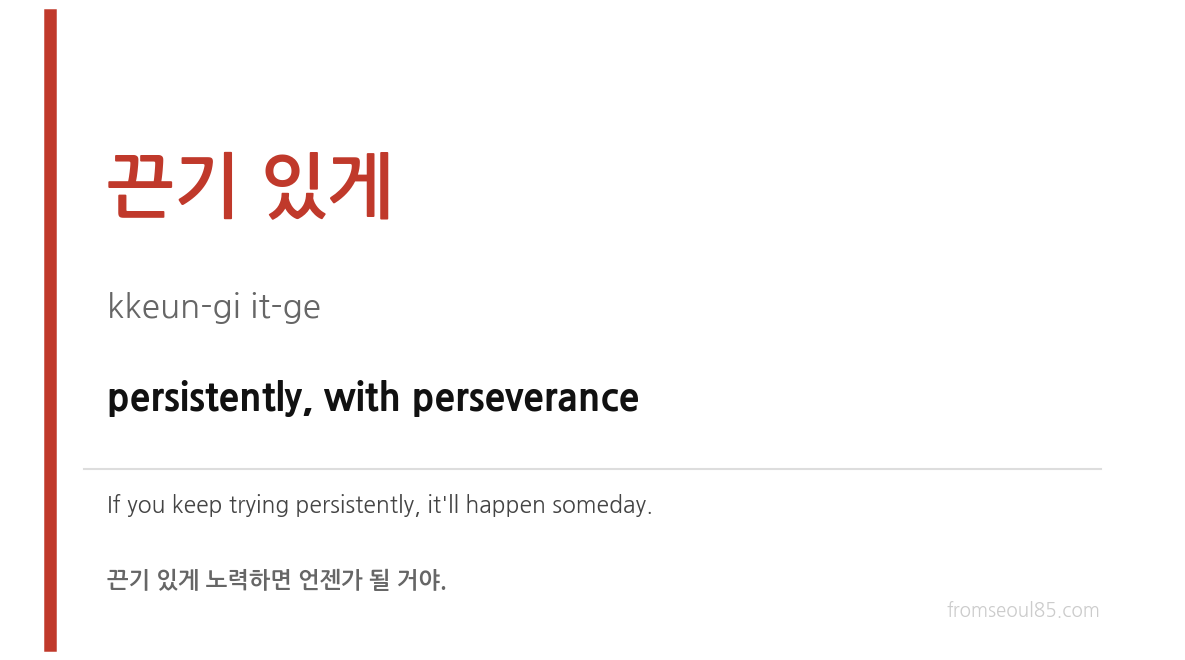
- 끈기가 필요하다 (kkeun-gi-ga pi-ryo-ha-da) — perseverance is needed
Example: 이 일은 끈기가 필요한 일이다. (This job is one that needs perseverance.)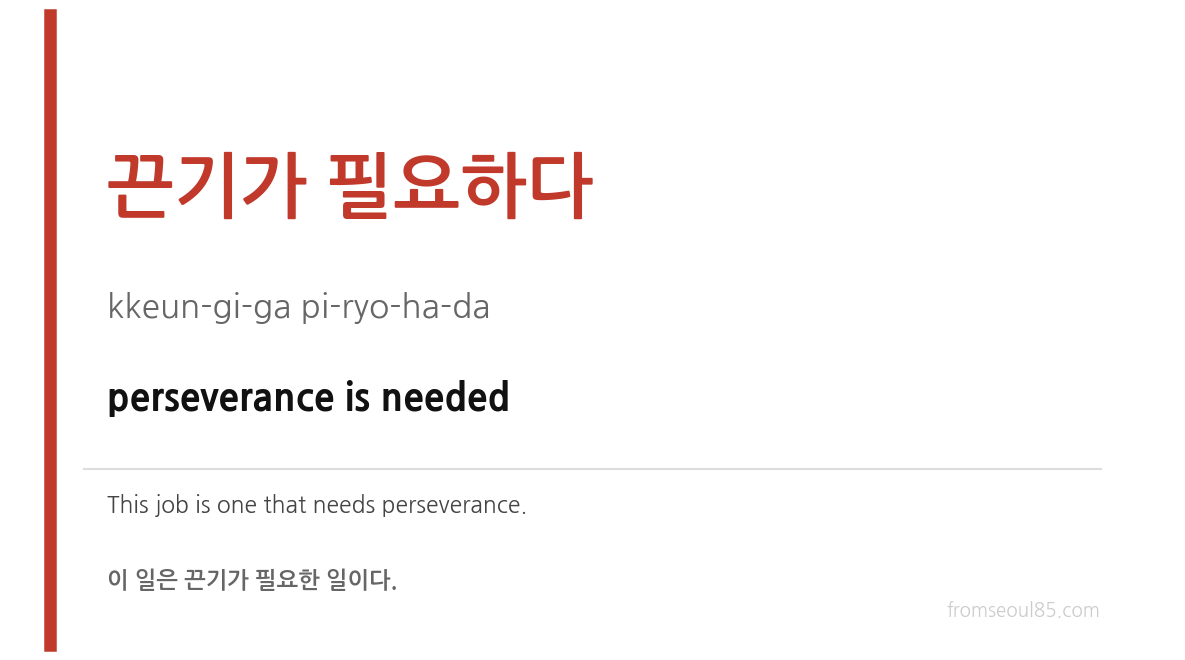
- 끈기를 가지다 (kkeun-gi-reul ga-ji-da) — to hold onto perseverance
Example: 끈기를 가지고 계속 도전해 보세요. (Keep your perseverance and try again.)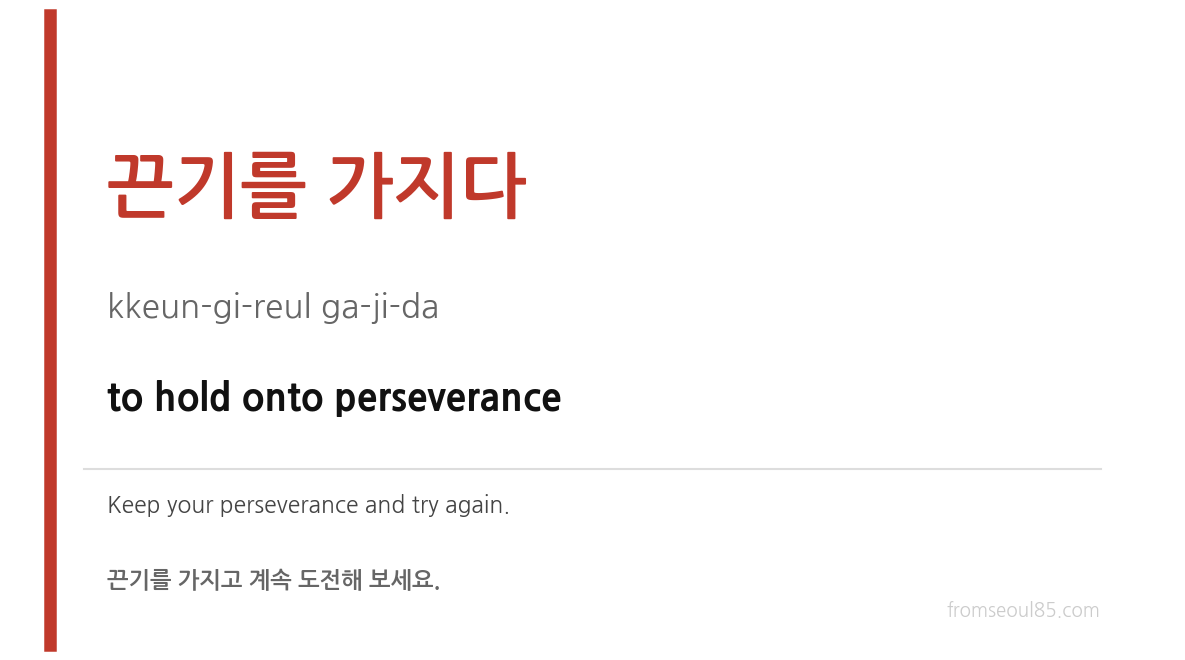
If you want to add this word to your own Korean, start small. Try 끈기 있다 the next time a friend sticks with a habit, or 끈기가 없다 the next time you laugh at yourself for quitting early. Just keep it away from 고집, since one word praises someone and the other one doesn’t. That one distinction will save you from a few awkward moments.
Written by a native Korean speaker born in Seoul in 1985. This is my personal experience. Other Koreans may see things differently.