Written by a native Korean speaker born in Seoul in 1985. This is my personal experience. Other Koreans may see things differently.
If you spend any time around Korean speakers, you will hear 귀찮다 (gwi-chan-ta) constantly. The gwichanta meaning is close to “bothersome” or “too much trouble,” but no single English word covers it exactly. It sits somewhere between being tired, being lazy, and just not wanting to deal with something. Once you notice it, you start hearing it everywhere, from text messages to muttered complaints at home.
What Gwichanta Really Means
귀찮다 (gwi-chan-ta) describes a feeling, not an action. It is what you feel right before you decide something is not worth the effort. A task itself might be small, like washing one cup, but if your energy is low, it can still feel gwichanta. This is also why people often ask about the Korean word for annoying or hassle and land on this word first. It is not really about anger. It is about effort feeling heavier than it should.
Turning Down Plans With Gwichanta
Picture this. A friend texts you asking to hang out. You are tired, so going out feels like too much. This is one of the most common uses of the word, and it is exactly how I answer these texts myself. Casually, I just reply 귀찮아ㅋㅋ 오늘은 집에 있을래 (gwi-chan-a-kkuk-kuk o-neu-reun jib-e it-eul-lae — I can’t be bothered lol, I’ll just stay home today). Sometimes I keep it even shorter and text back 아 귀찮ㅠㅠ 다음에 보자 (a gwi-chan-tt-tt da-eum-e bo-ja — ugh, can’t be bothered, let’s meet next time).
I honestly don’t use a polite version of this much, since it usually comes up with close friends. But if I had to say it more politely, I would soften it into something like 오늘은 좀 쉬고 싶어요 (o-neu-reun jom swi-go sip-eo-yo — I’d like to rest a bit today). Another option I use just as often is making up a small excuse, like saying I suddenly have housework to deal with, instead of admitting I just don’t feel like going out.
Chores at Home: Gwichanta and the Dishes
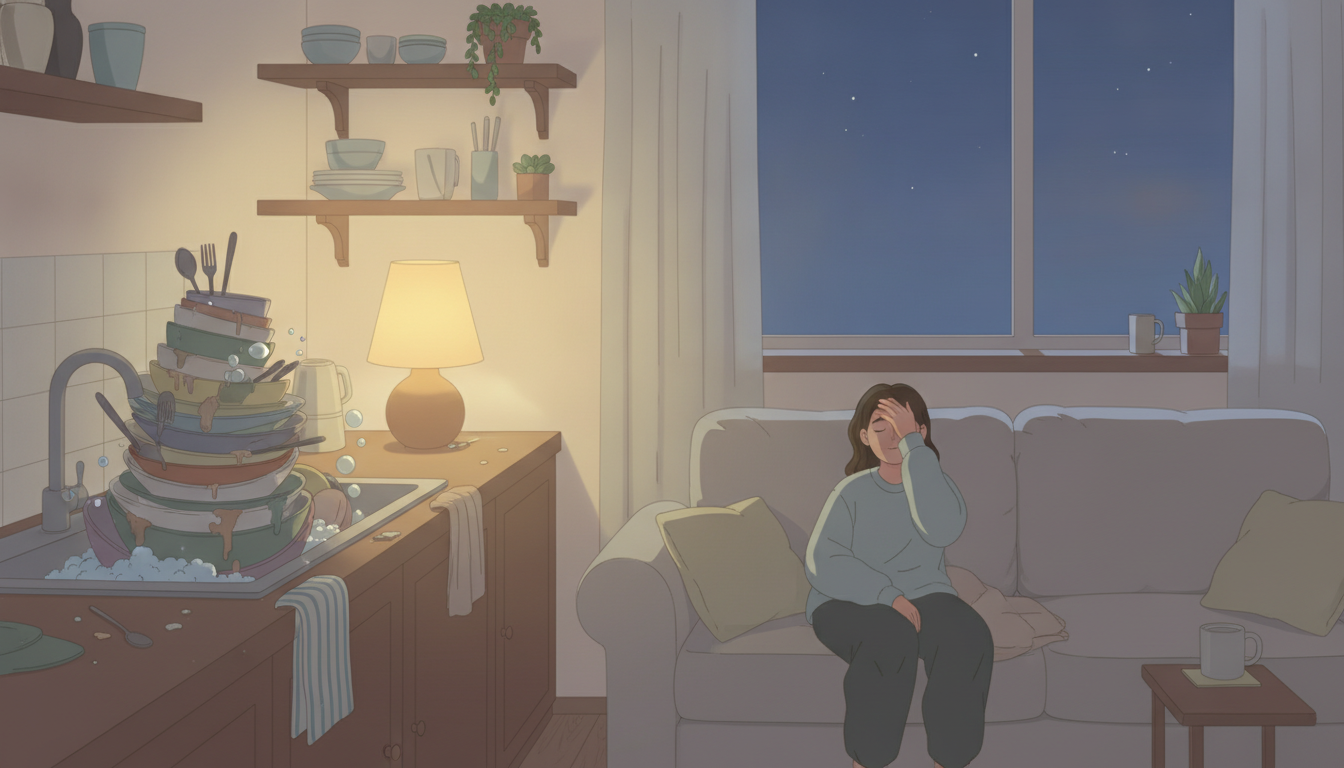
Coming home after a long day is another classic gwichanta moment. The dishes are piled in the sink, and you are too drained to touch them. Casually, you might say 설거지하기 귀찮아 (seol-geo-ji-ha-gi gwi-chan-a — washing dishes is such a hassle). A more polite version is 설거지하기 귀찮네요 (seol-geo-ji-ha-gi gwi-chan-ne-yo).
For me, this plays out pretty simply at home. I just say “아 설거지 귀찋아…” (a seol-geo-ji gwi-chan-a) and lie down on the couch instead of dealing with it. If my wife asks about it, I usually tell her 이따 할게~ (i-tta hal-ge — I’ll do it later~) and put it off. When I really want to express how tired I am, I say something stronger like 아 진짜 귀찮아 죽겠다 (a jin-jja gwi-chan-a juk-get-da — ugh, I seriously can’t be bothered at all).
When Gwichanta Is About a Person
Sometimes 귀찮다 describes a person’s behavior instead of a task. Imagine a coworker who keeps interrupting you with small questions. To a close friend, you might say 자꾸 귀찮게 하지 마 (ja-kku gwi-chan-ke ha-ji ma — stop bothering me so much). When you are asking someone for a favor, you would politely say 귀찮게 해드려서 죄송해요 (gwi-chan-ke hae-deu-ryeo-seo joe-song-hae-yo — sorry to bother you).
When a friend or family member keeps bugging me, I usually just say “아 좀, 귀찮게 하지 마ㅋㅋ” (a jom, gwi-chan-ke ha-ji ma-kkuk-kuk — come on, stop bothering me lol). If I am genuinely annoyed, it turns into 아 그만 좀 물어봐 (a geu-man jom mul-eo-bwa — seriously, stop asking so many questions). On the flip side, when I need a favor from someone, I usually open with 귀찮게 해드려서 죄송한데요, 이것 좀 도와주실 수 있을까요? (gwi-chan-ke hae-deu-ryeo-seo joe-song-han-de-yo, i-geot jom do-wa-ju-sil su iss-eul-kka-yo? — sorry to bother you, but could you help me with this?). Putting that phrase up front softens the request quite a bit.
A Whole Day of Gwichanta
귀찮다 does not always attach to one task. Sometimes it describes an entire mood. On those days, everything feels like too much effort, even things you normally do without thinking. I usually just say 아 오늘 진짜 다 귀찮다… (a o-neul jin-jja da gwi-chan-ta — ugh, today I really can’t be bothered with anything) or simply 아무것도 하기 싫어 (a-mu-geot-do ha-gi sil-eo — I don’t want to do anything). On worse days, it becomes 오늘은 그냥 아무것도 안 할래 (o-neul-eun geu-nyang a-mu-geot-do an hal-lae — today I’m just not doing anything). This isn’t laziness so much as being mentally worn out.
Gwichanta for Big, Tedious Tasks
The word also fits complicated, multi-step jobs, like preparing documents or moving to a new apartment. People often say 이거 진짜 귀찮은 일이야 (i-geo jin-jja gwi-chan-eun i-ri-ya — this is such a tedious hassle). It captures mental fatigue from complexity, not physical tiredness.
When I’m facing something like that, I say 아 이거 진짜 귀찮은데… (a i-geo jin-jja gwi-chan-eun-de — ugh, this is really such a hassle) or 할 게 너무 많아서 귀찮다 (hal ge neo-mu manh-a-seo gwi-chan-ta — there’s so much to do, it’s such a hassle). At work, though, I tone it down and say something closer to 이 작업이 좀 번거롭네요 (i jag-eob-i jom beon-geo-rob-ne-yo — this task is a bit tedious), since 귀찮다 can sound too blunt in a professional setting.
Gwichanta vs Jjajeungnada: Don’t Mix These Up
People often ask why do Koreans say gwichanta so much, and part of the answer is that it gets confused with a different word, 짜증나다 (jja-jeung-na-da — annoyed). 귀찮다 is about effort feeling like too much. 짜증나다 carries actual anger. For me, 짜증나다 comes out when something genuinely upsets me, like when someone breaks a promise. That’s when I’d say 아 짜증나 (a jja-jeung-na — ugh, this is so annoying). 귀찮다, on the other hand, is just for when I don’t feel like doing something.
Calling someone 너 귀찮아 (neo gwi-chan-a) directly can also sound harsh. Between close friends, it works fine as a joke. But said to someone you just met, or someone you should be polite with, it can come across as rude. It’s safer to aim the word at a task, like 귀찮게 하지 마, rather than labeling a person with it.
Key Expressions
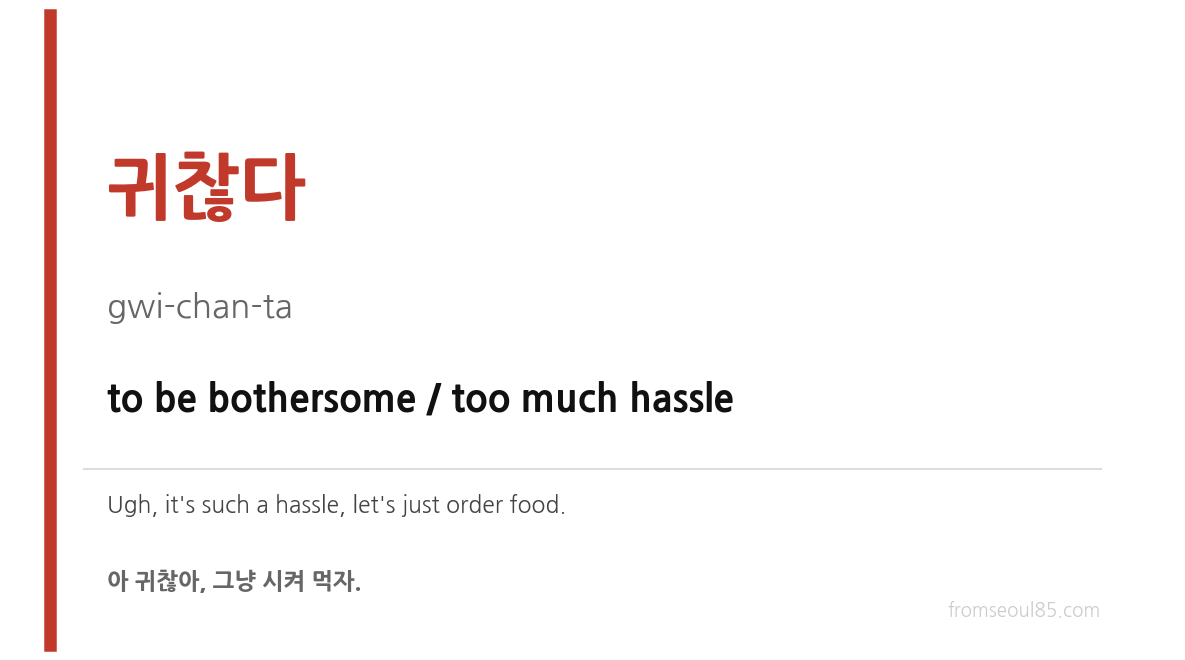 귀찮다 (gwi-chan-ta) — to be bothersome / too much hassle.
Example: 아 귀찮아, 그냥 시켜 먹자. (Ugh, it’s such a hassle, let’s just order food.)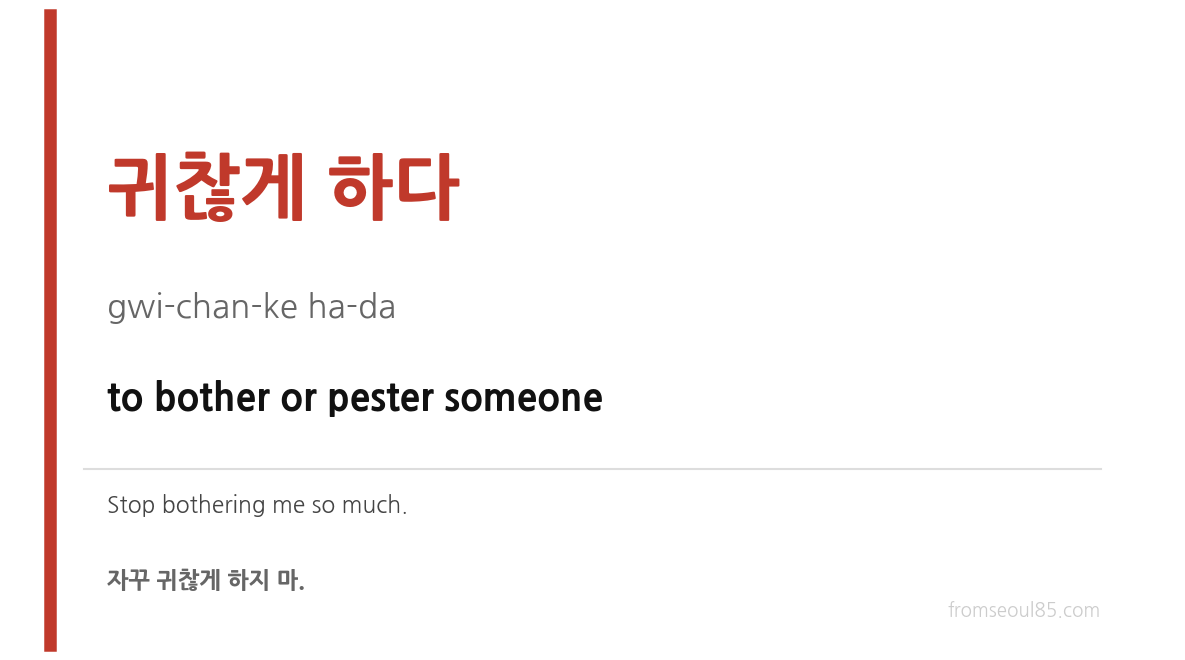 귀찮게 하다 (gwi-chan-ke ha-da) — to bother or pester someone.
Example: 자꾸 귀찮게 하지 마. (Stop bothering me so much.)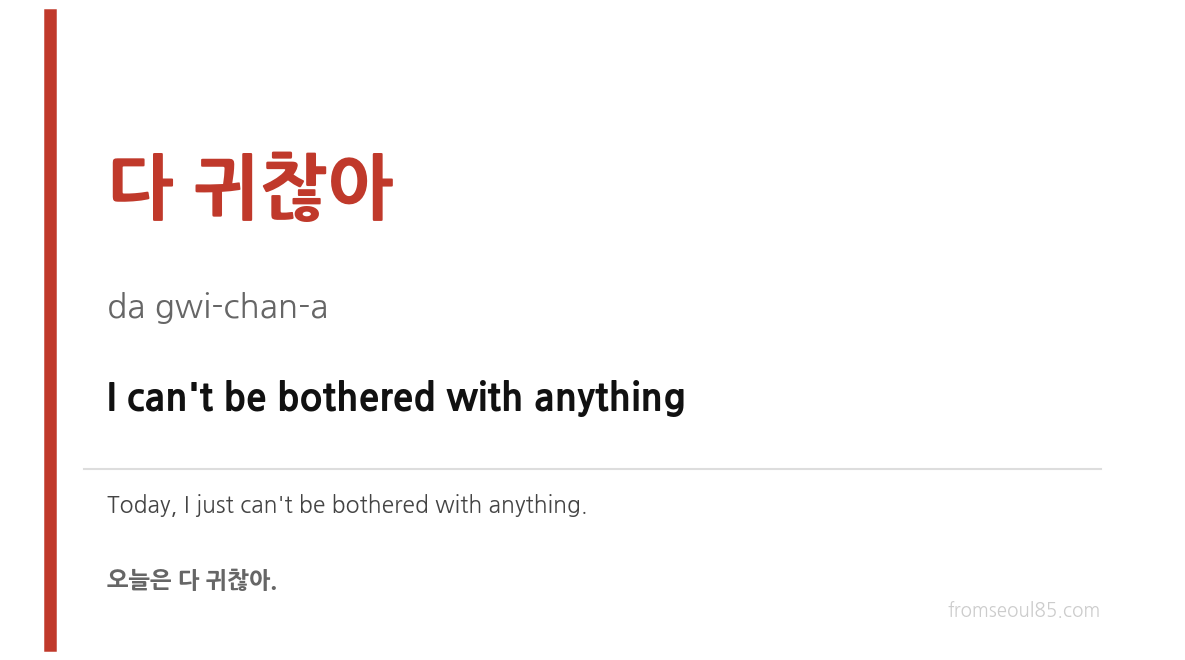 다 귀찮아 (da gwi-chan-a) — I can’t be bothered with anything.
Example: 오늘은 다 귀찮아. (Today, I just can’t be bothered with anything.)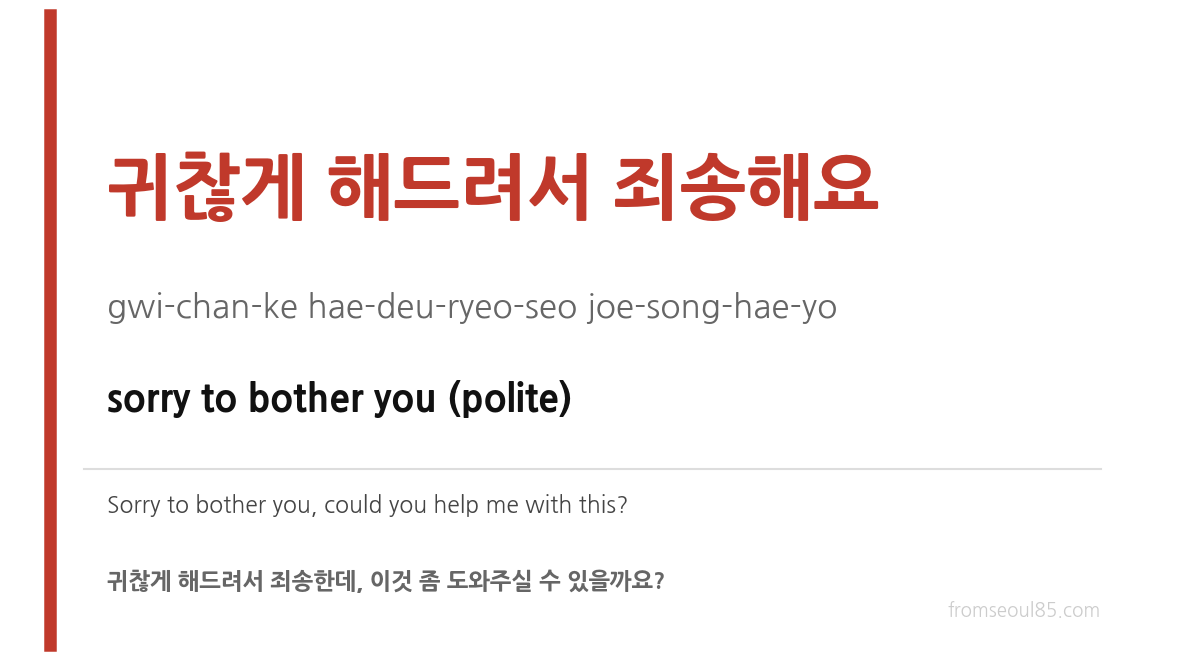 귀찮게 해드려서 죄송해요 (gwi-chan-ke hae-deu-ryeo-seo joe-song-hae-yo) — sorry to bother you (polite).
Example: 귀찮게 해드려서 죄송한데, 이것 좀 도와주실 수 있을까요? (Sorry to bother you, could you help me with this?)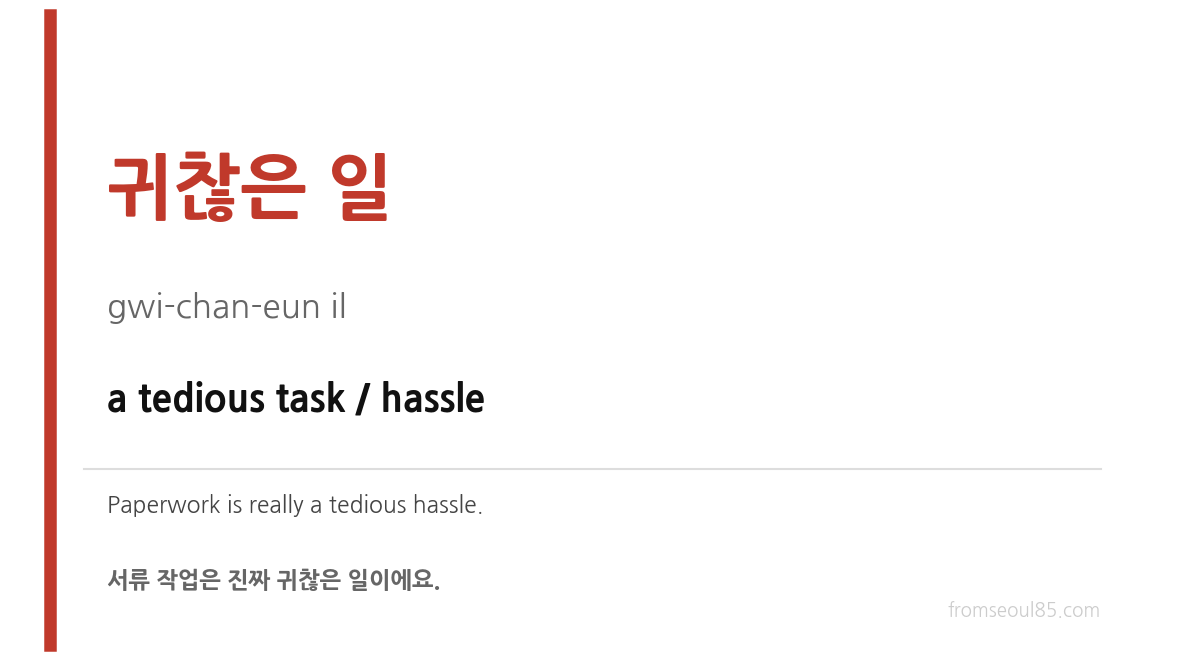 귀찮은 일 (gwi-chan-eun il) — a tedious task / hassle.
Example: 서류 작업은 진짜 귀찮은 일이에요. (Paperwork is really a tedious hassle.)
How to Say I Can’t Be Bothered Without Sounding Rude
If you’re wondering how to say I can’t be bothered in Korean without offending anyone, the safest rule is to point the word at a task or a situation, not at a person. 귀찮아 about dishes, plans, or paperwork is fine among friends and family. Saying 너 귀찮아 to someone directly is where it gets risky, so save that for people you’re already close with. For related everyday words Koreans use when things feel tiring or draining, this post on eohyu and how Koreans sigh, vent, and complain pairs well with this one.
For anyone who wants a more formal reference point, the National Institute of Korean Language keeps an official dictionary entry for 귀찮다, which confirms the base meaning of “troublesome” or “bothersome” that this word carries in daily speech.
A Few Practical Tips
Start by using 귀찮다 about tasks, not people, until you get a feel for the tone. It’s a very casual word, so save the plain form for friends and family, and switch to something softer, like 번거롭다 (beon-geo-rop-da), around coworkers or people you don’t know well. Once you notice how often this word shows up in daily Korean, you’ll start hearing it in dramas, texts, and casual conversations everywhere. This is my personal experience, and other Koreans may use it a little differently depending on their own habits.