Open any Korean drama and you’ll hear singyeong (신경) within minutes. It literally means “nerve,” the same nerve a doctor checks with a small hammer. But the singyeong meaning stretches far past biology. Koreans use this single word to talk about attention, care, worry, and irritation, ideas that English usually keeps in separate boxes. A friend might say 신경 쓰지 마 (sin-gyeong sseu-ji ma — don’t worry about it) one minute, then say 신경질 나 (sin-gyeong-jil na — I’m getting irritated) the next. Same root word, two completely different feelings. That’s what makes singyeong confusing for learners, and genuinely useful once you get a feel for it.

What Singyeong Really Means Day to Day
When I hear the word 신경, care and attention come to mind first, not the biological nerve. The actual nerves in my body only cross my mind when I’m sitting in a hospital waiting room. In regular life, I use 신경 several times a day without even noticing it. I’ll tell a friend 아 그거 신경 쓰지 마 (a geu-geo sin-gyeong sseu-ji ma — ah, don’t worry about that), then later that same day say to someone else 나 요즘 그거 좀 신경 쓰여 (na yo-jeum geu-geo jom sin-gyeong sseu-yeo — that’s been on my mind lately). It’s one of those words that just slips out of my mouth on its own.
Singyeong Sseuda: Paying Careful Attention
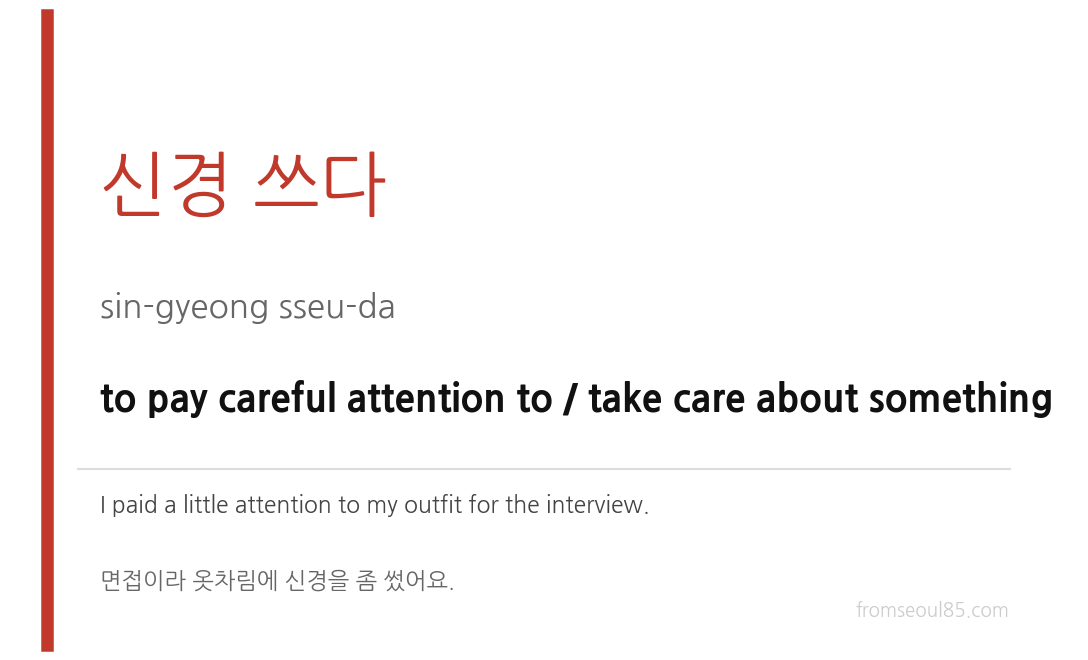
Picture getting ready for a job interview and checking your shirt in the mirror one more time before you leave. In Korean, that habit has a name. It’s 신경 쓰다 (sin-gyeong sseu-da), which literally means “to use nerve.” It describes paying careful attention to something because it actually matters to you.
When I put a little extra effort into how I look, I keep the sentence simple. Casually, I just say 나 오늘 좀 신경 썼어 (na o-neul jom sin-gyeong sseo-sseo — I put some effort in today), without bothering to explain what exactly I was careful about. In a more polite setting, I might say 오늘 좀 신경 써서 입고 왔어요 (o-neul jom sin-gyeong sseo-seo ip-go wa-sseo-yo — I dressed with a bit of care today). Before an actual job interview, I’d say 면접이라 신경 좀 썼어요 (myeon-jeo-bi-ra sin-gyeong jom sseo-sseo-yo — since it’s an interview, I paid some attention to it).
Singyeong Sseuji Ma: How Koreans Say Don’t Worry About It
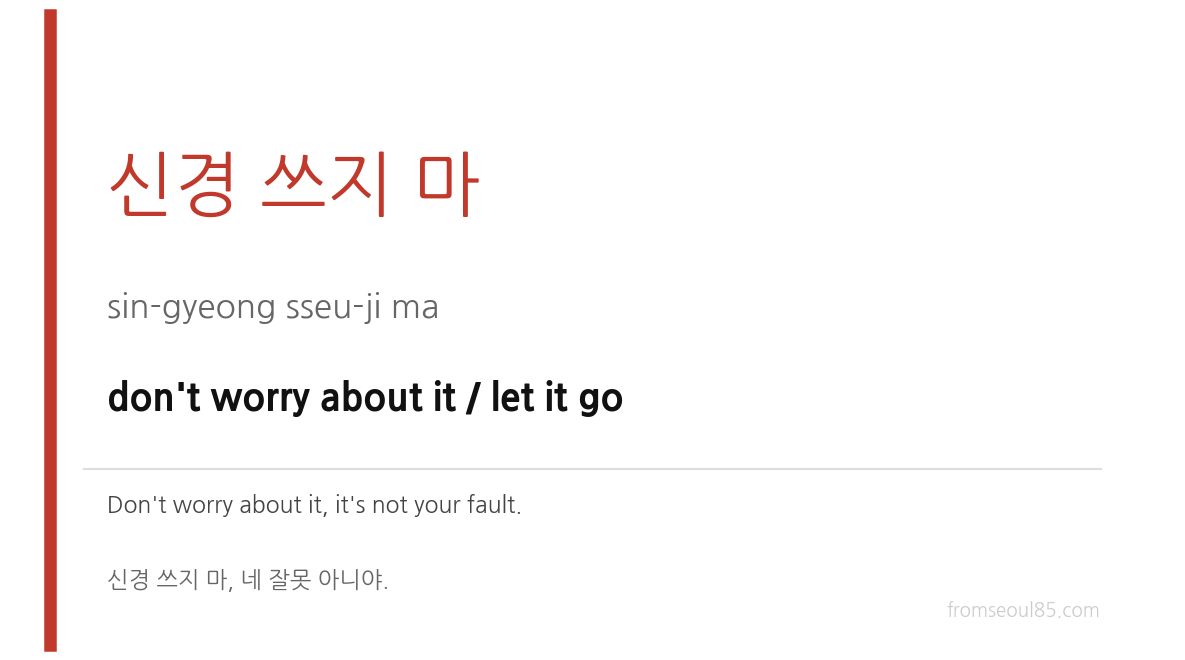
Your friend cancels plans at the last minute and keeps apologizing over text. You want to tell them it’s fine, forget it. That’s exactly when Koreans reach for 신경 쓰지 마 (sin-gyeong sseu-ji ma), one of the most common ways Koreans say don’t worry about it.
With a close friend, I just brush it off. I’d say 아 신경 쓰지 마, 괜찮아 (a sin-gyeong sseu-ji ma, gwaen-chan-a — ah, don’t worry about it, it’s fine). When the relationship is a bit more distant, or I want to sound a little more polite, I often flip the word order instead. 괜찮아요, 신경 쓰지 마세요 (gwaen-chan-a-yo, sin-gyeong sseu-ji ma-se-yo — it’s okay, please don’t worry about it) works just as well, and I actually use that order a lot.

Singyeong Sseuida: When Something Keeps Bothering You
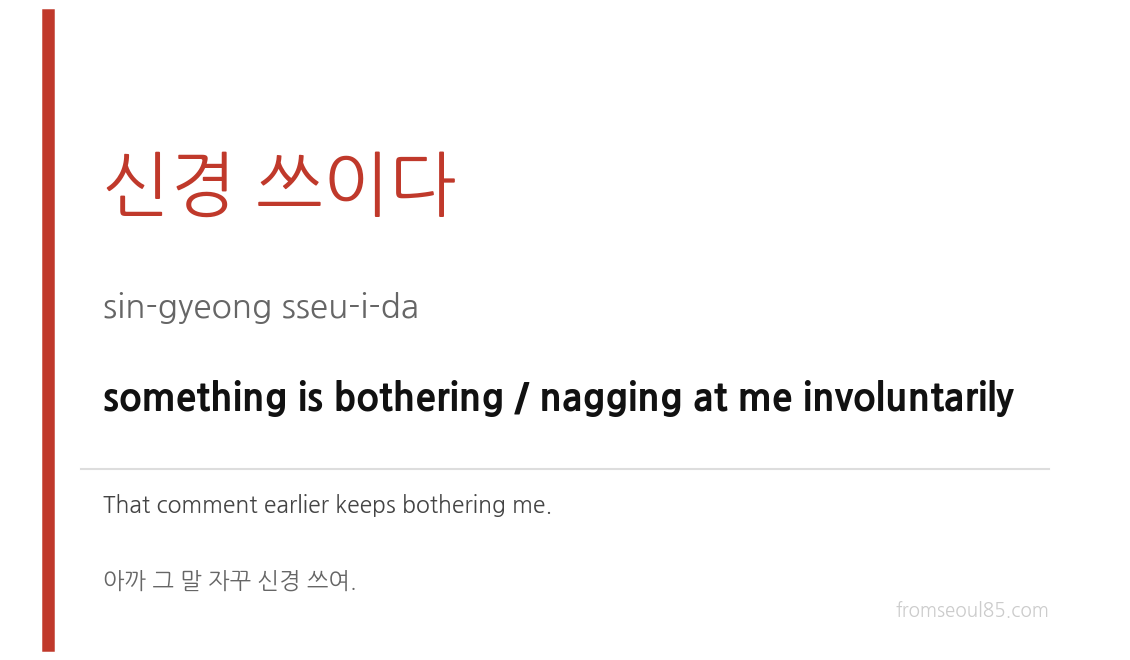
Someone drops an offhand comment at work, and somehow it keeps replaying in your head all afternoon. Koreans describe that feeling as 신경 쓰이다 (sin-gyeong sseu-i-da), something bothering you or nagging at you, without you meaning for it to.
When that happens to me, I usually just say 아 그거 계속 신경 쓰이네 (a geu-geo gye-sok sin-gyeong sseu-i-ne — ugh, that keeps bothering me). If I want to sound more relaxed about it, I might switch to 아 그 말 자꾸 생각나 (a geu mal ja-kku saeng-gak-na — ugh, I keep thinking about what they said) instead. But honestly, 신경 쓰이다 is still the phrase I reach for most, because it captures that involuntary, nagging feeling better than almost anything else I know.
Singyeong-jil Nada: Getting Irritated
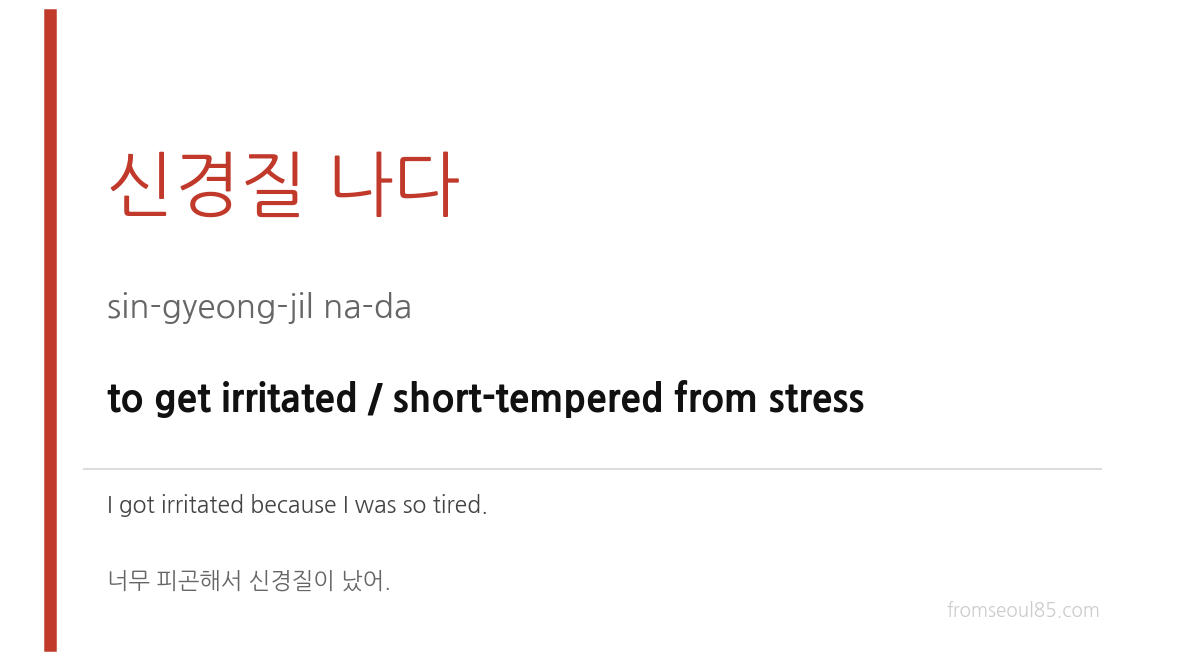
After a rough day at work, you come home tired and snap at your family over something small, like dirty dishes in the sink. Koreans call that mood 신경질 나다 (sin-gyeong-jil na-da), getting irritated, short-tempered, on edge for no big reason.
On a day like that, I’ll usually say 아 오늘 진짜 예민하네 (a o-neul jin-jja ye-min-ha-ne — ugh, I’m really on edge today), or 나 요즘 왜 이렇게 신경질적이지 (na yo-jeum wae i-reo-ke sin-gyeong-jil-jeo-gi-ji — why have I been so irritable lately). I still use 신경질 나다 sometimes, but it carries a slightly old-fashioned ring these days. In my experience, 예민하다 (ye-min-ha-da — to be sensitive or on edge) has become the more common way to describe this same feeling among people my age.
Singyeong Kkeo: Mind Your Own Business
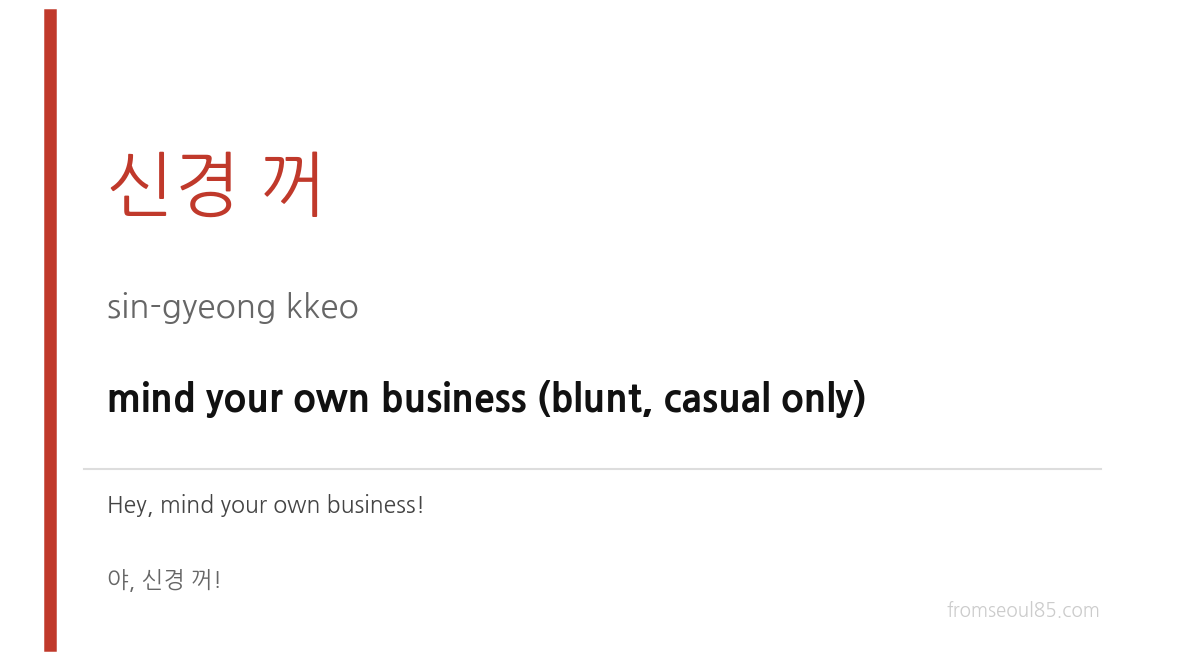
One nuance worth knowing. 신경 쓰다 is not the same as 걱정하다 (geok-jeong-ha-da — to worry). 신경 쓰다 can be neutral, or even positive, like paying careful attention to your outfit before an interview. 신경 꺼 (sin-gyeong kkeo), on the other hand, literally means “turn off your nerve,” and it lands much closer to mind your own business. It sounds blunt, almost rude, if you say it to the wrong person.
I only use 신경 꺼 with really close friends or my younger siblings, usually half-joking. It sounds too harsh for anyone older than me, or anyone I don’t know well, so I would never say it to them. In those situations, I soften it instead. 아 됐어, 신경 쓰지 마 (a dwae-sseo, sin-gyeong sseu-ji ma — ah, forget it, don’t worry about it) does the same job without the edge. This is my personal experience. Other Koreans may see it differently.
Things to Watch Out For
A few practical notes before you start using these phrases. Save 신경 꺼 for people you’re genuinely close to. Using it with a stranger, a coworker you just met, or anyone older than you will come across as disrespectful, even if you don’t mean it that way. Word order is flexible with 신경 쓰지 마 too. You can say it first, or place 괜찮아 (gwaen-chan-a — it’s okay) at the front instead, and both sound natural depending on the mood of the conversation.
Tone matters more than the words themselves. The same sentence, 신경 쓰지 마, can sound comforting or dismissive depending on how you say it, so pay attention to context, not just the phrase. If you’re curious about another Korean word that covers a similar cluster of frustration and annoyance, our post on the dapdap meaning in Korean is worth a look. For a more formal reference on how 신경 is defined and used, the National Institute of Korean Language’s dictionary is a solid place to check individual entries.
Quick Tips for Using Singyeong
Start with 신경 쓰지 마, since it’s the safest of these phrases. You can use it with almost anyone, in almost any mood, and it rarely sounds wrong. Save the sharper phrases, like 신경질 나다 and especially 신경 꺼, until you know the relationship well enough to read the room. Once you get comfortable switching between these forms, singyeong stops being confusing and starts being one of the most useful words in your everyday Korean.
Key Expressions
- 신경 쓰다 (sin-gyeong sseu-da) — to pay careful attention to / take care about something. Example: 면접이라 옷차림에 신경을 좀 썼어요. (I paid a little attention to my outfit for the interview.)
- 신경 쓰지 마 (sin-gyeong sseu-ji ma) — don’t worry about it / let it go. Example: 신경 쓰지 마, 네 잘못 아니야. (Don’t worry about it, it’s not your fault.)
- 신경 쓰이다 (sin-gyeong sseu-i-da) — something is bothering / nagging at me involuntarily. Example: 아까 그 말 자꾸 신경 쓰여. (That comment earlier keeps bothering me.)
- 신경질 나다 (sin-gyeong-jil na-da) — to get irritated / short-tempered from stress. Example: 너무 피곤해서 신경질이 났어. (I got irritated because I was so tired.)
- 신경 꺼 (sin-gyeong kkeo) — mind your own business (blunt, casual only). Example: 야, 신경 꺼! (Hey, mind your own business!)
Written by a native Korean speaker born in Seoul in 1985. This is my personal experience. Other Koreans may see things differently.