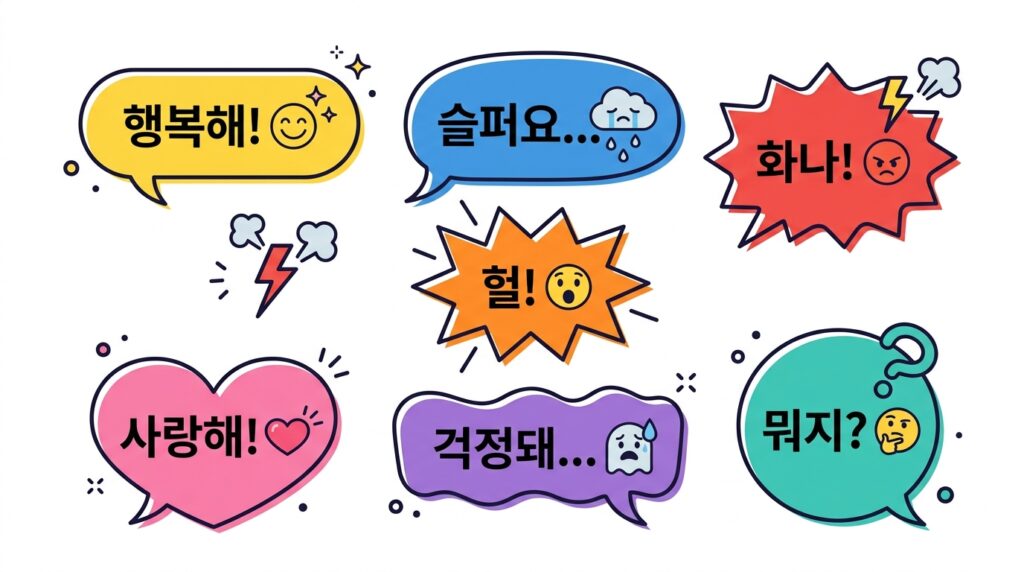
Korean textbooks teach words like 행복하다 (haeng-bok-ha-da — to be happy) and 슬프다 (seul-peu-da — to be sad). These words are not wrong, and Koreans do use them. But the language gives you far more options than any textbook shows. Some people say 행복해 (haeng-bok-hae — I’m happy), 기분 좋아 (gi-bun jo-a — I feel good), or 너무 좋다 (neo-mu jo-ta — this is so good). For sadness, you might hear 슬퍼 (seul-peo), 우울해 (u-ul-hae — I feel down), or 눈물나 (nun-mul-na — I’m tearing up). Everyone has their own style. In my experience, the real gap between textbook Korean and natural Korean is not that these words disappear. It’s that there are so many more layers underneath them.
아 진짜 — The One Expression That Means Everything
You will hear 아 진짜 (a jin-jja — oh seriously / come on) constantly in Korea. But here is the thing: you cannot understand it from text alone. You need to see the face. Hear the tone. Watch the timing.
Think of it as emotional shorthand. Koreans often skip the emotion word entirely. Instead of saying “I’m so frustrated, seriously,” someone just says 아 진짜 with a tight jaw and sharp voice. The feeling is already there. The word just carries it out.
And it gets more interesting. Imagine someone making a frustrated face, voice sharp, and saying 아 진짜! You would assume they are angry. Then they smile and say 너무 행복해 (neo-mu haeng-bok-hae — I’m so happy). Total reversal. This kind of dry humor is real. The emotion flips at the last word. This is actually why Koreans say you have to listen all the way to the end of a sentence. The meaning can change completely before it finishes.
This is my personal experience. Other Koreans may see it differently.
답답하다 — When Anger Has No Exit
Many learners translate 답답하다 (dap-dap-ha-da) as frustrated. That is close, but not quite right. To me, 답답하다 is what happens when you are angry but cannot do anything about it. You cannot yell. You cannot act out. You just have to hold it in.
The feeling is blocked. Something is stuck inside and will not come out. It is the pressure of unexpressed emotion with nowhere to go. That specific suffocation — that is 답답하다. Just saying “frustrated” does not capture it.
A related idea: when Koreans drink hot soup and feel warmth loosen something inside, they say 시원하다 (si-won-ha-da — refreshing, relieved). That is the opposite of 답답하다. One is blocked. The other is released. Once you feel that contrast, both words make more sense.
울컥했어 — When Emotion Rises Before You Can Stop It
울컥했어 (ul-keok-haess-eo) is a physical word. Think of something rising from your stomach — pushing upward, like a wave. Now picture your eyes. They fill slowly. Then, all at once, they overflow. You did not plan it. You could not stop it. That is 울컥.
You can use this when something happy moves you. You can use it when sadness hits suddenly. You can use it at a surprise. The emotion type is flexible. What stays constant is that feeling — sudden, rising, uncontrolled. If you use this word naturally, Koreans will notice. I’m one Korean man. I don’t speak for everyone. But in my experience, this one word says more than a whole paragraph.
기분이 묘하다 — When You Cannot Name the Feeling
기분이 묘하다 (gi-bun-i myo-ha-da — my feelings are strange or hard to describe) is for moments when emotions are mixed and you cannot sort them out. Not sad. Not happy. Just complex. Several feelings at once, overlapping, with no clear label.
You do not have to identify it. 기분이 묘하다 lets you leave it unnamed. I think that is very Korean — sometimes there is no single word for what you feel, and that is okay to say out loud.
마음이 무겁다 — A Heavy Heart
마음이 무겁다 (ma-eum-i mu-geop-da — my heart feels heavy) is the feeling of being emotionally weighed down. Your mood is low. It presses on you. You cannot shake it off easily.
Think of the opposite: 날아갈 것 같아 (na-ra-gal geot ga-ta — I feel like I could fly). When you are truly happy, you feel light — weightless, almost floating. When something is dragging you down, you feel the opposite. 마음이 무겁다 is that quiet, slow heaviness. The two expressions make each other clearer.
One Last Thing
Korean emotion vocabulary is not a list you memorize and recite. The same phrase can mean completely different things depending on tone, timing, and face. 아 진짜 alone can carry joy, frustration, or sarcasm — and sometimes all three in one conversation.
There are too many cases to explain all at once. Start with one or two expressions. Try them in real situations. And if you get it wrong — do not be embarrassed. Koreans will understand. Getting the feeling right matters more than getting the grammar perfect. Just keep going.
Key Expressions
아 진짜 (a jin-jja — Oh seriously / Come on — meaning changes completely with tone)
He cancelled again. Ah seriously.
또 취소했어. 아 진짜.
답답하다 (dap-dap-ha-da — Feeling stuck and unable to release emotion — like something is blocked inside)
Nobody is listening to me. I feel so stuck.
아무도 내 말을 안 들어. 진짜 답답해.
기분이 묘하다 (gi-bun-i myo-ha-da — My feelings are strange or hard to describe — mixed emotions with no clear name)
Seeing my old school again felt strange and hard to explain.
옛날 학교를 다시 보니까 기분이 묘했어.
울컥했어 (ul-keok-haess-eo — A sudden wave of emotion rose inside me — almost tearing up, from joy or sadness)
When she said that, a wave of emotion suddenly hit me.
그녀가 그 말을 했을 때 갑자기 울컥했어.
마음이 무겁다 (ma-eum-i mu-geop-da — My heart feels heavy — a quiet emotional weight that won’t lift)
After that conversation, my heart felt really heavy.
그 대화 후에 마음이 너무 무거웠어.
Written by a native Korean speaker born in Seoul in 1985. This is my personal experience. Other Koreans may see things differently.