I will be honest. I am not someone who passes on other people’s words. If my mom says something to my younger sister, I usually just do nothing. But even for someone like me, understanding how indirect speech works matters. You hear it every single day.
In Korean, quoting or relaying someone’s words is called 간접화법 (gan-jeop-hwa-bap — indirect speech). You do not repeat the exact words. Instead, you attach a special ending to the verb. In my experience, learners avoid this grammar for too long. They understand it when they hear it, but they do not use it.
Why Indirect Speech Is Harder Than It Looks
Here is something no textbook tells you. When you relay someone’s words, the original meaning can get lost. Not the words — the feeling behind them.
My mom once said to me: 찌개 빨리 식으니까 얼른 와서 밥먹으라고 해 (jji-gae ppal-li si-geu-ni-gga eo-reun wa-seo bap-meog-eu-ra-go hae). She was asking me to go get my sister. The stew was cooling down fast. She wanted us to eat it while it was still hot.
What did I say to my sister? 야 엄마가 빨리 밥먹으래 (ya eom-ma-ga ppal-li bap-meog-eu-rae). Something like: “Hey, mom says eat fast.”
My sister heard “mom says eat” and thought: okay, no rush. So she took her time. My mom got angry — because to her, the urgency was obvious. The stew was getting cold. But that detail never made it into my words.
This is the real difficulty with 간접화법. The structure travels. The feeling often does not. This is my personal experience. Other Koreans may see it differently.
The Core Pattern: -다고 하다
The basic structure uses 고 하다 (go ha-da — to say that). For statements, attach -다고 하다 (-da-go ha-da) after the verb stem.
Example: 간다고 했어 (gan-da-go haess-eo) — “he said he was going.”
But here is something I want you to understand. In real speech, -다고 is rarely just reporting a fact. If someone keeps asking whether I will go tomorrow, I might say with some irritation: 나 내일 간다고! (na nae-il gan-da-go!) The feeling is: “I already said I’m going. Why do you keep asking?”
For a simple statement, 나 내일 갈거야 (na nae-il gal-geo-ya — I will go tomorrow) sounds more natural. The -다고 form often carries extra weight — emphasis, or the sense that you already said something and expect it to be remembered. Sometimes it even feels like a notification: I told you this, now you know.
Younger Koreans might see this differently. But in my experience, -다고 by itself is rarely neutral.
Questions: -냐고 묻다
For questions, use -냐고 하다 (nya-go ha-da) or -냐고 묻다 (nya-go mut-da — to ask whether).
Example: 어디 가냐고 물었어 (eo-di ga-nya-go mu-reoss-eo) — “she asked where I was going.”
Personally, I think this form sounds the most natural in spoken Korean. You will hear it constantly in real conversation.
Commands: -라고 vs -는다고
This is where many learners get confused. These two endings look similar. They mean very different things.
Take this simple command: 여기 앉아 (yeo-gi an-ja) — “sit here.”
If someone says 친구가 여기에 앉는다고 했어 (chin-gu-ga yeo-gi-e an-neun-da-go haess-eo), they are saying: my friend said he is going to sit here. It is information about what my friend plans to do.
But if someone says 친구가 여기에 앉으라고 했어 (chin-gu-ga yeo-gi-e an-jeu-ra-go haess-eo), they are saying: my friend told me — or told you — to sit here. It is a command being passed on.
One is a fact. One is an order. The ending makes all the difference.
Use -(으)라고 하다 (-(eu)-ra-go ha-da) when you are relaying an instruction. Example: 엄마가 일찍 들어오라고 했어 (eom-ma-ga il-jjik deu-reo-o-ra-go haess-eo) — “my mom told me to come home early.”

Suggestions: -자고 하다
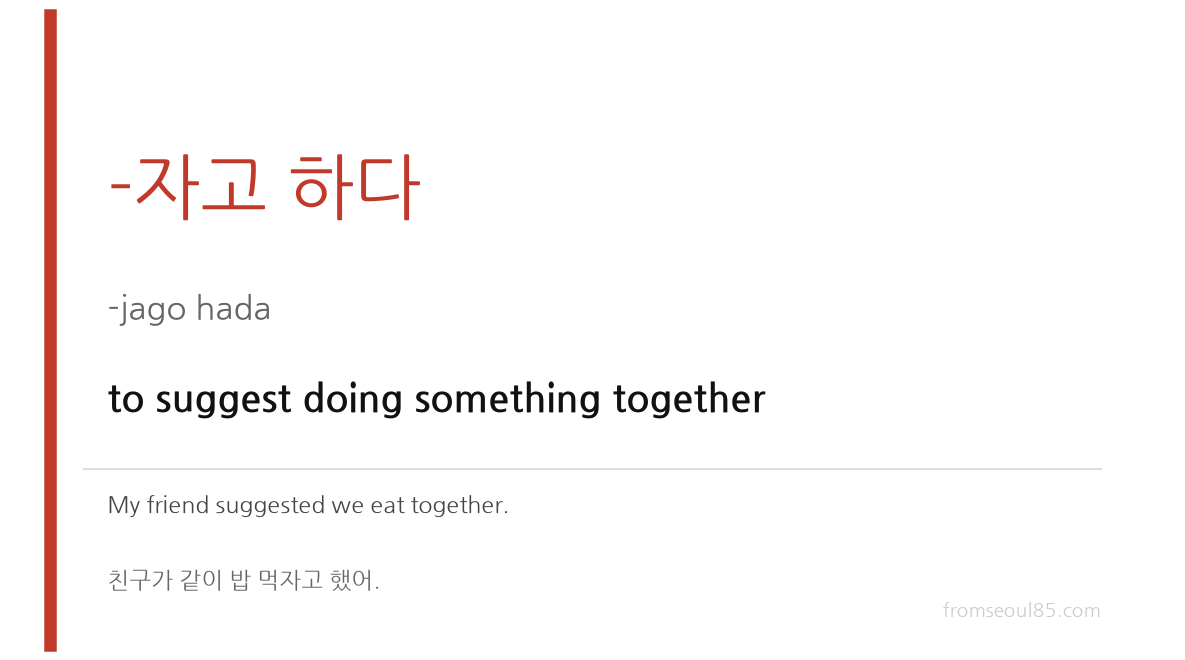
For suggestions — things you do together — use -자고 하다 (-ja-go ha-da).
Example: 친구가 같이 밥 먹자고 했어 (chin-gu-ga gat-chi bap meok-ja-go haess-eo) — “my friend suggested we eat together.”
Like -다고, this form can carry strong feeling depending on tone. You know the situation: a friend keeps saying “let’s eat sometime” but never makes real plans. After hearing it too many times, you might say with real frustration: 우리 밥 먹자고! (u-ri bap meok-ja-go!) The meaning becomes: “We said we’d eat together — when are we actually going to do it?”
The words look simple. The feeling changes completely based on your tone.
The Short Form: Dropping 하다
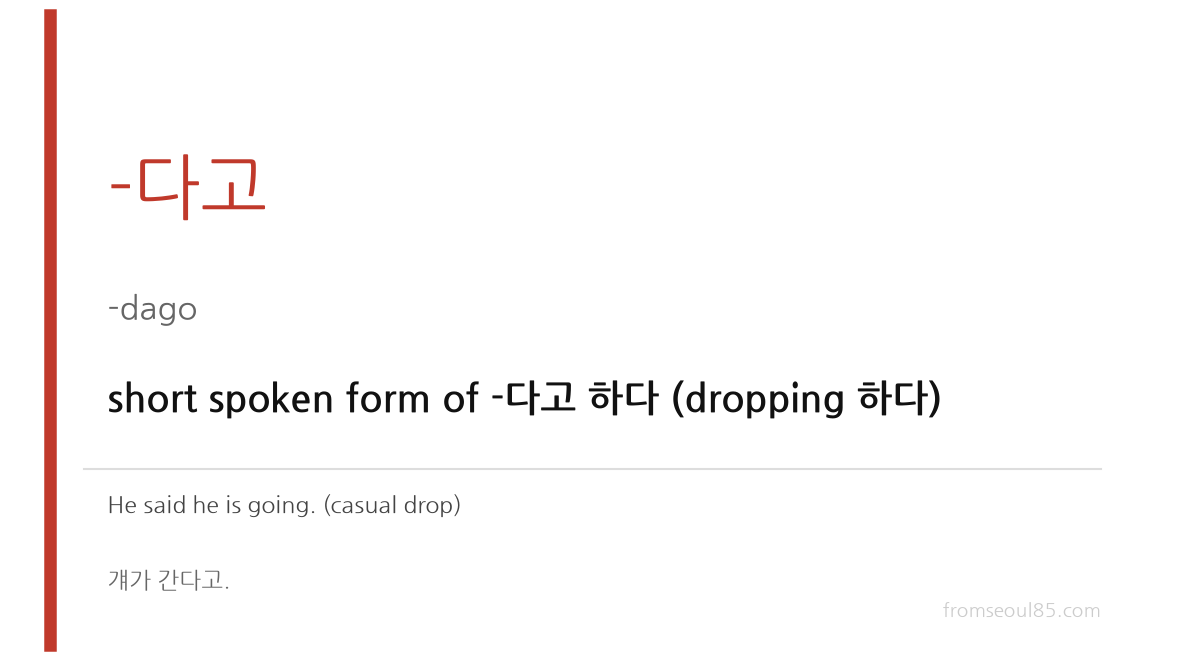
In spoken Korean, people often drop 하다 (ha-da) completely. So 간다고 했어 becomes just 간다고 (gan-da-go).
You will hear this a lot on Korean TV shows. In my experience, this short form sounds more natural between close friends. This is my personal experience. Other Koreans may see it differently.
The Grammar Is Only Half of It
I want to say something honest before I finish. Korean — like any language — changes meaning based on much more than words alone.
나 내일 간다고 can be a calm statement, an annoyed reply, or a firm notice that you are not changing your plans. The words are identical. What changes is everything around them: your tone, your expression, your relationship with the person, and what was said just before.
This is why I think the best way to really learn indirect speech in Korean is not from grammar tables. Watch Korean shows. Listen to how people actually talk. Pay attention to how tone and expression shift the meaning of the exact same sentence.
The examples I gave are based on how I personally think and feel when I hear these patterns. I am one Korean man. Your Korean friends may use them slightly differently. That is completely normal.
Key Expressions
-다고 하다 (-da-go ha-da — to say that; often carries emphasis or reminder)
She said she was tired.
그녀가 피곤하다고 했어.
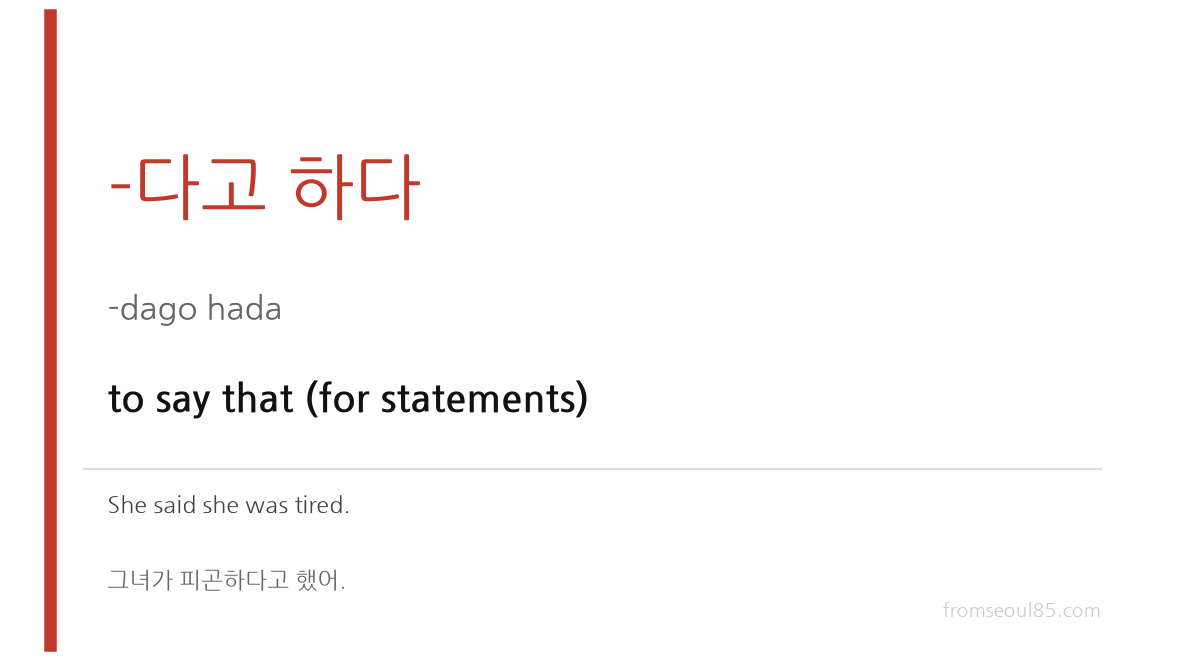 -냐고 묻다 (-nya-go mut-da — to ask whether / to ask if)
He asked if I was okay.
그가 나 괜찮냐고 물었어.
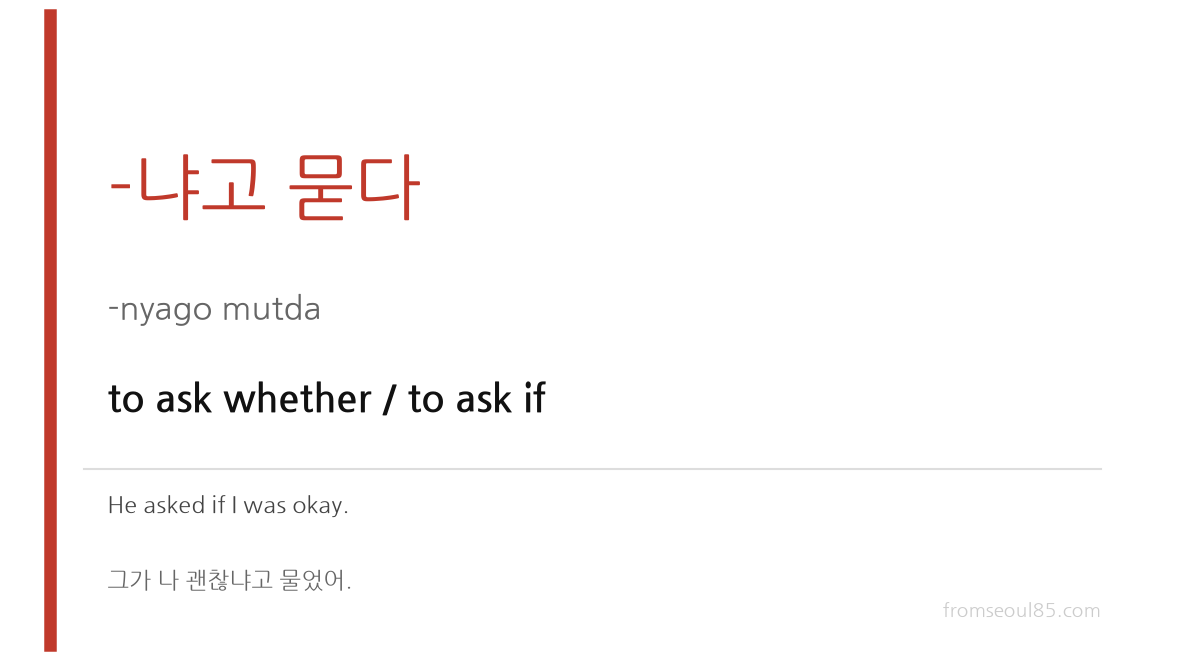 -(으)라고 하다 (-(eu)-ra-go ha-da — to tell someone to do something)
My mom told me to come home early.
엄마가 일찍 들어오라고 했어.
 -자고 하다 (-ja-go ha-da — to suggest doing something together)
My friend suggested we eat together.
친구가 같이 밥 먹자고 했어.
 -다고 (-da-go — short spoken form, dropping 하다)
He said he is going. (casual spoken)
걔가 간다고.
 Written by a native Korean speaker born in Seoul in 1985. This is my personal experience. Other Koreans may see things differently.