Korean days of the week follow a satisfying pattern. Each day is named after a natural element. Once you see the pattern, you remember them fast. In my experience, this is one of the easiest parts of learning Korean. Let me show you why.
The Seven Days of the Week
Here are all seven days. Each one ends in 요일 (yo-il — day of the week).
- 월요일 (wor-yo-il — Monday): moon day
- 화요일 (hwa-yo-il — Tuesday): fire day
- 수요일 (su-yo-il — Wednesday): water day
- 목요일 (mog-yo-il — Thursday): wood day
- 금요일 (geum-yo-il — Friday): gold day
- 토요일 (to-yo-il — Saturday): earth day
- 일요일 (ir-yo-il — Sunday): sun day
Pretty cool, right? The elements are moon, fire, water, wood, gold, earth, and sun. Just remember those seven, in that order.
Why the Days Have These Names
Here is something your textbook may skip. These names come from Chinese characters, called 한자 (han-ja — Hanja). Korea used Chinese characters long before Hangul was created. A huge part of Korean vocabulary still comes from them.
Take 월요일. It breaks into three small parts:
- 월 (wol) = moon, from the character 月
- 요 (yo) = shine, from the character 曜
- 일 (il) = day, from the character 日
So 월요일 means something like “moon shine day.” Every weekday uses the same shape: element + 요 + 일. You do not need to memorize the characters. But knowing this makes the pattern stick.
I learned these characters in school, so the meanings felt natural to me. I am not sure if schools still teach Hanja the same way today. When I was young, newspapers used many Chinese characters. Honestly, they were hard for a kid to read.
One bonus, just for fun. Not every Korean word comes from Chinese characters. Some are pure native Korean. My favorite is 윤슬 (yun-seul — sunlight or moonlight sparkling on water). There is no Hanja for it. It is purely Korean, and I think it is beautiful.
Korean Months Are Even Simpler
Months are easier than the days. You take a number and add 월 (wol — month).
- 1월 (il-wol — January)
- 2월 (i-wol — February)
- … and so on up to …
- 12월 (si-bi-rwol — December)
Here is a nice detail. The 월 for “month” is the same 月 as the moon. One moon cycle, one month. The Hanja quietly connects them.
Days of the month work the same way. You take a number and add 일 (il — day). The first is 1일, the fifteenth is 15일, up to 31일. Yes, it is the same 일 you saw in the weekday names.
Personally, I think this number system is where Korean beats English. There is almost nothing to memorize.
The Two Months That Change: 유월 and 시월
Two months get a small sound change. They soften for easier pronunciation.
- 6월 is 유월 (yu-wol — June), not 육월
- 10월 is 시월 (si-wol — October), not 십월
These softer forms are the standard ones. Koreans say them without even thinking. It is just easier on the tongue.
Here is the good news for you. If you say 육월 or 십월 by mistake, nobody will mind. It does not sound weird, and no one will judge you. So please do not feel shy or embarrassed. Just speak. This is my personal experience, but I really mean it.
Days or Dates? What Koreans Actually Say
Now for some real-life advice. In daily life, I use days of the week more than dates.
I say things like “see you next Monday” or “how about this Friday?” If I give someone a date instead, they often ask back. They might say, “Wait, what day is that?” So days of the week feel more natural for casual plans.
Dates are different in formal situations. For deadlines, we use the number and 일. Think “submit it by the 20th” or “the deadline is the 5th.” That sounds more business-like.
Here is a recent example from my own life. I was dealing with a loan and a move, so exact dates mattered. I kept saying, “I must finish the move by 6월 30일 (June 30).” For big formal plans, the date wins.
This is just how I do it. Other Koreans may have a different style.
How to Say a Full Date
For a full date, Korean goes from big to small. The order is year, then month, then day.
For example, March 15, 2026 is 2026년 3월 15일 (sam-wol si-bo-il for the month and day part).
- 년 (nyeon — year)
- 월 (wol — month)
- 일 (il — day)
Notice the pattern. You start wide, then zoom in. Korean does this a lot. Addresses go from the city down to the building. Names put the family name first.
In my opinion, it connects to how Korean sentences work. We often give the background first, then the main point. So big-to-small just feels natural to us.
Key Expressions
Here are useful phrases to practice out loud.
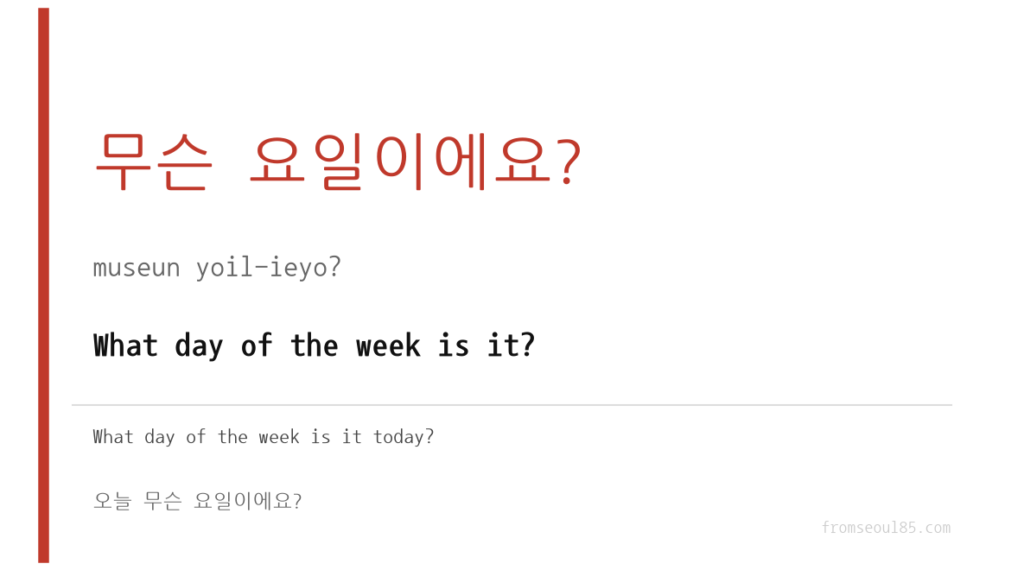
무슨 요일이에요? (mu-seun yo-il-i-e-yo — What day of the week is it?)
What day is it today? → 오늘 무슨 요일이에요? (o-neul mu-seun yo-il-i-e-yo)
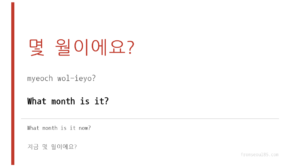
몇 월이에요? (myeot wol-i-e-yo — What month is it?)
What month is it now? → 지금 몇 월이에요? (ji-geum myeot wol-i-e-yo)
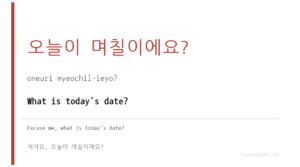
오늘이 며칠이에요? (o-neu-ri myeo-chil-i-e-yo — What is today’s date?)
Excuse me, what is today’s date? → 저기요, 오늘이 며칠이에요? (jeo-gi-yo, o-neu-ri myeo-chil-i-e-yo)
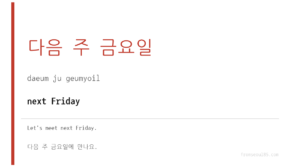
다음 주 금요일 (da-eum ju geum-yo-il — next Friday)
Let’s meet next Friday. → 다음 주 금요일에 만나요. (da-eum ju geum-yo-il-e man-na-yo)
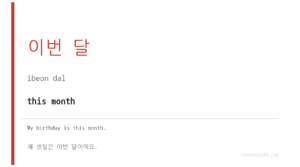
이번 달 (i-beon dal — this month)
My birthday is this month. → 제 생일은 이번 달이에요. (je saeng-il-eun i-beon dal-i-e-yo)
Written by a native Korean speaker born in Seoul in 1985. This is my personal experience. Other Koreans may see things differently.