
The Real Job of 좀 in Korean
You already know 좀 (jom — a little) from your textbook.
It is the casual short form of 조금 (jo-geum — a little).
But that quantity meaning is not what this post is about.
I am not talking about asking your mom for a little rice.
In real life, 좀 does something more interesting. It controls pressure.
Think of 좀 as a dial for how hard you push someone.
It can make a request softer. It can also make it sharper.
Imagine “walk faster” sits at 100.
“조금 빨리 걷자 (jo-geum bbal-li geot-ja — let’s walk a little faster)” feels like 80 to 90.
It is a gentle push. You are asking nicely.
Now hear “아 좀 빨리 걸어 (a jom bbal-li geo-reo — ugh, walk faster).”
That one feels like 110 to 120. It is annoyed.
The tone carries a strong, sharp accent.
If a Korean said both out loud, you would feel the gap instantly.

How 좀 Works in a Request
In my experience, 좀 shines most in requests.
Compare “도와주세요 (do-wa-ju-se-yo — please help me)” with “좀 도와주세요 (jom do-wa-ju-se-yo — please help me).”
The second one feels softer. It sounds almost like an apology.
Less “help me!” and more “sorry, could you help me?”
But here is an important point.
Dropping 좀 does not make 도와주세요 rude.
도와주세요 by itself can sound gentle, even pleading.
Tone, face, and situation change everything.
좀 is one extra layer, not a rule you must follow.
This is my personal experience. Other Koreans may see it differently.
When 좀 Means “Come On!”
좀 also shows up in frustration.
Say “좀! (jom!)” alone and it means “come on!” or “stop it!”
It is not really “seriously?” It is closer to “enough.”
The tone does all the heavy lifting here.
You will hear many irritated versions:
“좀 빨리해 (jom bbal-li hae — hurry up).”
“보고만 있냐 좀 (bo-go-man it-nya jom — are you just watching?).”
“짜증나게 좀 하지마 (jja-jeung-na-ge jom ha-ji-ma — stop annoying me).”
I am an only child.
When my parents nagged me, I always said the same thing.
“아 좀 그만… 아 좀… 알겠어요 (a jom geu-man… a jom… al-ge-sseo-yo — ugh, stop… ugh… okay, fine).”
That tiny 좀 carried all my teenage frustration.
좀 in Korean Is a Fluency Signal
Younger Koreans might disagree, but I think 좀 reveals your level fast.
Foreigners who skip 좀 can sound too blunt or too stiff.
Use it at the right moment and you sound like a local.
Here is the fun part.
Once you can use 좀 freely, for soft pushing and for annoyance, something happens.
A Korean will look at you and say, “오 좀 하네? (o jom ha-ne — oh, not bad!).”
And yes, that praise uses 좀 too. It means “you’ve got skills.”

Why Context Beats the Rule
The tricky part is that 좀 is not always soft.
Context, tone, and the words around it all matter.
“빨리 좀 해 (bbal-li jom hae — hurry up already)” does not feel soft.
“왜 이렇게 느려 좀 빨리해 (wae i-reo-ke neu-ryeo jom bbal-li-hae — why so slow, hurry up)” feels sharp.
Picture a couple. The boyfriend keeps clinging and bothering her.
She snaps, “아 좀 그만해! 저리가! (a jom geu-man-hae! jeo-ri-ga! — stop it! go away!).”
This is why 좀 is so hard to teach with text alone.
You have to feel the tone, the face, and the moment.
This is my personal experience. Other Koreans may see it differently.
Mastering 좀 means reading the whole situation, not just the word.
Key Expressions
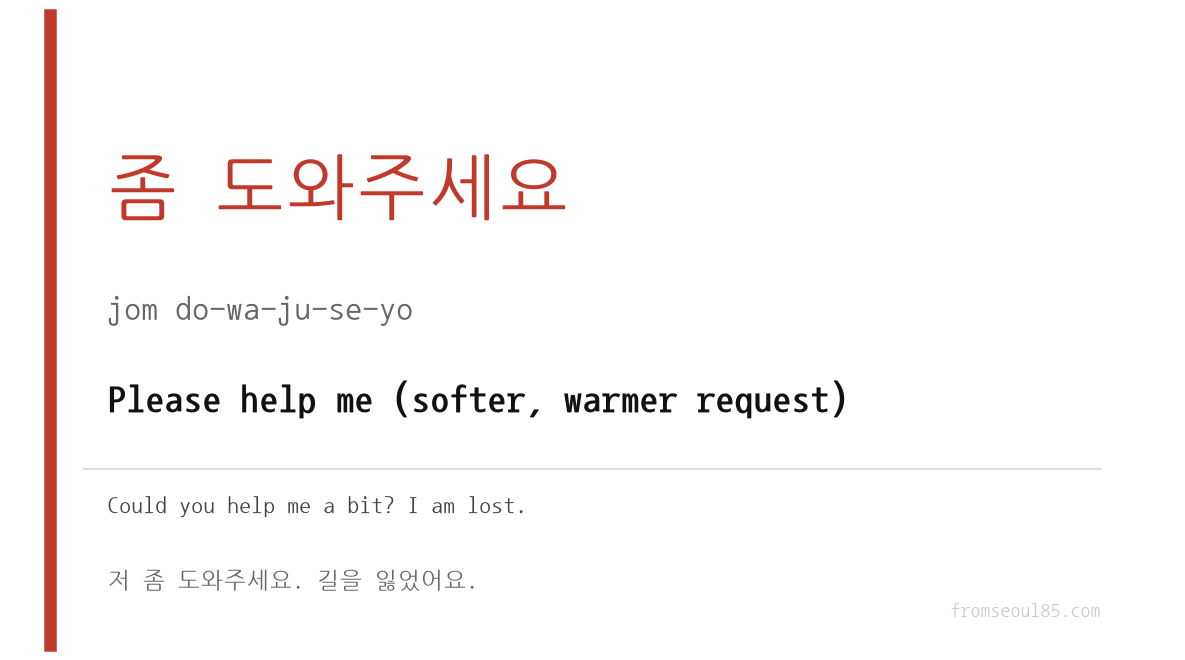
좀 도와주세요 (jom do-wa-ju-se-yo — Please help me (softer, warmer request))
Could you help me a bit? I am lost.
저 좀 도와주세요. 길을 잃었어요.
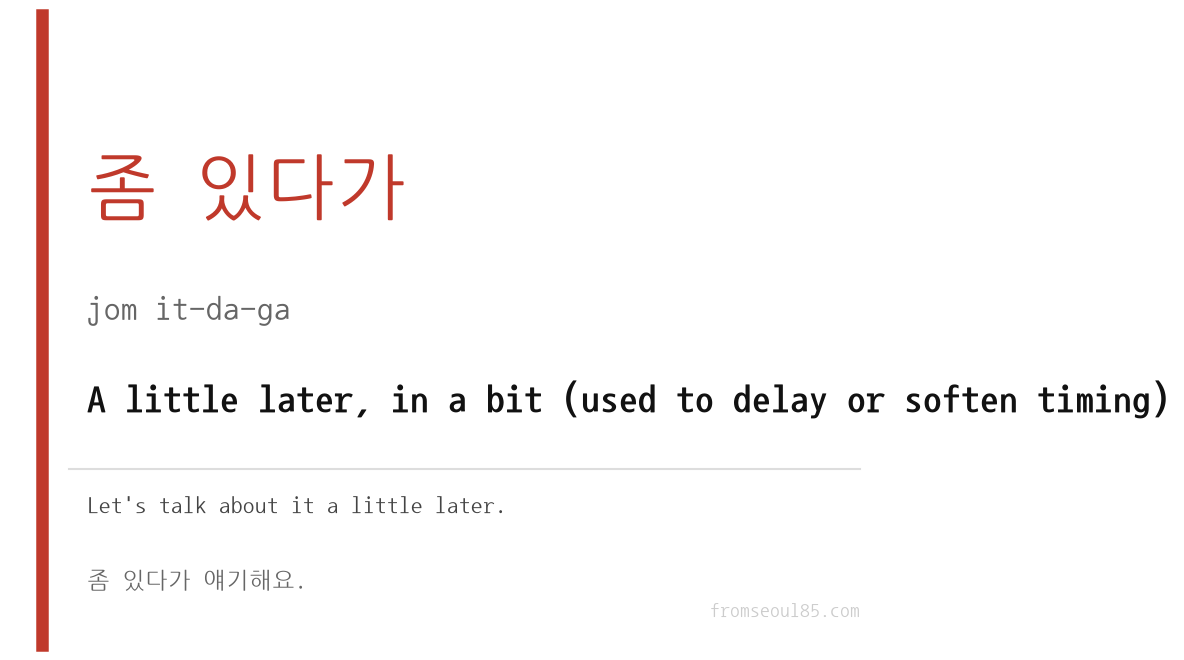
 좀 있다가 (jom it-da-ga — A little later, in a bit (used to delay or soften timing))
Let’s talk about it a little later.
좀 있다가 얘기해요.
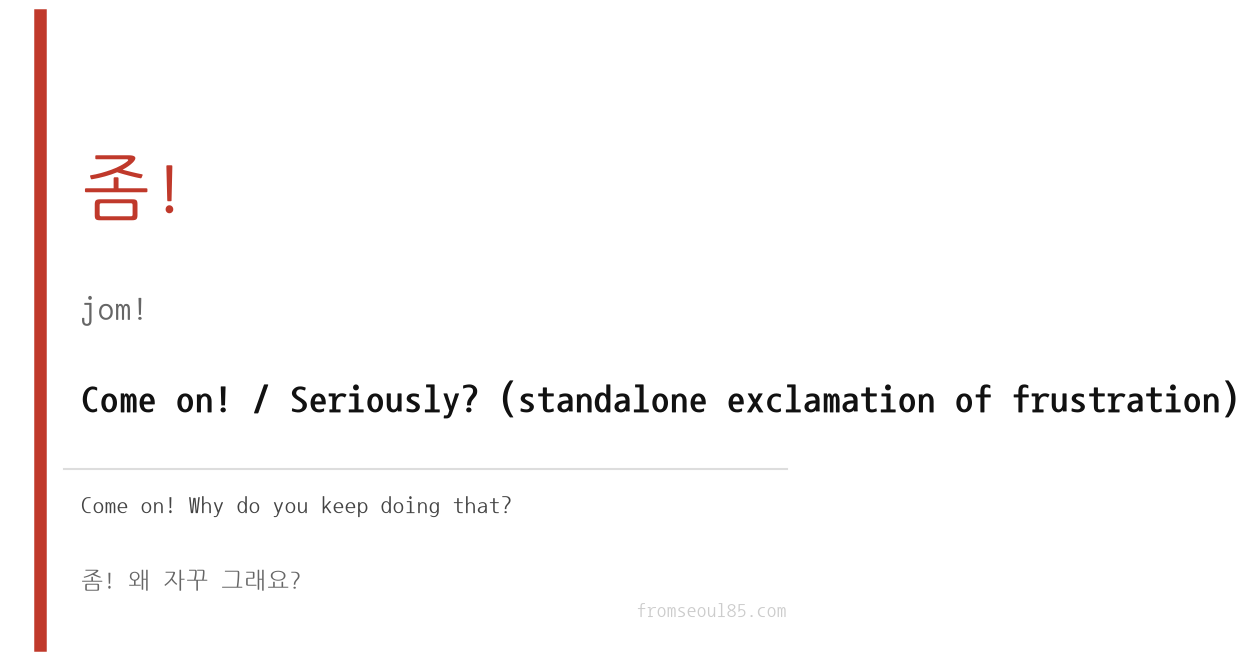
 좀! (jom! — Come on! / Stop it! (standalone exclamation of frustration))
Come on! Why do you keep doing that?
좀! 왜 자꾸 그래요?
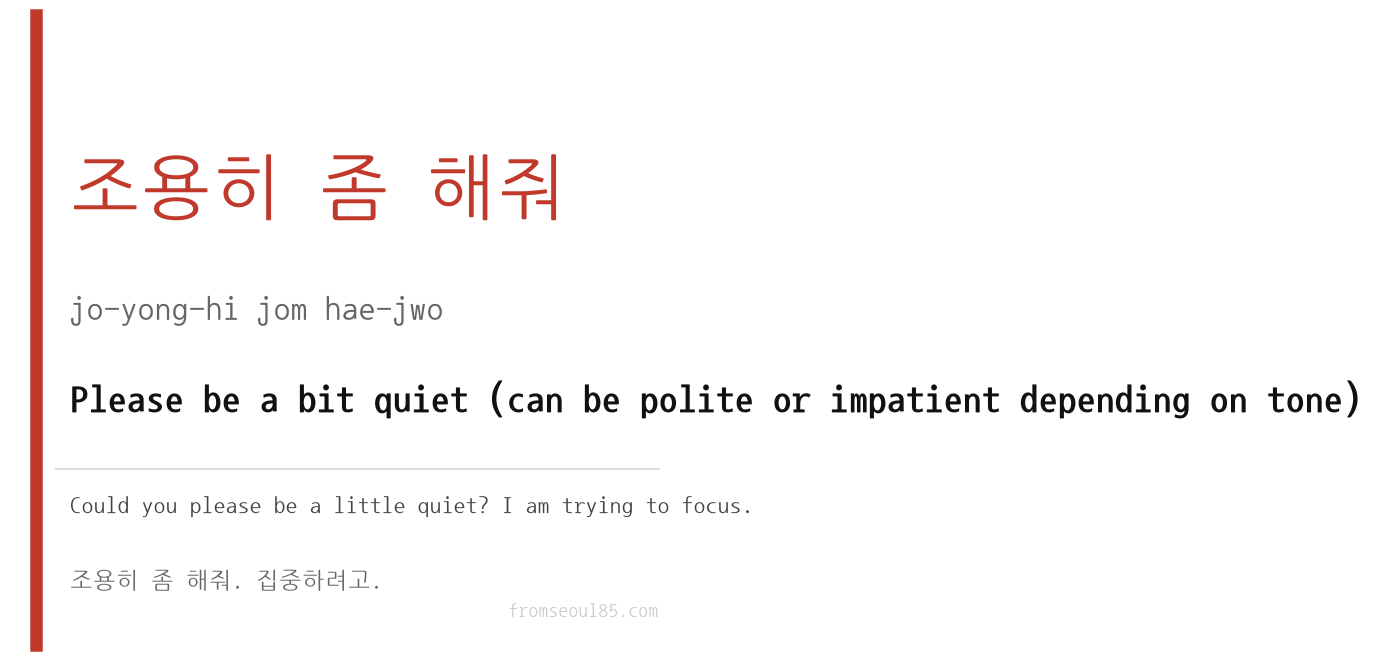
 조용히 좀 해줘 (jo-yong-hi jom hae-jwo — Please be a bit quiet (can be polite or impatient depending on tone))
Could you please be a little quiet? I am trying to focus.
조용히 좀 해줘. 집중하려고.
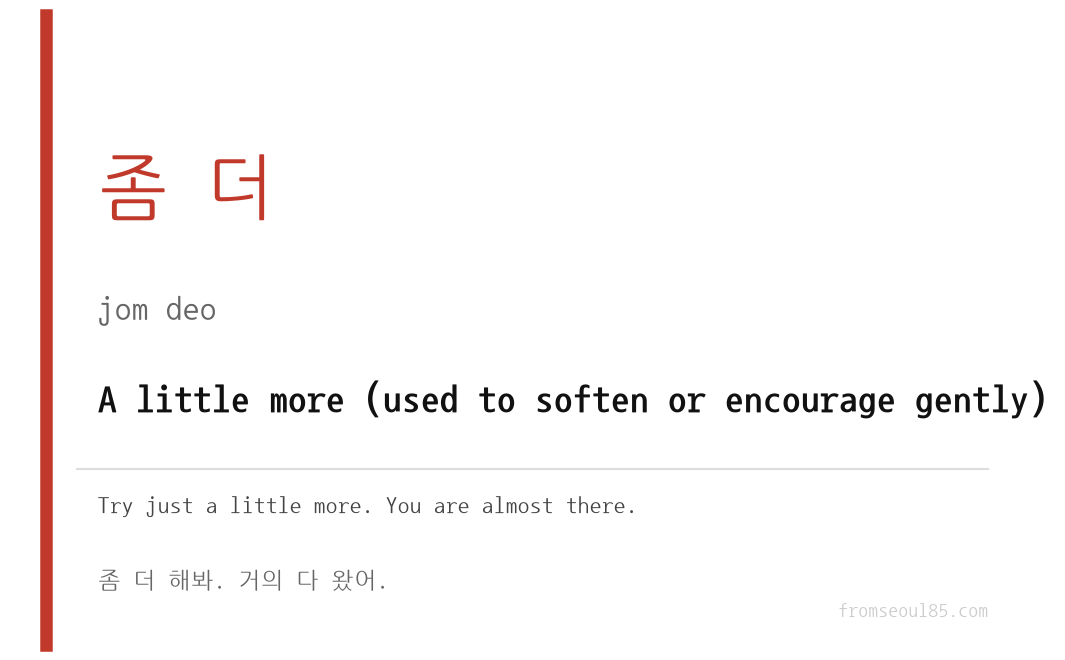
 좀 더 (jom deo — A little more (used to soften or encourage gently))
Try just a little more. You are almost there.
좀 더 해봐. 거의 다 왔어.
 Written by a native Korean speaker born in Seoul in 1985. This is my personal experience. Other Koreans may see things differently.