Why Workplace Korean Is About Attitude, Not Grammar
Talking to your boss in Korean is a real skill. It is not just grammar. It is about attitude and timing. This is one big reason workplace Korean feels hard for learners. Korean work culture is vertical, not flat. In many Western offices, people use first names freely. We rarely do that here. We call a boss by title, like 부장님 (bu-jang-nim — department head, with respect). In my experience, even small word choices change everything. One wrong phrase can sound rude without meaning to.
Here is something textbooks skip. Imagine a 사장 (sa-jang — company president) asks me about a 부장 (bu-jang — a manager above me). The 부장 outranks me, but the 사장 is higher. So I lower the 부장 when I speak to the 사장. I drop the polite 님 (nim) and skip the honorific verb. I say he “went out,” not the extra-polite form. Korean men often pick this up in the army. Some women may not. Some offices still do this, and some do not anymore. This is my personal experience. Other Koreans may see it differently.
존댓말: The Default at Work
Korean workplaces use 존댓말 (jon-daet-mal — formal, polite speech) as the base. You use it with your boss. That part rarely changes. But how strict it feels depends on the company. I have not worked at both a big firm and a startup. My guess is bigger companies have stronger internal rules. With strong rules, you follow them even if you dislike them. At my own job, I was very formal at first. As the years passed, talking to my boss felt easier. The formality softened over time. But I still did not treat him like a friend. Personally, I think reading the mood beats memorizing rules.

How to Report to Your Boss (보고)
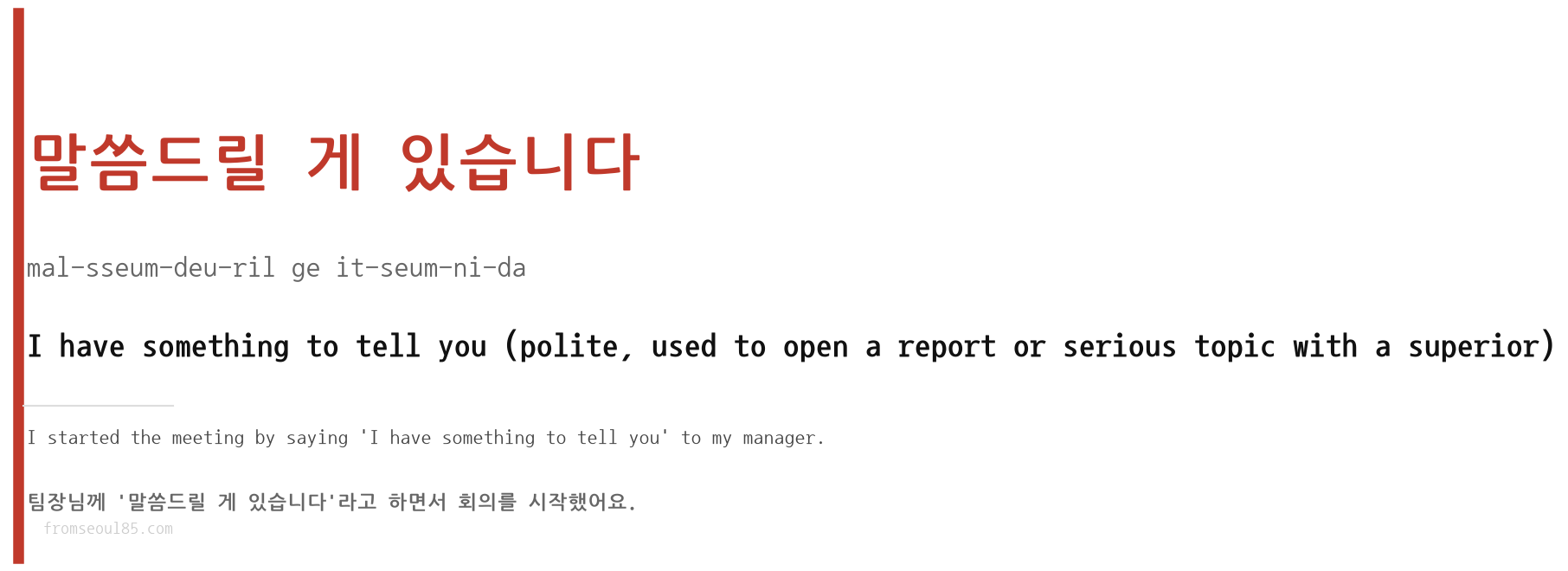
One key moment is reporting to your boss. In Korean offices, we call this 보고 (bo-go — work report). How you open it matters. For something important, I ask first if they have a moment. I say 시간 잠깐 괜찮으신가요? (si-gan jam-kkan gwaen-chan-eu-sin-ga-yo — do you have a moment?). Then I add 드릴 말씀이 있어서요 (deu-ril mal-sseum-i it-seo-seo-yo — I have something to tell you). For a normal 보고, I skip the intro. I just state the purpose. Something like 월간 보고입니다 (wol-gan bo-go-im-ni-da — this is the monthly report). Honestly, the best approach depends on each boss. Watch how senior coworkers do it. Then copy them. That alone gets you more than halfway.
How to Disagree Without Sounding Rude
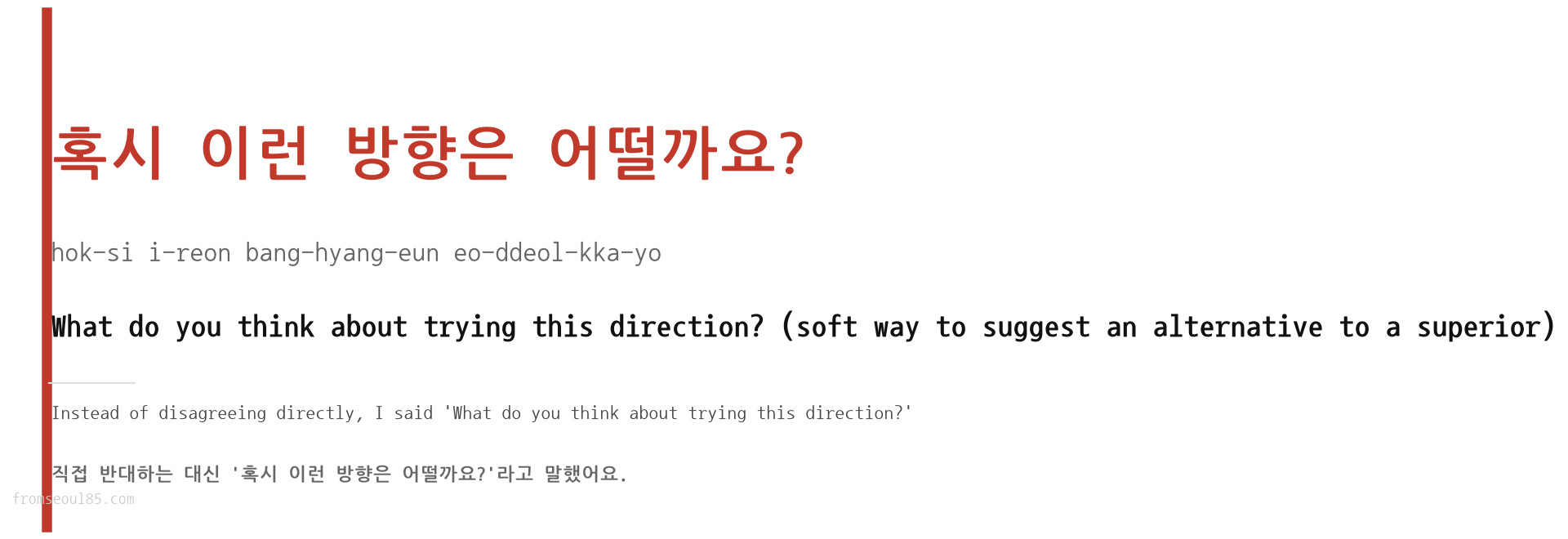
Disagreeing with your boss needs careful words. For small things, I do not push back. Lunch spot or dinner place? I just go along. But for real decisions, I may share a different view. I avoid saying 저는 반대합니다 (jeo-neun ban-dae-ham-ni-da — I disagree) directly. Instead, I ask a question. I might say 혹시 이런 방향은 어떨까요? (hok-si i-reon bang-hyang-eun eo-ddeol-kka-yo — what about trying this direction?). Or I ask if my idea is wrong: 이런 방법은 안 좋은 건가요? (i-reon bang-beob-eun an-jo-eun geon-ga-yo — is this approach not good?). I sound unsure, not certain. This lets my boss think it over. He does not feel pushed. Younger Koreans might handle this differently. But this still feels safer in most offices.

How to Say You Understand
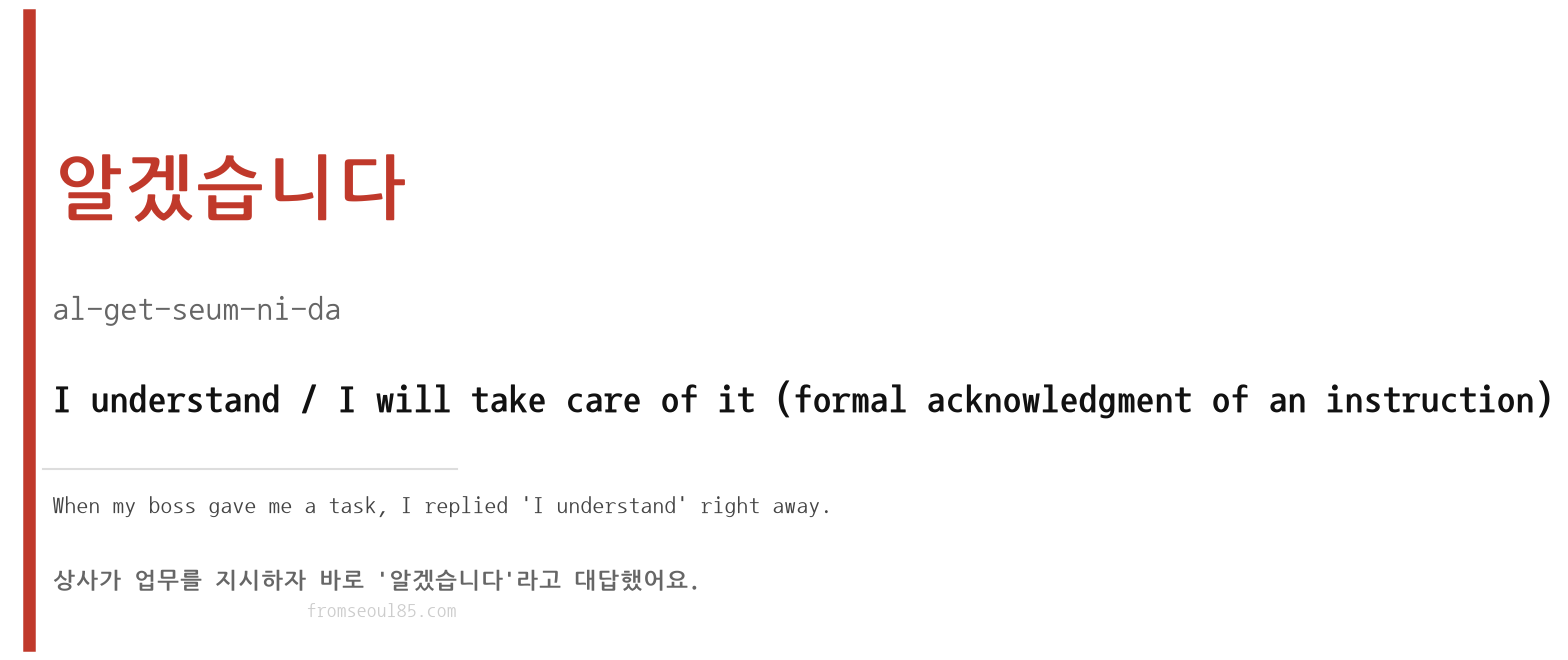
After getting instructions, saying 알겠습니다 (al-get-seum-ni-da — understood) is essential. It sounds clean and professional. You can also say 네 (ne — yes) or 네, 알겠습니다. For a direct task, these feel about the same to me. For an invitation, the 네 adds a sense of agreement. If my boss asks about lunch, 네 means “yes, I am in.” For work tasks, I often check that I understood right. I might ask 이렇게 하면 될까요? (i-reo-ke ha-myeon doel-kka-yo — should I do it like this?). That shows I am paying attention. It also avoids mistakes later.
Workplace Korean Gets Easier
Workplace Korean takes time. That is true for anyone, in any country. So here is some good news. Korean offices are less strict than they used to be. The old military-style pressure has faded a lot. These days, some bosses even watch their younger staff carefully. They joke, “young people hate work dinners, right?” Years ago, you joined every 회식 (hoe-sik — work dinner). There were no excuses. Now many places do a lunch 회식, or skip it completely. So do not stress too much about workplace Korean. Effort and politeness still go a long way. Bosses notice when someone genuinely tries.
Key Expressions
드릴 말씀이 있어서요 (deu-ril mal-sseum-i it-seo-seo-yo — I have something to tell you (polite, used to open a serious topic with a superior))
I asked for a moment and said “I have something to tell you” to my manager.
팀장님께 잠깐 시간을 여쭙고 ‘드릴 말씀이 있어서요’라고 했어요.
알겠습니다 (al-get-seum-ni-da — I understand / I will take care of it (formal acknowledgment of an instruction))
When my boss gave me a task, I replied “I understand” right away.
상사가 업무를 지시하자 바로 ‘알겠습니다’라고 대답했어요.
혹시 이런 방향은 어떨까요? (hok-si i-reon bang-hyang-eun eo-ddeol-kka-yo — What do you think about trying this direction? (soft way to suggest an alternative to a superior))
Instead of disagreeing directly, I said “What do you think about trying this direction?”
직접 반대하는 대신 ‘혹시 이런 방향은 어떨까요?’라고 말했어요.
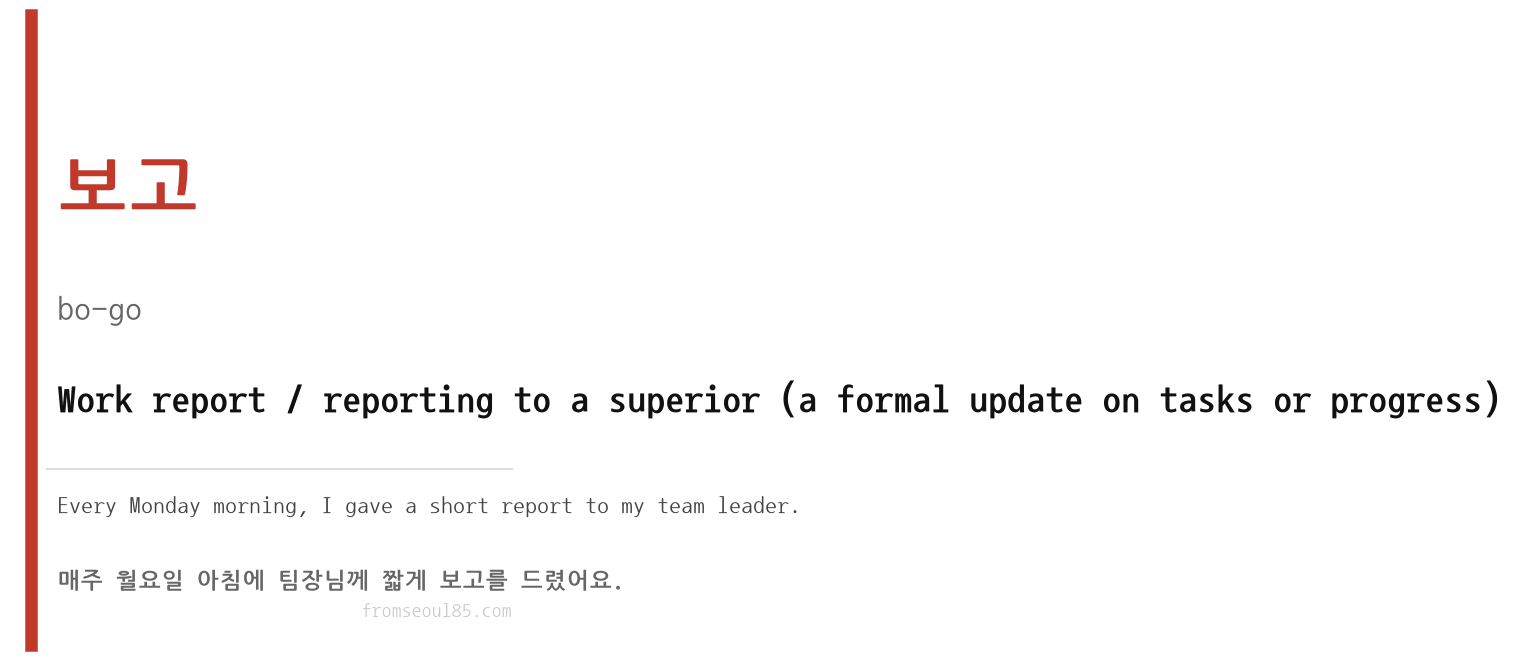
보고 (bo-go — Work report / reporting to a superior (a formal update on tasks or progress))
Every Monday morning, I gave a short report to my team leader.
매주 월요일 아침에 팀장님께 짧게 보고를 드렸어요.
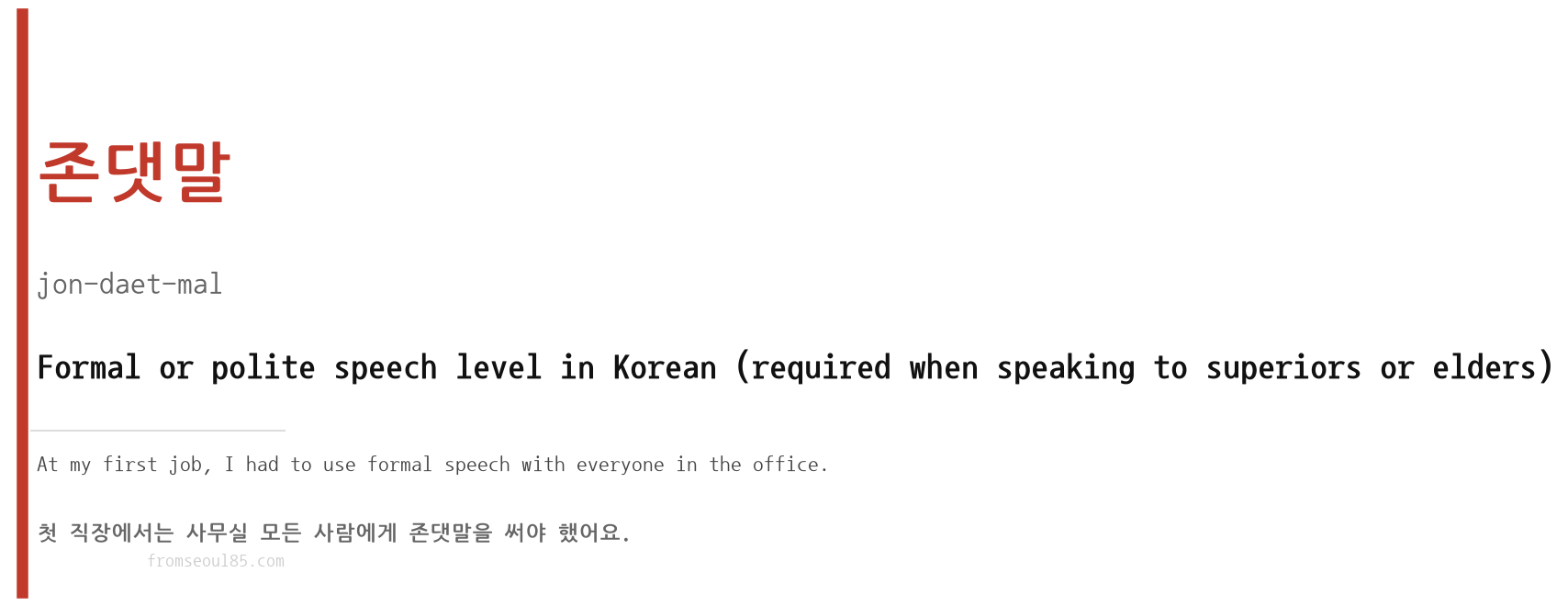
존댓말 (jon-daet-mal — Formal or polite speech level in Korean (required when speaking to superiors or elders))
At my first job, I had to use formal speech with everyone in the office.
첫 직장에서는 사무실 모든 사람에게 존댓말을 써야 했어요.
Written by a native Korean speaker born in Seoul in 1985. This is my personal experience. Other Koreans may see things differently.