
What 같다 (Gata) Really Means
If you look up the 같다 (ga-ta — it seems / I think) meaning in Korean, it’s more than grammar. Saying exactly what you think can feel too direct. So many Koreans soften their words. One natural way is 같다. You attach it to almost anything. It makes your words feel less like a hard fact.
It doesn’t mean you have no idea. It’s more like being 80 or 90 percent sure. You’re saying, “this is how I see it.” But you leave room. Other people might feel differently, and that’s fine.
How I Use 같다 Without Thinking
As a regular Korean, I use 같다 all the time. I don’t even notice it. If someone asks about a movie, I rarely say 재미없어 (jae-mi-eob-seo — it’s boring) flat out. I say 재미없는 것 같아 (jae-mi-eob-neun geot ga-ta — it seems boring to me).
The meaning is close. But the second one feels softer. I’m not speaking with 100 percent certainty. It’s more like: this is what I think — what about you? I leave a little space for the other person.

Three Forms of 같다 in Daily Life
You’ll hear 같다 in three main forms every day.
First is 것 같아 (geot ga-ta), casual, for friends. With a friend, I might say 야 이거 이런 것 같아 (“hey, this feels like this to me”). It’s my honest read, and I’m open to yours.
Second is 것 같아요 (geot ga-ta-yo), the polite everyday form.
Third is 것 같습니다 (geot gat-seum-ni-da), which is more formal. At work I might say 이건 이런 것 같습니다 (“from what I can tell, it’s like this”). Often it’s a soft way to ask my boss to confirm. Like: this is my read, so how should we go?
The core meaning stays the same across all three. You’re only changing the politeness level.
Does Dropping 같다 Sound Rude? Not Really
Here’s something I want to correct. This is my personal experience. Other Koreans may see it differently.
Dropping 같다 doesn’t sound rude to me. It just sounds like a firm opinion. When I say 이거 맛있어 (i-geo ma-si-sseo — this is delicious), I mean I’m fully sure.
But 맛있는 것 같아 (ma-sin-neun geot ga-ta — it seems delicious) is different. It means: I really like it, but you might feel another way. So I add 같다 to leave that space.
You can even use it for food you haven’t tried. 맛있을 것 같아요 (ma-si-sseul geot ga-ta-yo — it looks like it’ll taste good) means you expect it, but you’re not sure yet.
Say a dish is a little salty. I might tell you 괜찮으실 것 같아요 (gwaen-chan-eu-sil geot ga-ta-yo — I think you’ll be fine). I’m really saying: I’m not fully sure, so keep that in mind.

같다 Works for Good Opinions Too
So 같다 isn’t only for softening bad news. Koreans use it with good opinions too. Saying 좋은 것 같아 (jo-eun geot ga-ta — I think it’s good) instead of 좋아 (jo-a — I like it) doesn’t mean weak feeling. To my ear, it still sounds warm and real. It just leaves that same small space for your view.
My tip: don’t overthink the 같다 meaning in Korean. Start by adding 것 같아 when you share an opinion. It buys you space, and it sounds natural fast.
Key Expressions
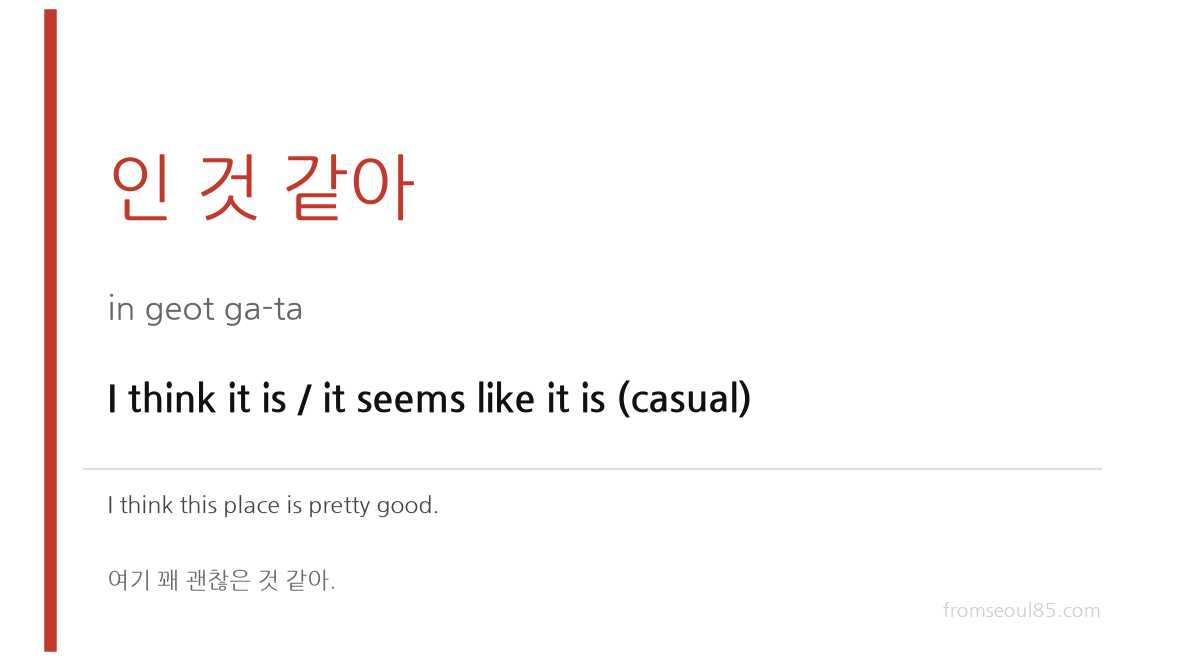
인 것 같아 (in geot ga-ta — I think it is / it seems like it is (casual))
I think this place is pretty good.
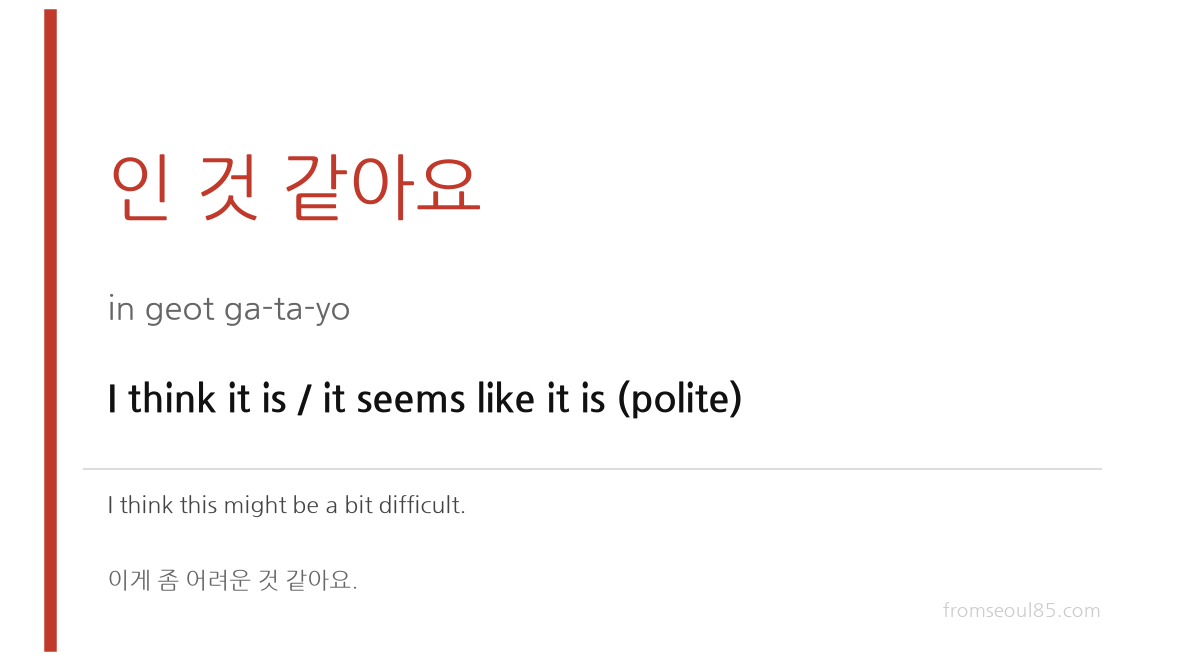
 인 것 같아요 (in geot ga-ta-yo — I think it is / it seems like it is (polite))
I think this might be a bit difficult.
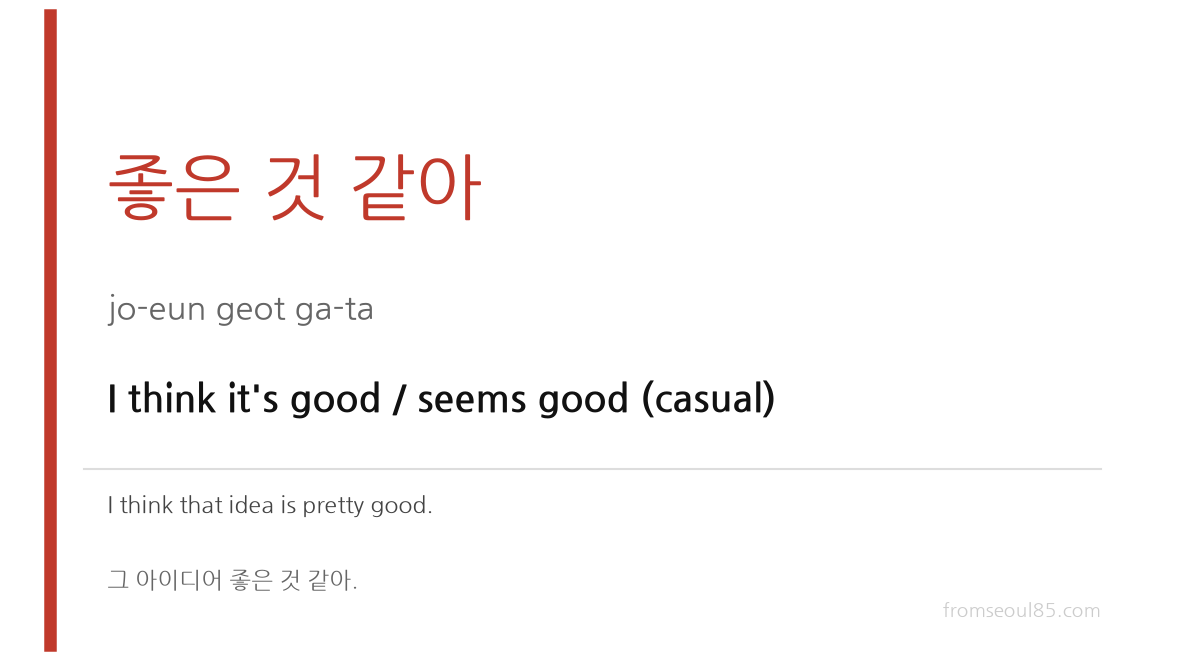
 좋은 것 같아 (jo-eun geot ga-ta — I think it’s good / seems good (casual))
I think that idea is pretty good.
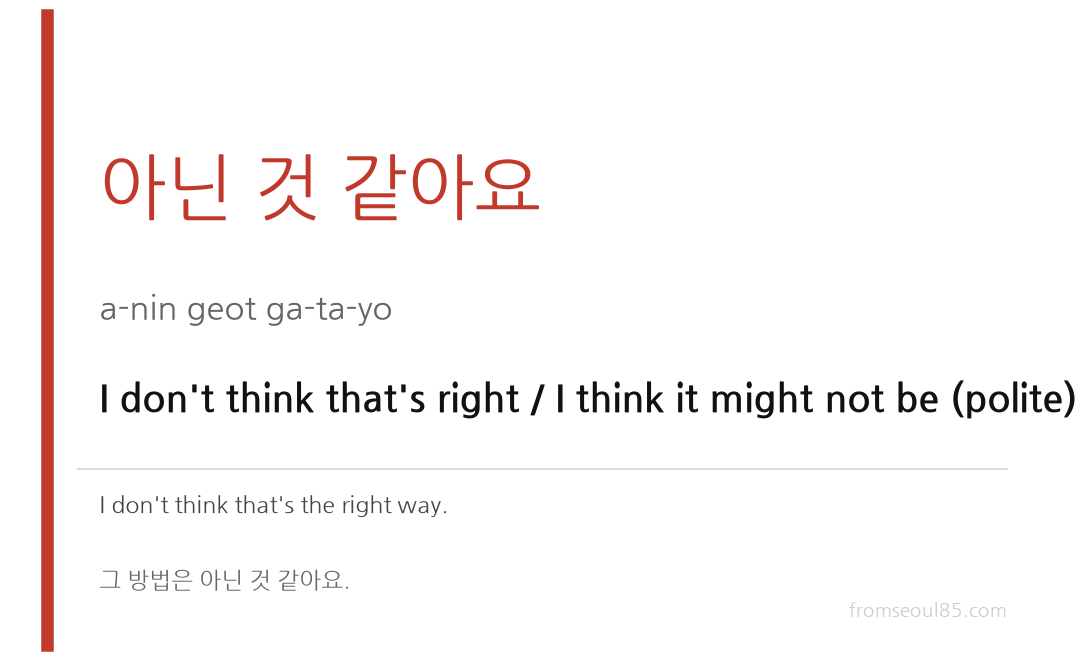
 아닌 것 같아요 (a-nin geot ga-ta-yo — I don’t think that’s right / I think it might not be (polite))
I don’t think that’s the right way.
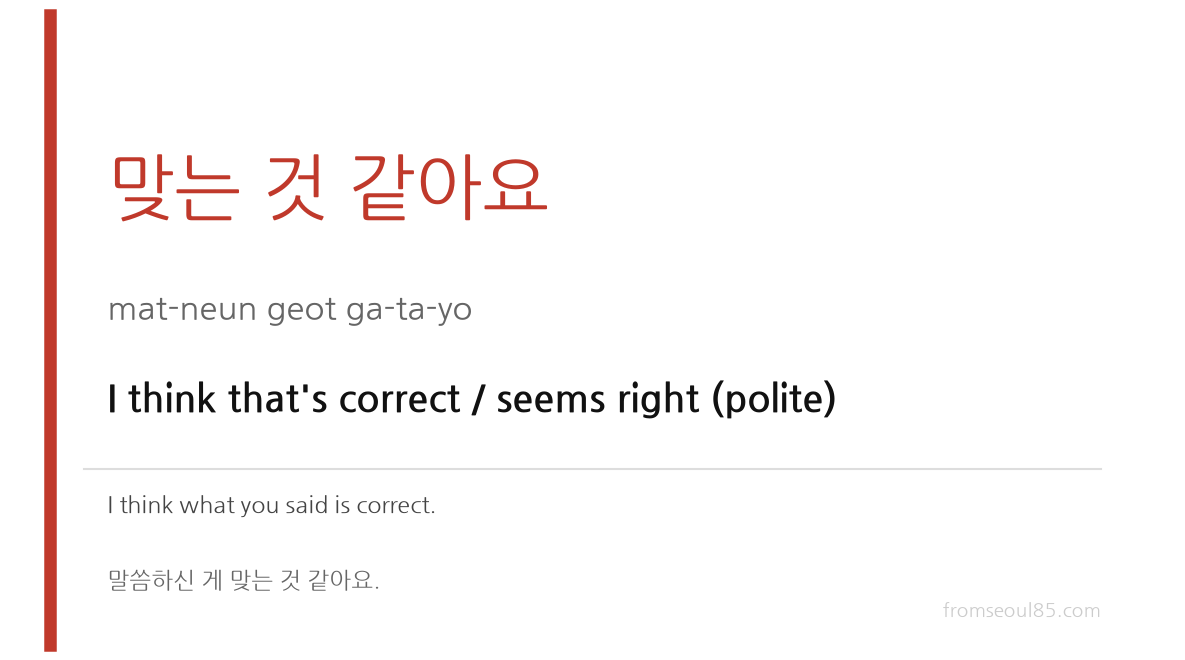
 맞는 것 같아요 (mat-neun geot ga-ta-yo — I think that’s correct / seems right (polite))
I think what you said is correct.
 Written by a native Korean speaker born in Seoul in 1985. This is my personal experience. Other Koreans may see things differently.