If you’re learning Korean, you hit this wall fast. 좋다 (jo-ta — good/like) and 좋아하다 (jo-a-ha-da — to like) look like the same word. In English, “I like coffee” covers both. But in Korean, mixing them up can sound off. Not always wrong — just a little unnatural. Here’s the honest part. As a regular Korean, I don’t think about a rule. When someone uses the wrong one, I just hear it. It sounds strange right away, before I can explain why.
And one thing surprised me while writing this post. 좋다 quietly does two jobs. Sometimes it means “good.” Sometimes it means “like.” That double life is the real key, and we’ll get there.
The basic split: 좋다 vs 좋아하다
좋다 (jo-ta) is a descriptive word — closer to “is good” or “feels good.” 좋아하다 is an action verb — “to actively like something.” But here’s a note that helps a lot. In real speech, we rarely say the plain form 좋아하다. We say 좋아해 (jo-a-hae) or 좋아한다 (jo-a-han-da) or 좋아합니다 (jo-a-ham-ni-da). The dictionary form 좋아하다 by itself sounds odd to my ear. So when you learn it, learn the everyday shapes, not the textbook one.
Compare these. 이 커피 좋다 (i keo-pi jo-ta) is like “this coffee is good” or “I’m into this coffee.” 커피 좋아해 (keo-pi jo-a-hae) means “I like coffee” as a lasting habit. One reacts to the cup in front of me. The other describes my taste in general. Honestly, for coffee I usually just say 맛있다 (ma-sit-da — it’s tasty). 이 커피 좋다, 이 커피 맛있다, 이 커피 좋은데 (jo-eun-de) — all natural.

좋다 as a quick reaction
In real conversations, 좋다 shows up a lot as a response. Someone suggests a plan, and you say 좋아 (jo-a — sounds good / okay). A friend shows you something, and you say 좋은데 (jo-eun-de — oh, nice). These aren’t about your taste. They’re fast, in-the-moment reactions.
Now, an old idea says answering with 좋아하다 sounds stiff. I don’t fully agree. Say a coworker asks 커피 마실까요? (keo-pi ma-sil-kka-yo — shall we get coffee?). You can reply 저 커피 좋아요 (jeo keo-pi jo-a-yo) or 저는 커피를 좋아해요 (jeo-neun keo-pi-reul jo-a-hae-yo). Both sound fine to me. The short 좋아 is just the easiest, lightest choice. So don’t overthink it.
The two faces of 좋다: good and like
Here’s the part that clicked for me. 좋다 splits into two feelings. With a mood or the weather, it means “good,” not “like.” 기분이 좋다 (gi-bun-i jo-ta) is “I’m in a good mood.” 날씨가 좋다 (nal-ssi-ga jo-ta) is “the weather is nice.” You aren’t “liking” the weather here. You’re describing a state, so 좋아하다 doesn’t fit at all.
But with food, an object, or a person, 좋다 leans toward “like.” 이 음식 좋다 feels close to “I like this dish.” 그 사람이 좋다 (geu sa-ram-i jo-ta) can mean “I like that person.” Same word, two different jobs. For me, on a nice day, I’ll text 날씨 좋다 (nal-ssi jo-ta). With close friends, I might even say 날씨 미쳤다 (nal-ssi mi-chyeot-da — the weather is crazy good).

So which one should you use?
Here’s my honest take as an ordinary Korean. If I understand my own language right, 좋다 covers both “good” and “like,” depending on what you’re talking about. For a mood, weather, or a state, 좋다 means “good.” For a thing or a person you’re drawn to, 좋다 can mean “like.”
When you want to state a firm, lasting preference, use 좋아해 or 좋아한다. “I like jazz.” “I like hiking.” When you’re reacting to a moment — a plan, a taste, a feeling — 좋다 is usually more natural. And if you’re stuck? A simple 좋아 almost always works. This is my personal experience. Other Koreans may see it differently.
Key Expressions
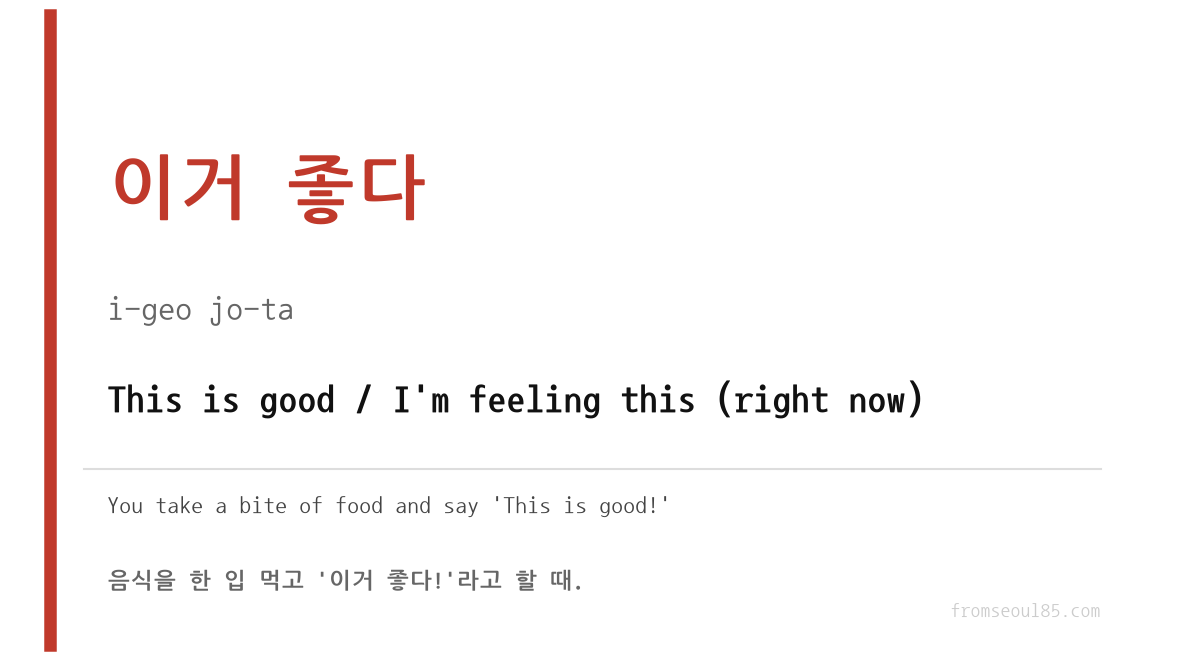
이거 좋다 (i-geo jo-ta — This is good / I’m into this right now)
You take a bite of food and say “This is good!”
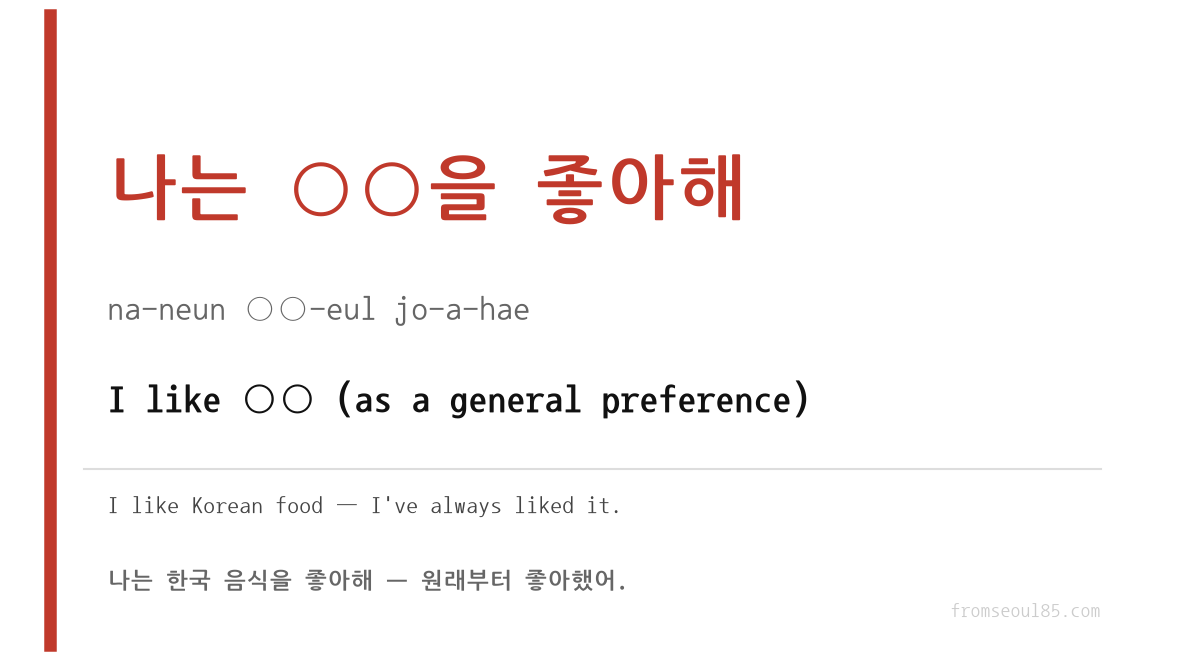
 나는 ○○을 좋아해 (na-neun ○○-eul jo-a-hae — I like ○○ as a general preference)
“I like Korean food — I’ve always liked it.”
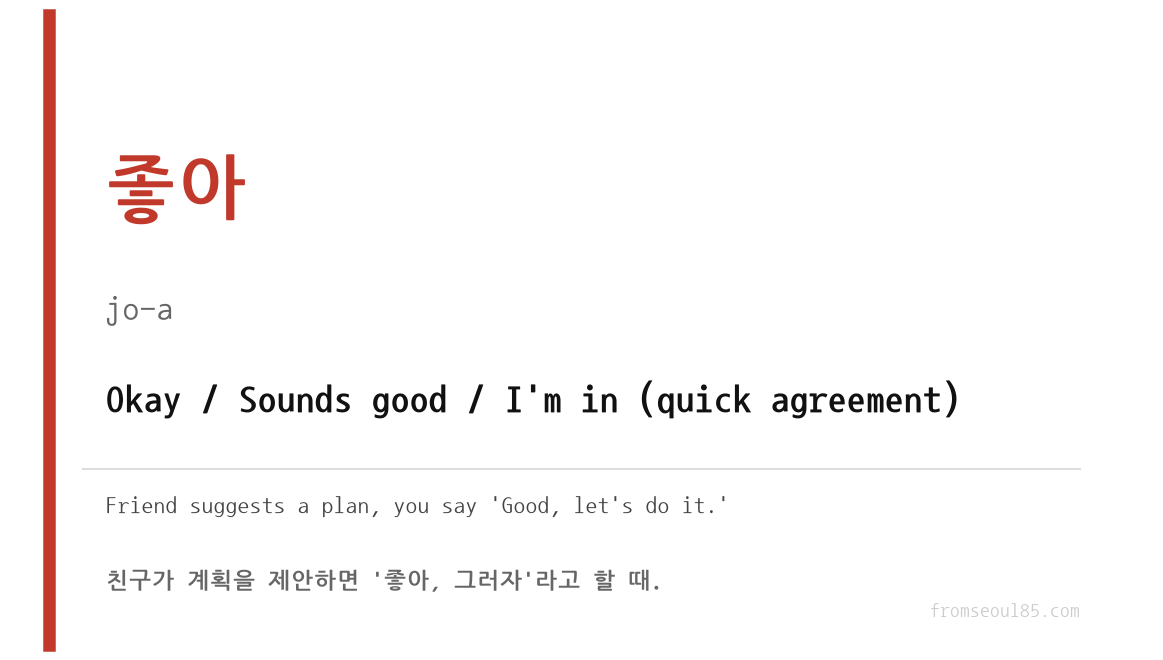
 좋아 (jo-a — Okay / Sounds good / I’m in)
A friend suggests a plan, and you say “Good, let’s do it.”
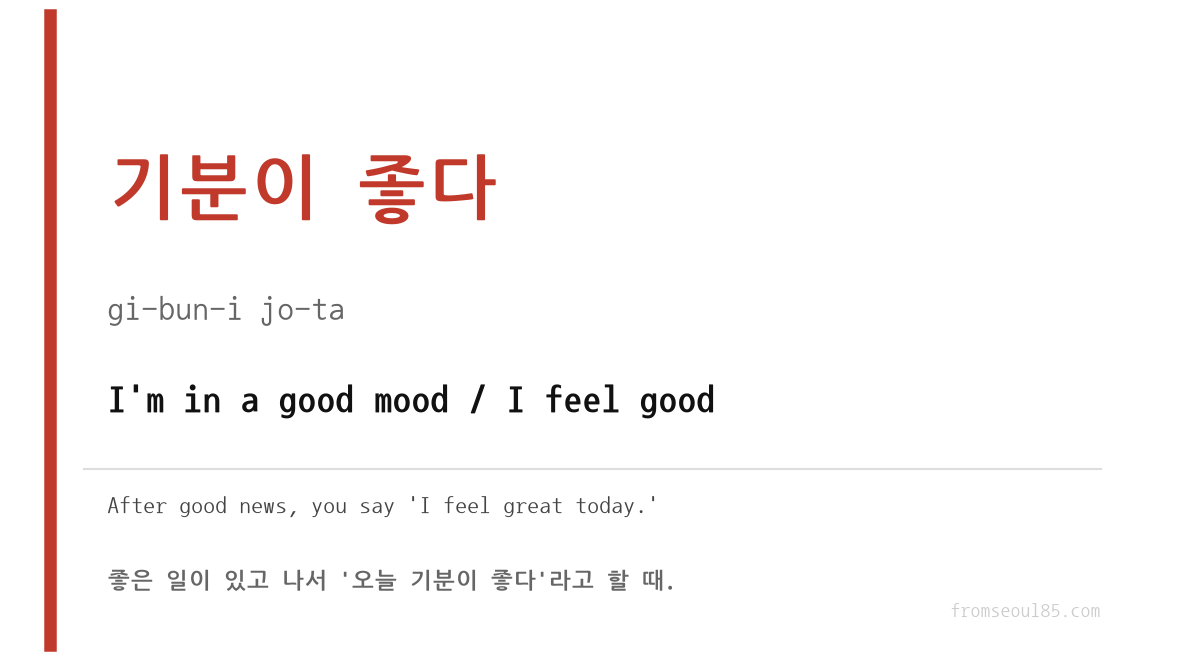
 기분이 좋다 (gi-bun-i jo-ta — I’m in a good mood)
After good news, you say “I feel great today.”
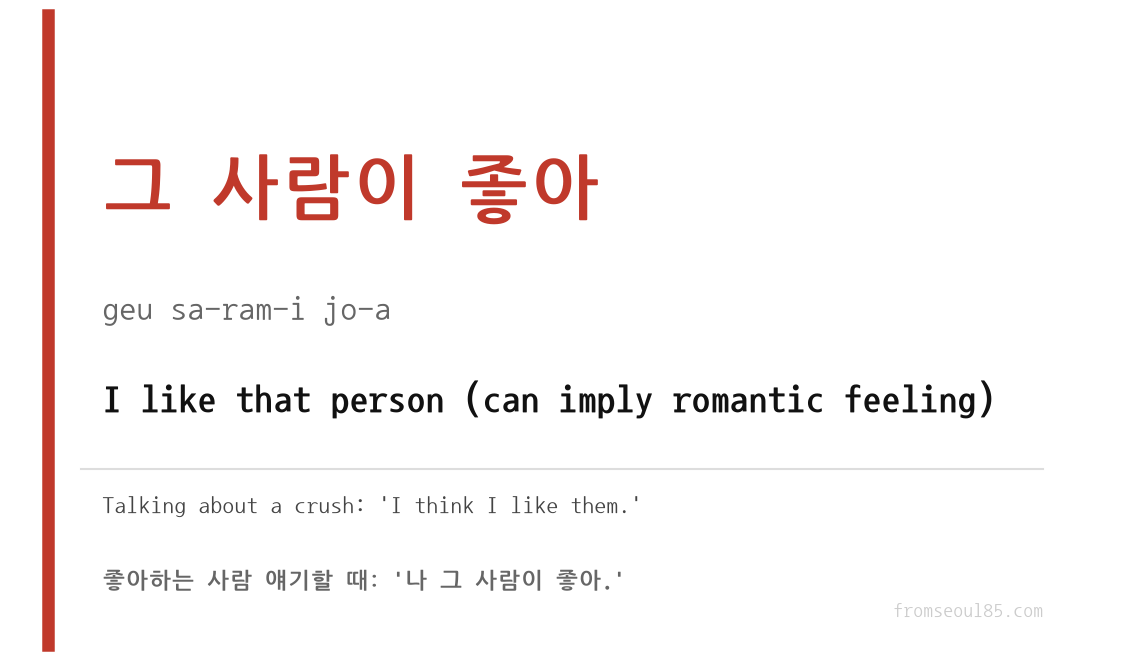
 그 사람이 좋아 (geu sa-ram-i jo-a — I like that person; can imply romantic feeling)
Talking about a crush: “I think I like them.”
 Written by a native Korean speaker born in Seoul in 1985. This is my personal experience. Other Koreans may see things differently.