Some Korean words are hard to pin down in English. 어차피 (eo-cha-pi — anyway, or either way) is one of them. The meaning of 어차피 sits close to “anyway,” but it carries a little more. For me, it often works like quiet self-comfort. You could still try something. But it feels half-hearted or unclear. So you talk yourself out of it.
Here is a small example. Say I have five minutes to eat. I know I really need six or seven. I could rush it. Instead I say, 어차피 5분 만에 밥 못 먹어 (eo-cha-pi o-bun ma-ne bap mot meo-geo — I can’t finish eating in five minutes anyway). The decision is already made in my head.
The Real Meaning of Eochapi in Daily Life
I use 어차피 a lot in ordinary moments. Often it comes out as a guess before I even check. Say a coffee shop looks packed. I might think, 어차피 자리 없을 텐데 (eo-cha-pi ja-ri eop-seul ten-de — there won’t be a seat anyway). Maybe a seat is open. But I already assumed there wasn’t.
It also softens small letdowns. If the food I wanted is sold out, I tell myself, 어차피 그거 먹으려던 거 아니야 (eo-cha-pi geu-geo meo-geu-ryeo-deon geo a-ni-ya — I wasn’t really going to get that anyway). If the café is full, I think, 어차피 테이크아웃하려고 했어 (eo-cha-pi te-i-keu-a-ut ha-ryeo-go hae-sseo — I was going to get it to go anyway). I quietly reframe what I wanted. Then it stops feeling like a loss.

Eochapi as a Push, Not a Retreat
어차피 can also be a push forward. Sometimes I use it to move myself, not to give up. If I keep delaying a task, at some point the delay stops helping. So I say, 어차피 해야 할 일이면 지금 하자 (eo-cha-pi hae-ya hal il-i-myeon ji-geum ha-ja — if I have to do it anyway, let’s just do it now). It cuts through the hesitation.
I also use it to fix my mood. When I grumble about work I dislike, I tell myself, 어차피 할 일인데 기분 좋게 하자 (eo-cha-pi hal il-in-de gi-bun jo-ke ha-ja — it’s my job anyway, so let’s do it in a good mood). The word stays the same. The energy changes.
The Feeling Behind the Word
어차피 also carries a feeling that is hard to name. It is not quite sadness. It is not anger. It sits somewhere in between. Often it shows up after a small letdown. You had some hope, but it did not work out.
So you say, 어차피 이럴 줄 알았어 (eo-cha-pi i-reol jul a-ra-sseo — I knew it would end this way anyway). Sometimes I add, 차라리 잘 됐어 (cha-ra-ri jal dwae-sseo — it’s better this way). That turns a letdown into something I can accept. From what I’ve seen, many Koreans handle disappointment quietly. You absorb it, say 어차피, and move on. This is my personal experience. Other Koreans may see it differently.

Watch Your Tone
One thing to watch: 어차피 can sound passive or negative if you miss the tone. Context changes everything. Here is the deflating version. A friend says, “나 이거 해보고 싶어” (I want to try this). Someone replies, 어차피 또 며칠 하다가 말 거잖아 (eo-cha-pi tto myeo-chil ha-da-ga mal geo-ja-na — you’ll just quit after a few days anyway). That can feel cold. The friend might snap, “왜 그렇게 말해!” (why would you say that!).
Now the light version. I say, “나 다이어트 할 거야” (I’m going on a diet). A friend laughs, 어차피 저녁에 또 치킨 시킬 거잖아 (eo-cha-pi jeo-nyeok-e tto chi-kin si-kil geo-ja-na — you’ll just order chicken again tonight anyway). Same word, but nobody gets hurt. Between friends, it can be almost funny.
Making It Feel Natural
If you want 어차피 to feel natural, don’t overthink it. Who plans their words in advance? It just comes out. It appears when something feels set or unavoidable. Try this simple habit. Notice when you’d say “anyway” or “it doesn’t really matter” in English. That is probably your 어차피 moment. Once you feel the meaning of 어차피 from the inside, it stops being just a vocabulary word.
Key Expressions
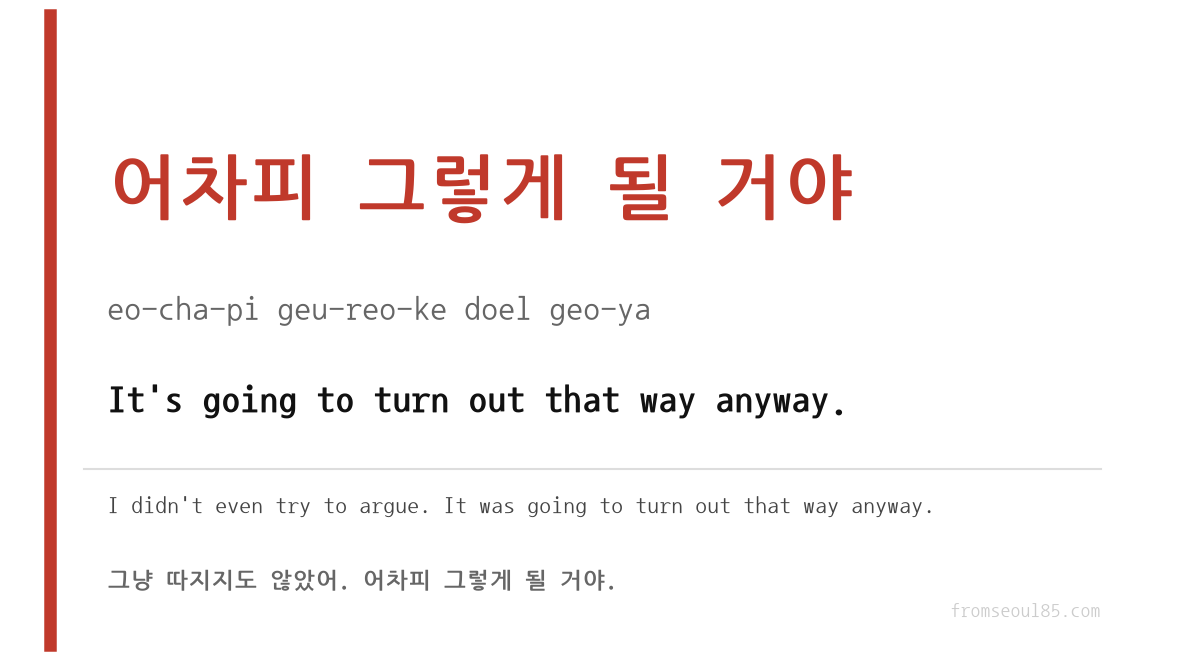
어차피 그렇게 될 거야 (eo-cha-pi geu-reo-ke doel geo-ya — It’s going to turn out that way anyway.)
I didn’t even try to argue. It was going to turn out that way anyway.
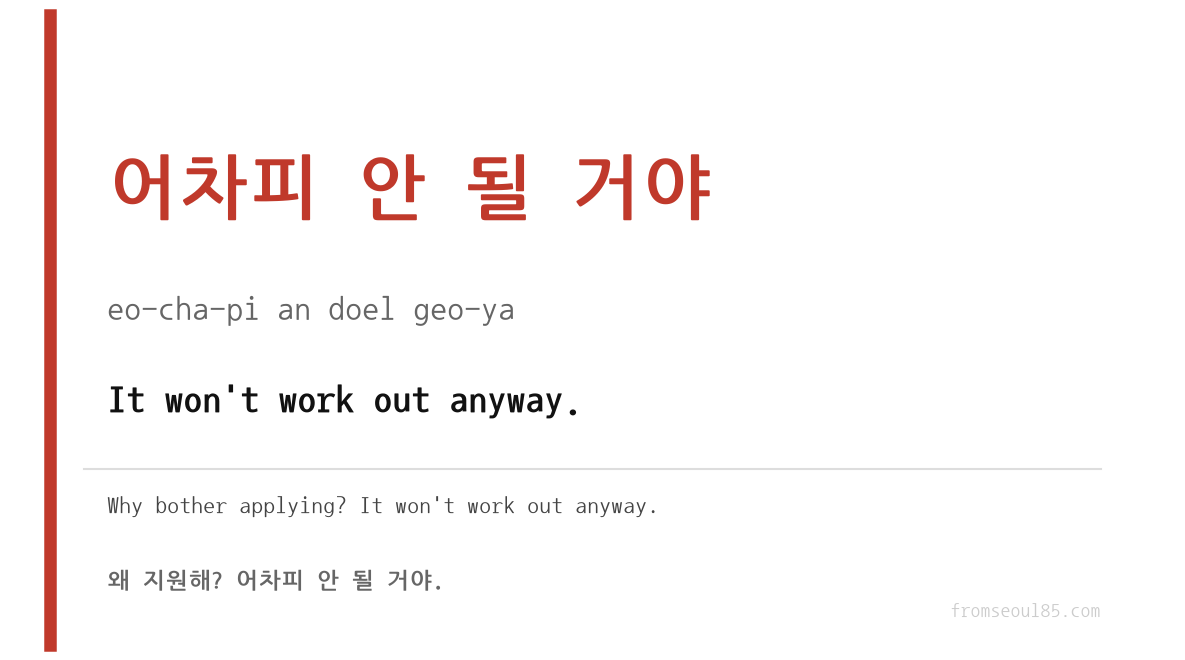
어차피 안 될 거야 (eo-cha-pi an doel geo-ya — It won’t work out anyway.)
Why bother applying? It won’t work out anyway.
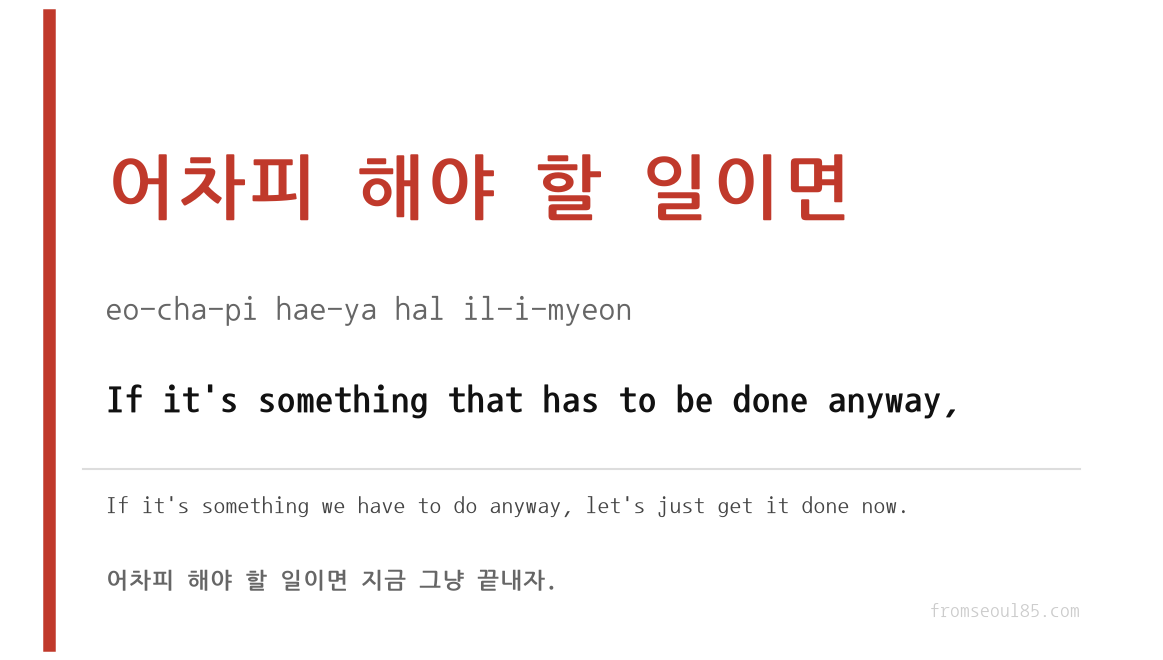
어차피 해야 할 일이면 (eo-cha-pi hae-ya hal il-i-myeon — If it’s something that has to be done anyway,)
If it’s something we have to do anyway, let’s just get it done now.
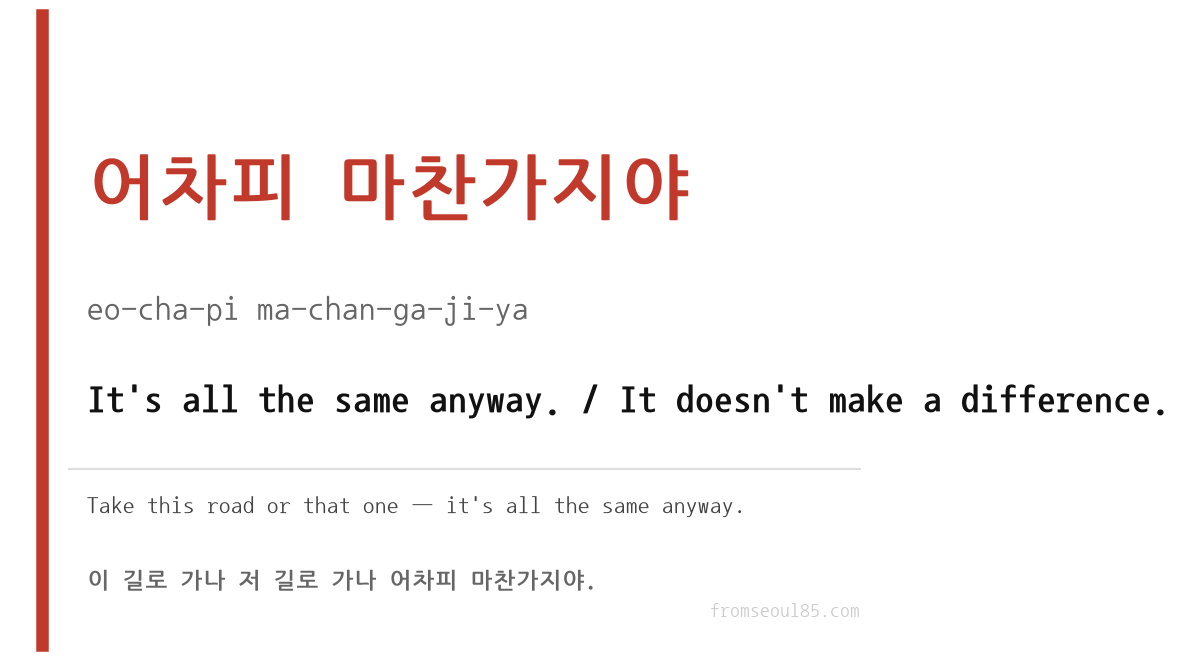
어차피 마찬가지야 (eo-cha-pi ma-chan-ga-ji-ya — It’s all the same anyway.)
Take this road or that one — it’s all the same anyway.
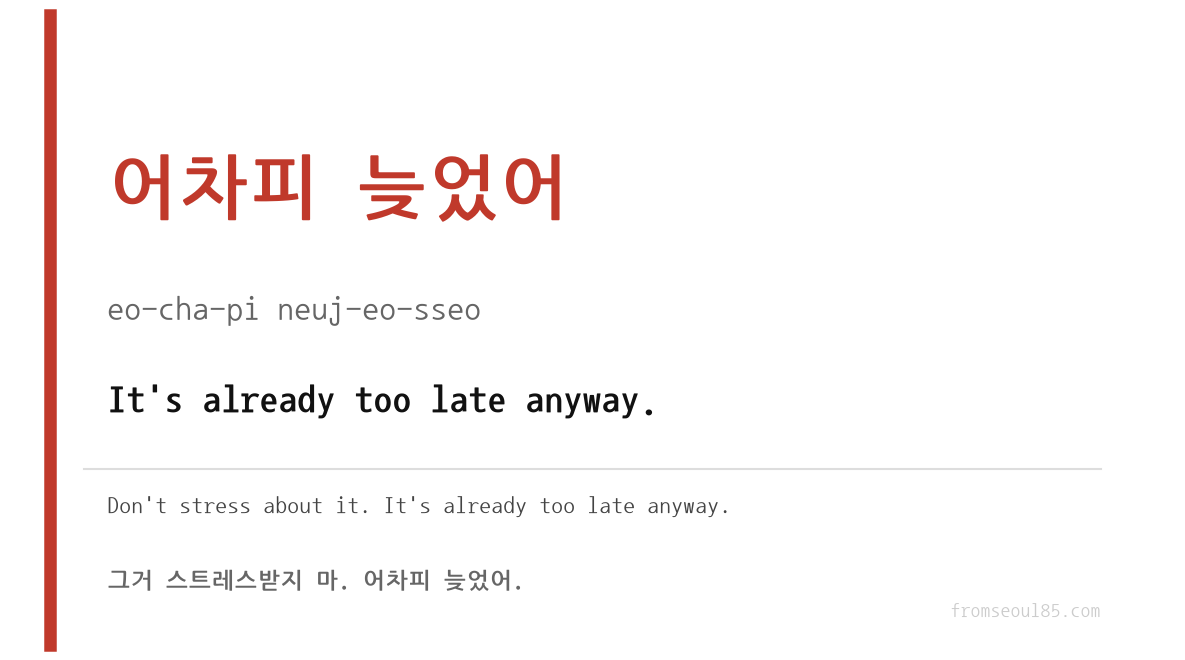
어차피 늦었어 (eo-cha-pi neu-jeo-sseo — It’s already too late anyway.)
Don’t stress about it. It’s already too late anyway.
Written by a native Korean speaker born in Seoul in 1985. This is my personal experience. Other Koreans may see things differently.