You’re mid-conversation with someone you’ve met before. You remember the face. You remember where you met, and what you talked about. But the name? Gone. In English, you can say “sorry, remind me of your name?” and move on. In Korean, it feels harder. You are not sure if asking again is rude. So you freeze. You avoid saying their name, or quietly ask someone nearby. Honestly, I do the same thing. But forgetting someone’s name in Korean is not always the crisis it feels like. This happens to Koreans too. And there are natural ways to handle it.
Why forgetting a name feels harder in Korean
Here is the part textbooks skip. In Korea, asking for a name again can send a quiet message. It can feel like you are saying “you were not important enough to remember.” That is why so many people avoid it. They talk around the name. They quietly ask a friend nearby. They do anything but ask the person directly.
So the pressure you feel is real. It is not just your imagination. But knowing this helps. Once you understand why it feels heavy, you can pick words that take the weight off. The goal is simple. Ask again without making the other person feel forgotten.
The polite phrase, and one small trick
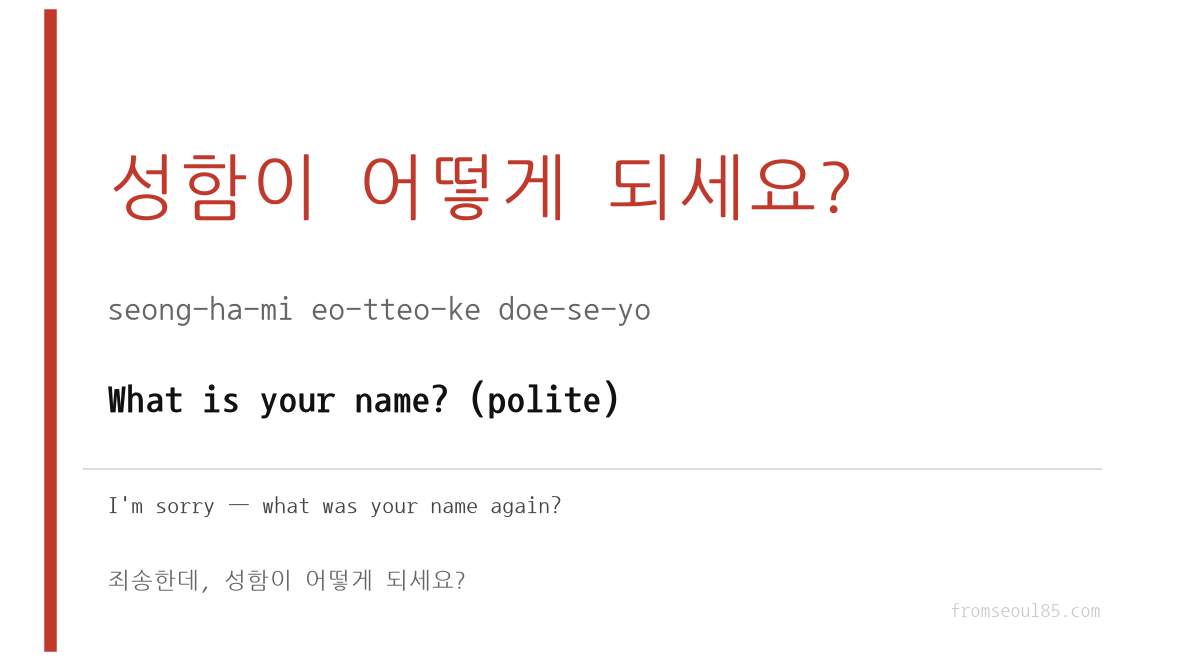
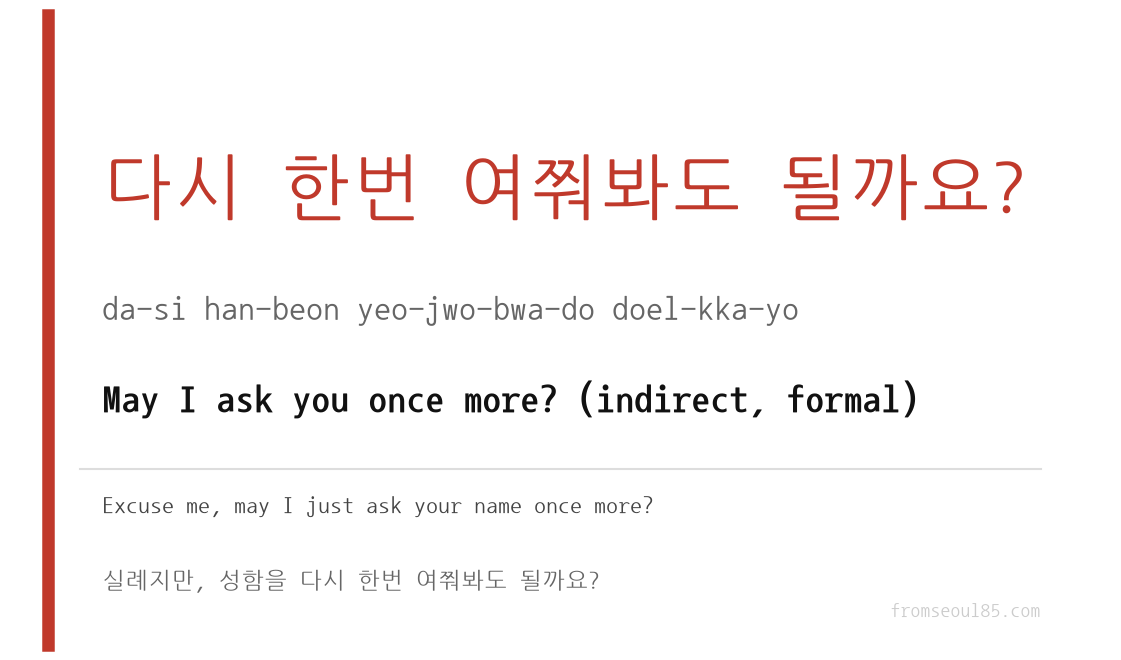
The most natural phrase is 성함이 어떻게 되세요? (seong-ha-mi eo-tteo-ke doe-se-yo — what is your name?). It is polite and clean. It does not come across as rude. 성함 (seong-ham) is the formal word for “name.” It carries respect on its own.
But here is my real tip. Do not ask cold. Give your own name first, then ask. Try this: 안녕하세요, 저는 ○○입니다. 혹시 성함이 어떻게 되세요? (an-nyeong-ha-se-yo, jeo-neun ○○ im-ni-da. hok-si seong-ha-mi eo-tteo-ke doe-se-yo — hello, I’m ○○. May I ask your name?). Leading with your own name feels warmer. It also gives the other person room to say theirs.
With friends of friends, casual is fine: 나는 ○○야. 너는? (na-neun ○○ ya. neo-neun — I’m ○○. And you?). The casual 이름이 뭐예요? (i-reum-i mwo-ye-yo — what’s your name?) works with people your age. With someone older, the polite version is safer.

What to say when you forgot someone’s name in Korean
What if you already know the person, but the name will not come? Some guides tell you to trail off: 성함이 어떻게 되셨더라… (seong-ha-mi eo-tteo-ke doe-syeot-deo-ra — your name was…?). In my experience, that trailing line feels off to someone’s face. It sounds more like muttering when you secretly ask a third person about them.
To the person directly, I just apologize and admit it. Here is how it usually sounds:
Me: 죄송한데, 제가 성함을 깜빡했어요. 다시 알려주시겠어요? (joe-song-han-de, je-ga seong-ha-meul kkam-ppak-haess-eo-yo. da-si al-lyeo-ju-si-ge-sseo-yo — sorry, I blanked on your name. Could you tell me again?)
Them: 아, 김민수입니다. (a, gim-min-su im-ni-da — oh, I’m Kim Min-su.)
Me: 아 맞다, 민수님! 죄송해요. (a mat-da, min-su-nim! joe-song-hae-yo — oh right, Min-su! I’m sorry.)
I lead with the apology and the reason. Then I ask. Being honest lands better than hiding it. This is my personal experience. Other Koreans may see it differently.
A small laugh does a lot
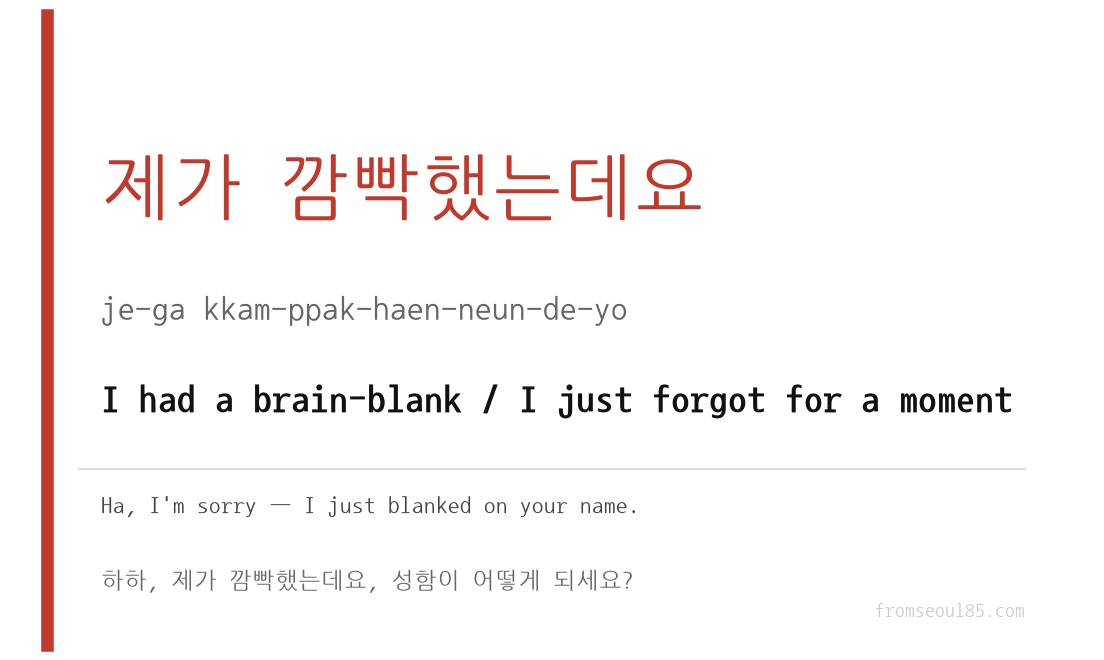
A light laugh softens everything. 제가 깜빡했는데요… (je-ga kkam-ppak-haen-neun-de-yo — I just blanked…), said with a short 하하 (ha-ha), takes the edge off. It is a little self-deprecating, but only a little. You are not putting yourself down. You are just admitting a small slip. They told you clearly, and you dropped it. That is normal, and they know it. A light laugh often softens things more than a perfect polite word.
With close friends, keep it casual
With friends, drop the formality. I just say: 진짜 미안한데, 이름이 뭐였지? (jin-jja mi-an-han-de, i-reum-i mwo-yeot-ji — I’m really sorry, what was your name again?). Or: 이름 까먹었는데 다시 알려줄 수 있어? (i-reum kka-meo-geot-neun-de da-si al-lyeo-jul su iss-eo — I forgot your name, can you tell me again?).
I also trail off, but with an apology first. Here is a real example with a friend:
Me: 아, 미안한데 이름이… (a, mi-an-han-de i-reum-i — ah, sorry, your name is…)
Friend: 야, 나 지훈이잖아. (ya, na ji-hun-i-ja-na — hey, I’m Ji-hun, come on.)
Me: 아 맞다 지훈아! 미안 미안. (a mat-da ji-hun-a! mi-an mi-an — oh right, Ji-hun! sorry, sorry.)
A bare 이름이 기억 안 나요 (i-reum-i gi-eok an-na-yo — I don’t remember your name), with no apology, can feel flat. Add a 미안한데 (mi-an-han-de — sorry) in front, and it warms right up. In casual Korean, people also skip names more than you’d expect. Close friends just use 야 (ya — hey), or a look.

When forgetting a name is actually rude
Now the honest part. Forgetting is not always fine. If you met someone once, quickly, nobody will mind. But if you have met several times, talked, shared meals — and still don’t know their name? That feels rude. To me, that is a real slip. It says you were not really paying attention.
Here is a tip that helps. In Korea, we often call people by their given name, not their family name. So the given name matters most. You might forget the family name, or the full name. That happens. But try hard to hold on to the given name. That is the part you will actually use when you speak to them.
Don’t panic, but do pay attention
Here is the truth from my everyday life. For people you barely know, Koreans are pretty forgiving. Someone told you their name once. Of course you might forget. You ask again, they tell you again. That is it. If someone gets angry over that, honestly, that is on them.
What people actually notice is how you handle the moment. Handle it lightly. A small apology, a small laugh, a direct ask. It usually goes fine. You do not need a perfect phrase. You just need to not panic — and to actually try to remember next time. This is my personal experience. Other Koreans may see it differently.
Key Expressions
성함이 어떻게 되세요? (seong-ha-mi eo-tteo-ke doe-se-yo — What is your name? (polite))
I’m sorry, may I ask your name?
죄송한데, 제가 성함을 깜빡했어요 (joe-song-han-de, je-ga seong-ha-meul kkam-ppak-haess-eo-yo — Sorry, I blanked on your name)
Sorry, I blanked on your name. Could you tell me again?
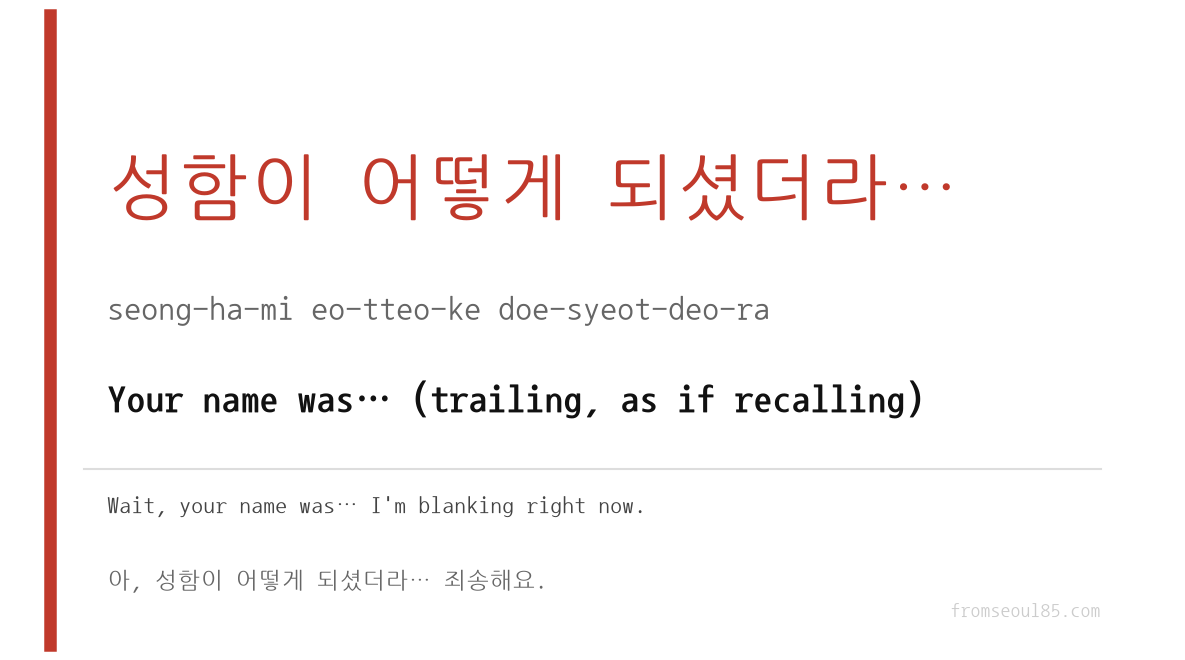
제가 깜빡했는데요 (je-ga kkam-ppak-haen-neun-de-yo — I had a brain-blank)
Ha, sorry, I just blanked for a second.
진짜 미안한데, 이름이 뭐였지? (jin-jja mi-an-han-de, i-reum-i mwo-yeot-ji — I’m really sorry, what was your name again? (casual))
I’m really sorry, what was your name again?
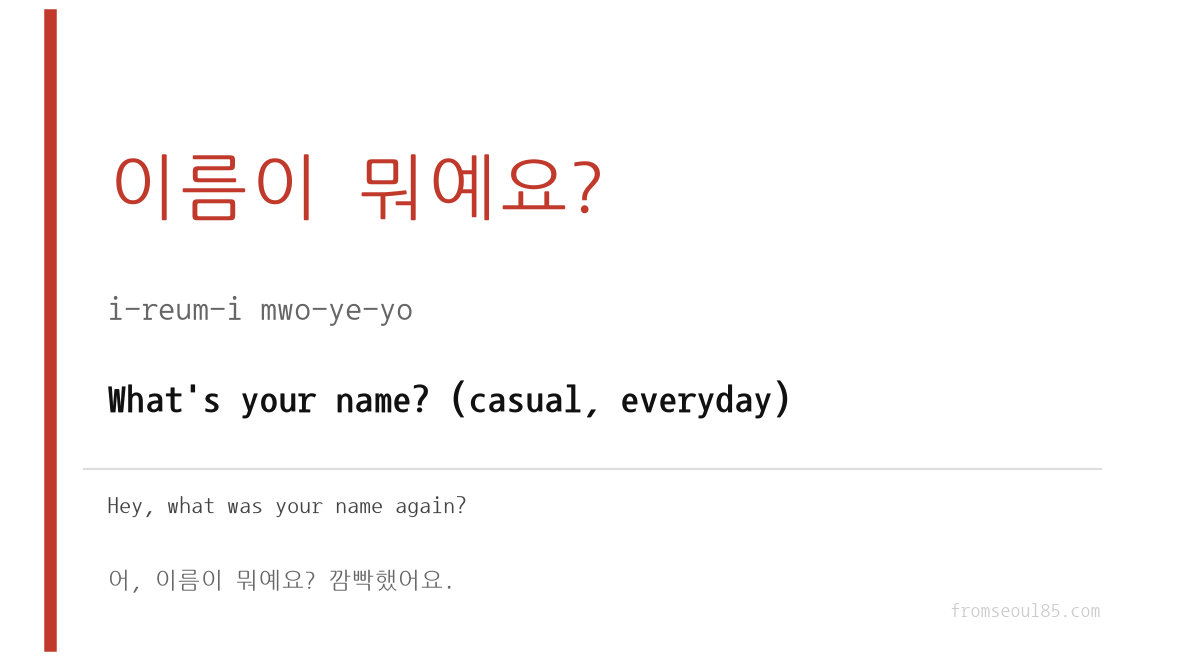
이름이 뭐예요? (i-reum-i mwo-ye-yo — What’s your name? (casual, everyday))
Hey, what was your name again?
Written by a native Korean speaker born in Seoul in 1985. This is my personal experience. Other Koreans may see things differently.