You are at a work dinner, or a night out with friends. The mood is still going strong. But you need to go home. In English, “I have to head out” comes easily. In Korean, that same moment can freeze you. You worry about seeming rude. You worry about breaking the mood. So you sit there and wait for a gap that never comes. Learning how to leave a gathering early in Korean removes that fear. Leaving early is not a taboo here. What matters is how you say it. Korean gatherings have a quiet rhythm. Once you learn a few natural phrases, an awkward exit becomes a smooth, respectful goodbye. In my experience, the words themselves are simple. The timing and tone do most of the work.
Leaving a work dinner: “먼저 들어가보겠습니다”
At a 회식 (hoe-sik — a company dinner), the rules feel heavier. Someone senior is usually at the table. You cannot just wave and walk out. The phrase I actually use is 먼저 들어가보겠습니다 (meon-jeo deu-reo-ga-bo-ge-sseum-ni-da — I will head home first).
들어가다 (deu-reo-ga-da) literally means “to go in.” Koreans use it to mean “go home.” And 먼저 (meon-jeo — first, ahead of others) is the polite heart of the phrase. It quietly admits you are leaving before everyone else. That small acknowledgment is what makes it feel respectful, not abrupt.
Here is how it plays out for me. First, I go to the most senior person at the table. In a quiet, one-on-one moment, I tell them something came up and I need to go. I say sorry, and I promise to stay to the end next time. It sounds like this: “제가 오늘 일이 있어서 먼저 들어가봐야 할 것 같습니다. 죄송합니다. 재밌게들 노시고 내일 뵙겠습니다.” Then I do the same with my team lead or direct senior. I do not announce it to the whole room. I handle it person to person, starting from the top.
If the senior is someone I am closer to, I add a small offer first. I ask if they still have a lot of work, or if they need a hand. If they say it is fine, then I say I will head out. That extra beat feels natural, not stiff.
Leaving a night out with friends: “나 먼저 갈게”
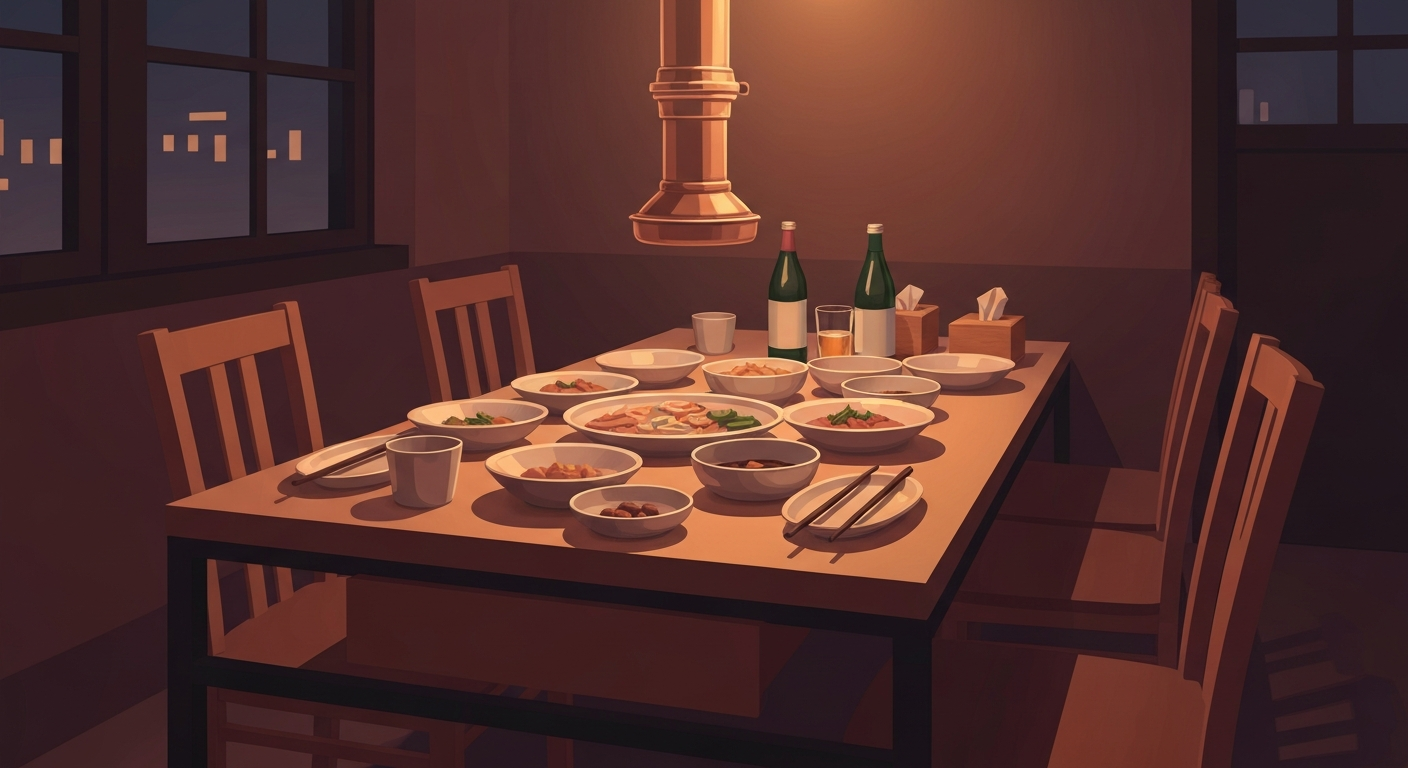
With close friends, formal phrases feel too heavy. Here, Koreans just say 나 먼저 갈게 (na meon-jeo gal-ge — I am gonna head out first). Short, warm, and honest. No ceremony needed. The difference between this and the work phrase is really a difference in Korean speech levels — casual with friends, polite with seniors.
For friends, timing matters more than the exact words. I usually wait for a natural break. When the first round (1차, il-cha) is wrapping up, that is a clean moment to say I am leaving. Or if we move to a second spot (2차, i-cha), I say it early — before the food even arrives — then stay a short while and slip out.
I almost always give my reason. I tell them why I am heading home, say bye, and go. If you want it softer, add 미안 (mi-an — sorry, my bad) at the front: 미안, 나 먼저 갈게. Friends often say “stay a little longer.” That is normal. If you really have to go, just say sorry, promise to see them soon, and leave. It reads as closeness, not rudeness.
Always add a short reason
Whatever phrase you pick, a small reason helps. Koreans tend to soften an early exit with a quick “why.” You do not need a long story. One line is plenty.
The ones I lean on: 아이가 있어서요 (a-i-ga i-sseo-seo-yo — I have a kid at home) and 집이 멀어서요 (ji-bi meo-reo-seo-yo — I live far away). 내일 아침 일찍 있어서요 (nae-il a-chim il-jjik i-sseo-seo-yo — I have something early tomorrow morning) works too.
The -서요 (-seo-yo) ending is doing quiet work here. It turns a flat statement into something like “the thing is, because…” In Korean, trailing off with a reason feels polite, not like a hard excuse. For example, “아이가 있어서 먼저 들어갈게” lands softly. The other person just nods. They understand you mean you are heading home, and they let it go. Honestly, sometimes the real reason is that I am simply tired. But saying that out loud feels a bit off, so a simple, believable reason does the job.
The phrase that does NOT mean “I am leaving”
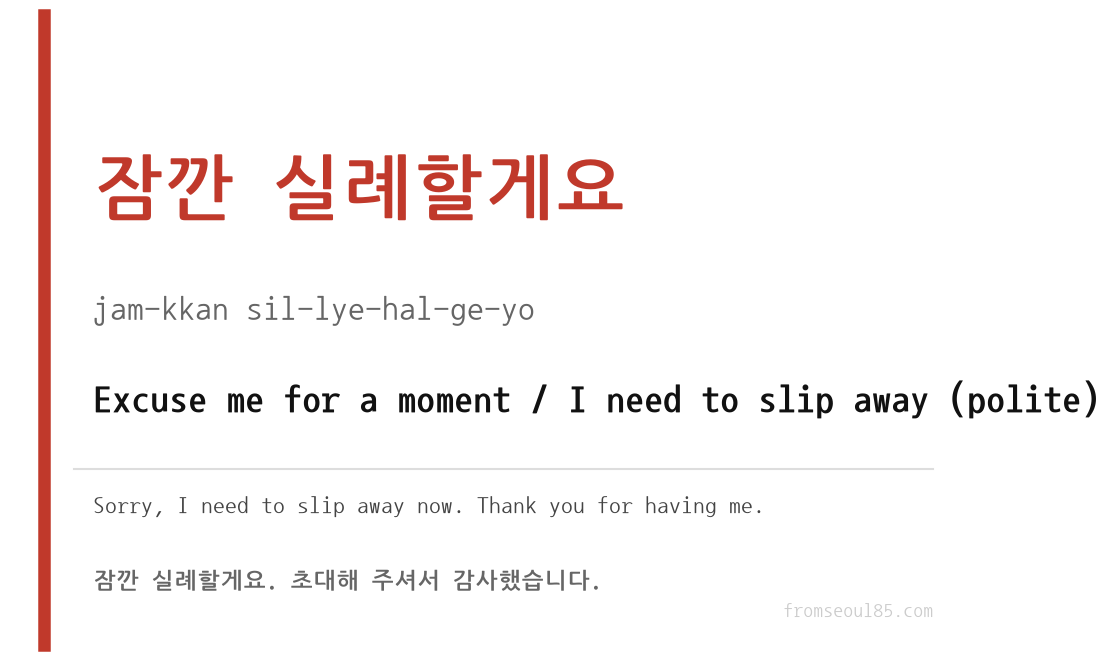
Here is one thing many textbooks get wrong. You might read that 잠깐 실례할게요 (jam-kkan sil-lye-hal-ge-yo — excuse me for a moment) is how you leave a gathering. In my experience, it is not. This is my personal experience, and other Koreans may see it differently.
잠깐 실례할게요 means you are stepping away for a second — like going to the restroom, or squeezing past people in a crowd. It also fits when you enter someone’s home. It is for a short break, not for going home for good. If I used it to leave a dinner, it would sound a little strange.
When you actually leave, a “let me say goodbye first” phrase fits better than an “excuse me” phrase. So reach for 먼저 들어가보겠습니다 or 먼저 인사드릴게요 (meon-jeo in-sa-deu-ril-ge-yo — let me say goodbye first), not 잠깐 실례할게요. That one small swap makes you sound much more natural.
Do not just disappear
One thing to avoid: do not vanish without a word. In Korean gatherings, the silent exit can feel abrupt. It feels worse when seniors or older guests are present. Korean goodbye culture leans on a quick word and a small bow. For more on why this formality carries so much weight, see my post on Korean workplace and drinking culture.
My own rule is simple. At a work dinner, I must tell the most senior person, no matter what. After that, I tell my team lead or mentor. Those two goodbyes are the line I do not cross. Skipping them feels wrong to me.
There is one exception. If I am truly drunk — the kind where I barely remember the night — I might just grab a taxi and go. People understand that. But if I am clear-headed, I say goodbye properly.
With friends, it is looser. Some people do slip away quietly. If someone vanishes, we might call to check on them. If they pick up and say they went home, we just say okay. If they do not answer, we assume they got home safe and leave it. However, even then, a quick text later — “먼저 갔어, 미안~” — is the kind, Korean thing to do.
Also, do not over-explain. A long, dramatic reason can make it a bigger deal than it needs to be. Keep it short. One reason, one phrase, one small bow.
A few tips for leaving a gathering early in Korean
So, how do you leave a gathering early in Korean without the stress? Match the phrase to the setting. Use 먼저 들어가보겠습니다 for work and for seniors. Use 나 먼저 갈게 with close friends. Add a short reason with -서요. Say goodbye to the most senior person first. And skip 잠깐 실례할게요 when you actually mean “I am going home.” Do that, and your exit will feel easy and natural. That said, every table is a little different. Read the room, and you will be fine.
Key Expressions
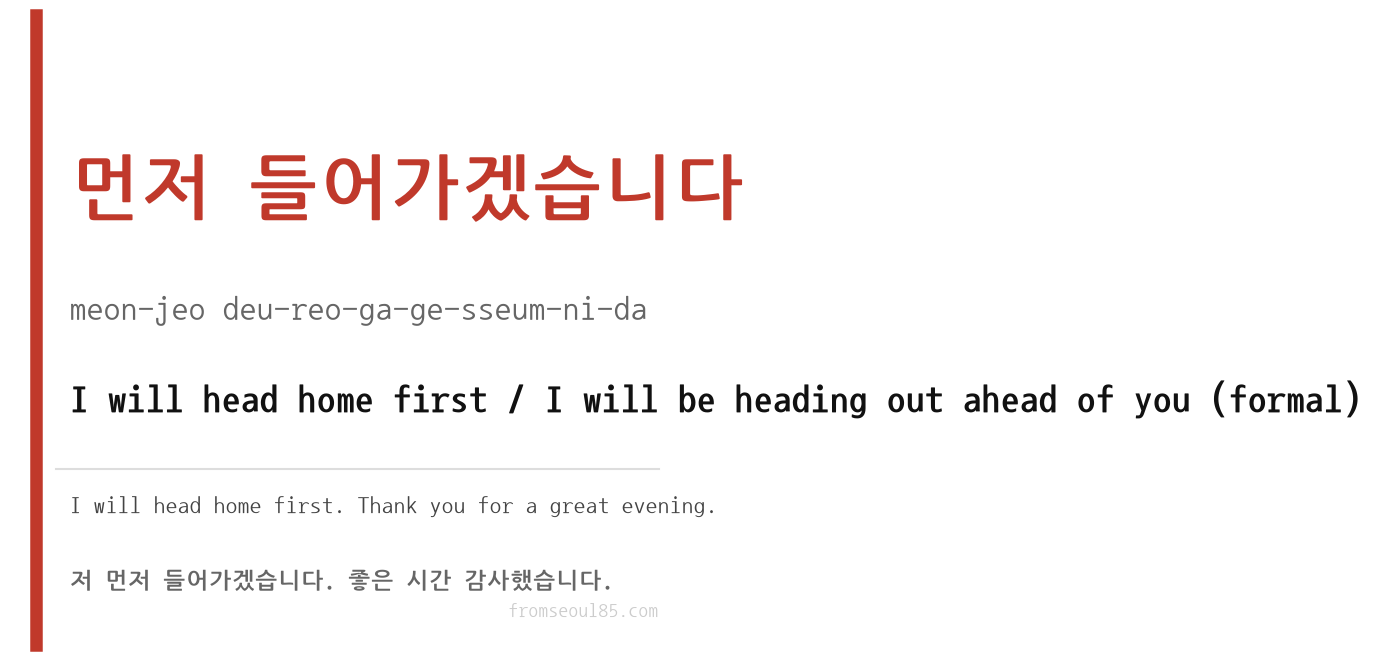
먼저 들어가겠습니다 (meon-jeo deu-reo-ga-ge-sseum-ni-da — I will head home first (formal, for work and seniors))
I will head home first. Thank you for a great evening.
저 먼저 들어가겠습니다. 좋은 시간 감사했습니다.
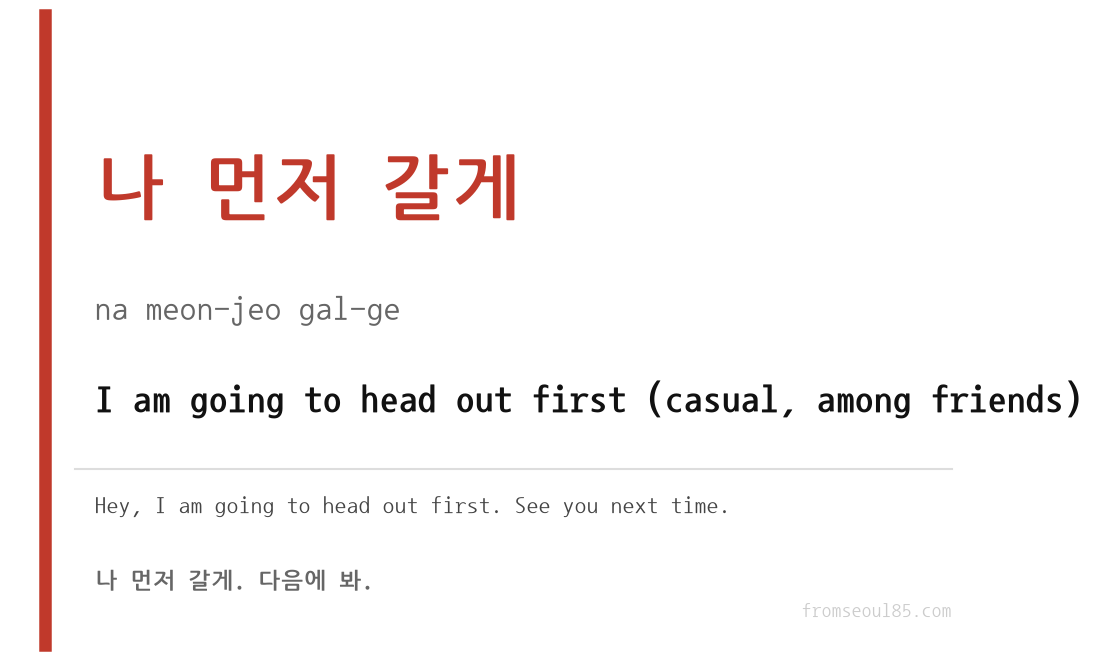
나 먼저 갈게 (na meon-jeo gal-ge — I am gonna head out first (casual, among friends))
Hey, I am gonna head out first. See you next time.
나 먼저 갈게. 다음에 봐.
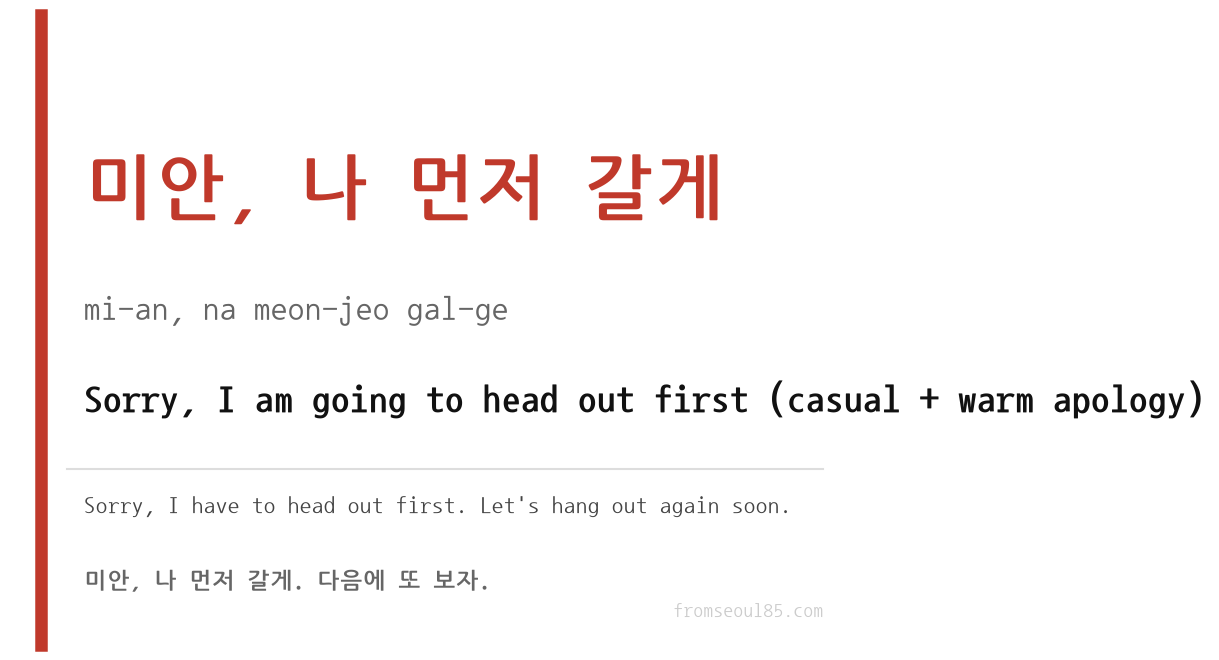
미안, 나 먼저 갈게 (mi-an, na meon-jeo gal-ge — Sorry, I am gonna head out first (casual, with a warm apology))
Sorry, I have to head out first. Let’s hang out again soon.
미안, 나 먼저 갈게. 다음에 또 보자.
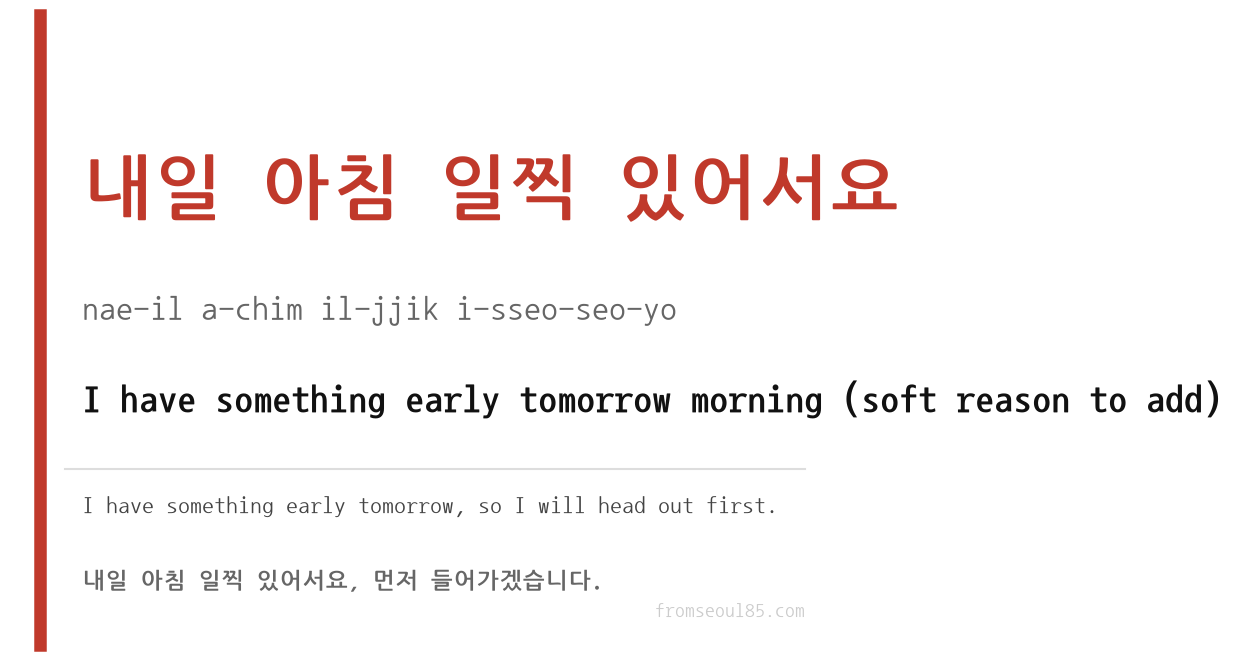
내일 아침 일찍 있어서요 (nae-il a-chim il-jjik i-sseo-seo-yo — I have something early tomorrow morning (a soft reason to add))
I have something early tomorrow, so I will head out first.
내일 아침 일찍 있어서요, 먼저 들어가겠습니다.
잠깐 실례할게요 (jam-kkan sil-lye-hal-ge-yo — Excuse me for a moment (stepping away briefly — NOT for leaving for good))
Excuse me for a moment, I will be right back.
잠깐 실례할게요. 금방 올게요.
Written by a native Korean speaker born in Seoul in 1985. This is my personal experience. Other Koreans may see things differently.