
You are standing at a bus stop in Seoul. The screen above you says your bus is fifteen minutes late. People around you start sighing. Someone mutters something under their breath. You want to react too, but you freeze, because you don’t know what fits this small moment. If you’re learning how to talk about a delayed bus in Korean, this happens to almost every learner sooner or later. The good news is, you only need a few phrases to sound natural. This post shares real ones Korean people actually use, including my own habits when I’m the one stuck waiting. This is my personal experience. Other Koreans may see it differently.
In my experience, the subway is usually on time, since there’s no traffic to slow it down. During rush hour, more trains run, so I don’t wait too long. But some lines cause a different kind of problem. On Line 1 or Line 7, for example, a train can be heading to a stop short of where I actually need to go. I have to get off in Incheon, but if the train pulling in only goes as far as Onsu, I just let it pass and wait for the next one. Buses are a different story. Traffic can slow them down a lot, so before I leave the house, I check an app for the arrival time and plan my walk around it. Korea makes this fairly easy. You can check bus and subway arrival times on an app, and most stops have a screen showing how many minutes are left. Because of that, I don’t worry about delays too much anymore.

Aa Jinjja: What Koreans Mutter When the Bus Won’t Come
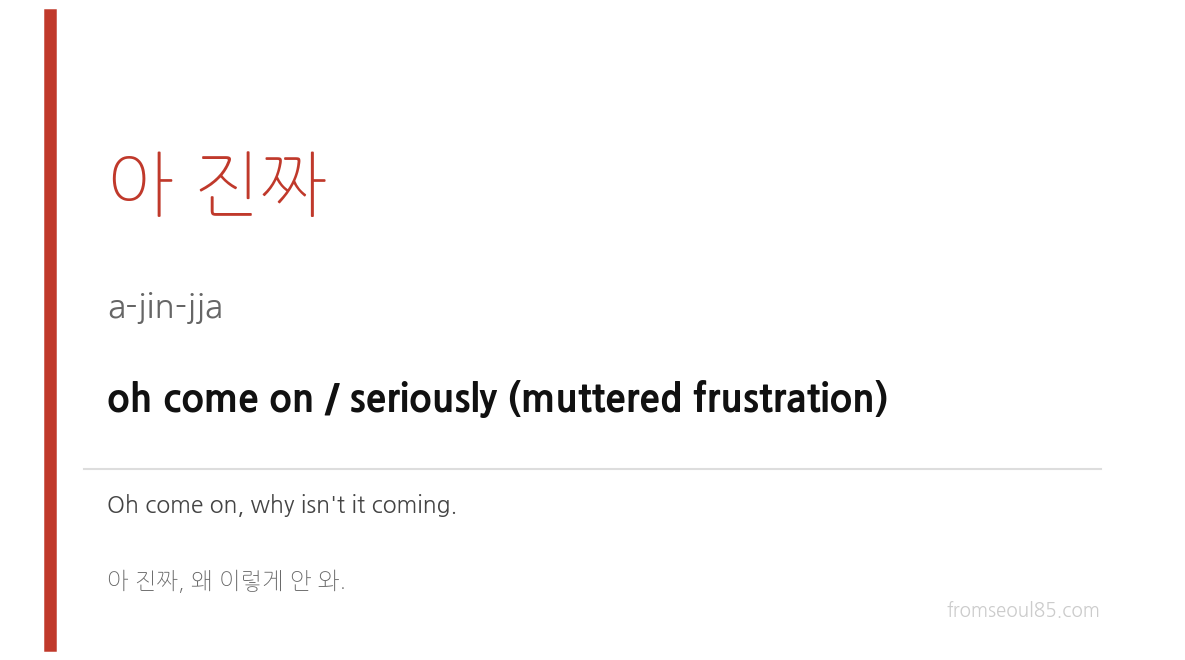
The first phrase you’ll hear at a bus stop is 아 진짜 (a-jin-jja — “oh come on” or “seriously”). People mutter it to themselves, not to anyone in particular. It sounds casual, almost like a sigh with words attached. You can say it even around strangers, and nobody will think you’re rude, because it isn’t aimed at any one person. It’s more like letting a little pressure out loud.
A short example: 아 진짜, 왜 이렇게 안 와 (a-jin-jja, wae i-reo-ke an wa — “oh come on, why isn’t it coming”).
For me, 아 진짜 isn’t only a bus-stop phrase. I say it when it’s too hot or too cold outside. I say it when I spill water by accident, too. I also say it when I walk into the kitchen wondering what to eat, or when I turn on the TV wondering what to watch. It’s less about the bus and more about a small burst of feeling, whatever the cause happens to be.
Wae Ireoke An Wa: Saying What Everyone Is Thinking
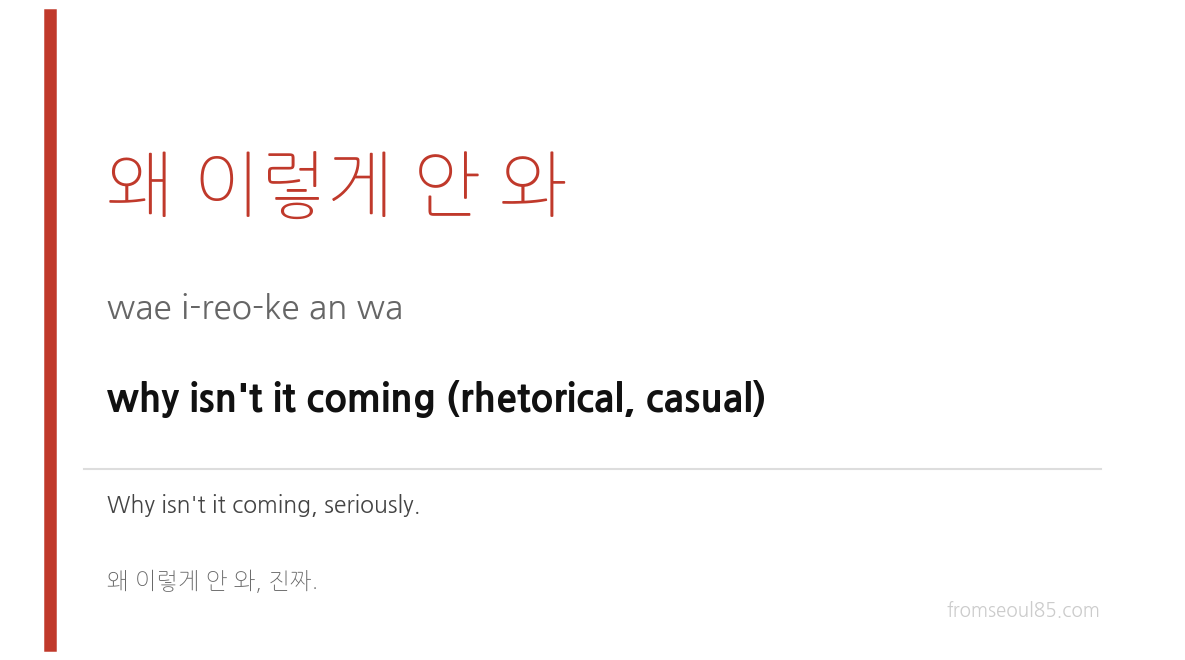
Another common line is 왜 이렇게 안 와 (wae i-reo-ke an wa — “why isn’t it coming”). It’s a rhetorical question. You’re not really asking anyone. You’re just saying what everyone at the stop is already thinking. It’s casual, so it fits with friends or under your breath, not really with strangers.
A softer version is 왜 이렇게 안 오지 (wae i-reo-ke an o-ji), which sounds more like thinking out loud than complaining. You wouldn’t say either version straight to a stranger’s face. It’s more for yourself, or for a close friend standing right next to you.
When I’m waiting with a friend, this comes up a lot, especially when the weather makes things worse. We might say 아씨 너무 추운데 (a-ssi neo-mu chu-un-de — “ugh, it’s so cold”) or 너무 더운데 (neo-mu deo-un-de — “it’s so hot”), then add 왜 이렇게 안 오냐 (wae i-reo-ke an o-nya) right on top. It’s less about the bus itself and more about being uncomfortable while we wait for it.
Asking a Stranger: Myeot Bun Namasseoyo
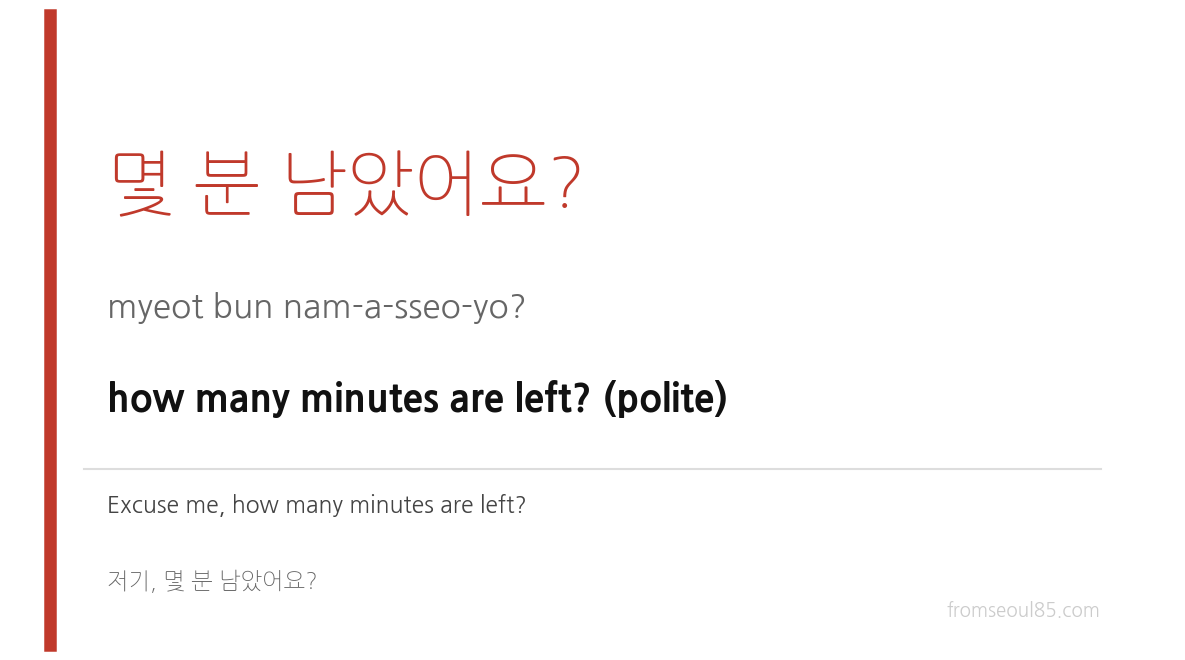
Sometimes you actually want to ask someone, not just mutter to yourself. 몇 분 남았어요? (myeot bun nam-a-sseo-yo — “how many minutes are left?”) works well here. It’s polite, with the -요 ending, so it’s safe to use with strangers. You might ask someone checking a transit app on their phone, or a station worker directly.
In my experience, the people who ask this most often are older adults. They’ll ask if a certain bus goes where they need, or which number to look for. The arrival board technically shows this information, but the text is small and there’s a lot on the screen, so I think it’s genuinely hard to find at a glance. When someone asks me, I usually check the board myself, or look it up on my phone, and just tell them what I see.
Bonding Over a Shared Delay
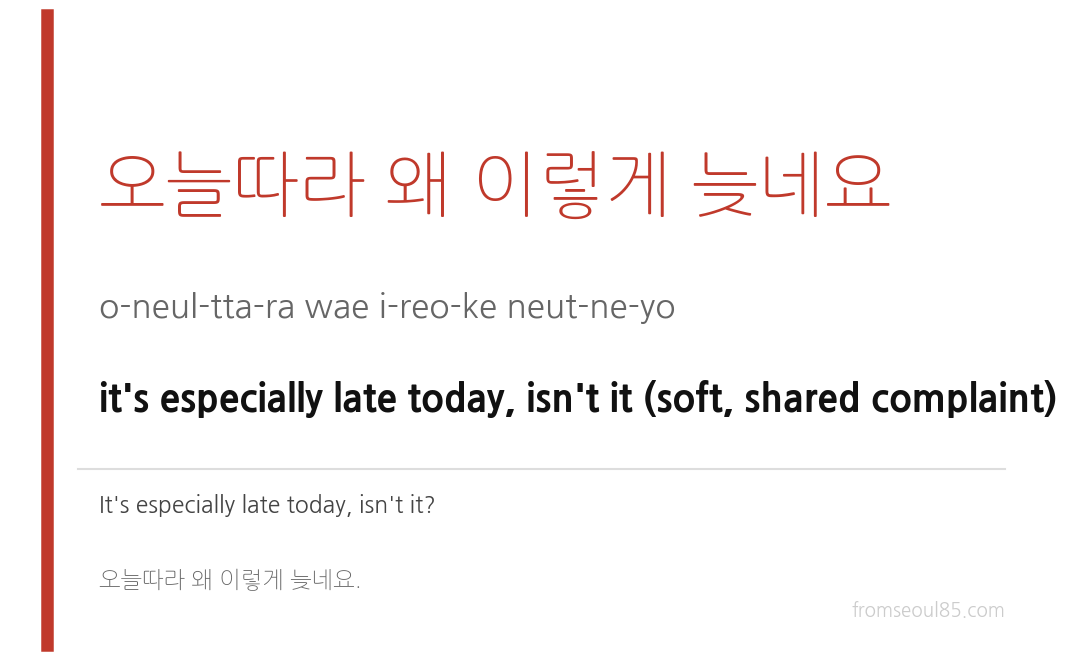
There’s also a softer way to connect with a stranger nearby. 오늘따라 왜 이렇게 늦네요 (o-neul-tta-ra wae i-reo-ke neut-ne-yo — “it’s especially late today, isn’t it”) works well here. The -네요 ending softens it into a shared observation instead of a complaint. It doesn’t blame anyone. It invites a small nod, or a quiet 그러게요 (geu-reo-ge-yo — “true, right”) in return.
Honestly, though, I should be straightforward about this. I’ve almost never seen strangers actually start a conversation this way at a bus stop. What I see more often is people apologizing with 죄송합니다 (joe-song-ham-ni-da) or bowing slightly if they bump into someone in a crowd. Outside of that, most Koreans stay quiet around people they don’t know. So treat this phrase as something that could work, and it does fit the culture if you ever try it, but don’t expect a stranger to start small talk with you first.
What Not to Say When the Bus Finally Arrives
One thing to avoid: don’t aim your frustration at a person. When the bus finally shows up, don’t say 왜 이렇게 늦었어요? (wae i-reo-ke neut-eo-sseo-yo — “why were you so late?”) straight to the driver. That can come across as a direct attack.
I don’t think getting angry at a city bus driver really makes sense, since it’s not like the driver chose to be late. It feels disrespectful to blame someone for something outside their control. That said, I see it a bit differently for intercity buses that leave on a fixed schedule. If one of those is late, a passenger has a real reason to be upset, because the departure time was promised in advance. Even then, I don’t think yelling at the driver is right. I don’t know exactly what the passenger said in a case like that, but a driver losing his temper back isn’t good either. I’d call that one extreme case, not the normal picture of how Koreans handle a late bus.

Key Expressions
- 아 진짜 (a-jin-jja) — oh come on / seriously (muttered frustration). Example: 아 진짜, 왜 이렇게 안 와. (“Oh come on, why isn’t it coming.”)
- 왜 이렇게 안 와 (wae i-reo-ke an wa) — why isn’t it coming (rhetorical, casual). Example: 왜 이렇게 안 와, 진짜. (“Why isn’t it coming, seriously.”)
- 몇 분 남았어요? (myeot bun nam-a-sseo-yo?) — how many minutes are left? (polite). Example: 저기, 몇 분 남았어요? (“Excuse me, how many minutes are left?”)
- 오늘따라 왜 이렇게 늦네요 (o-neul-tta-ra wae i-reo-ke neut-ne-yo) — it’s especially late today, isn’t it (soft, shared complaint). Example: 오늘따라 왜 이렇게 늦네요. (“It’s especially late today, isn’t it?”)
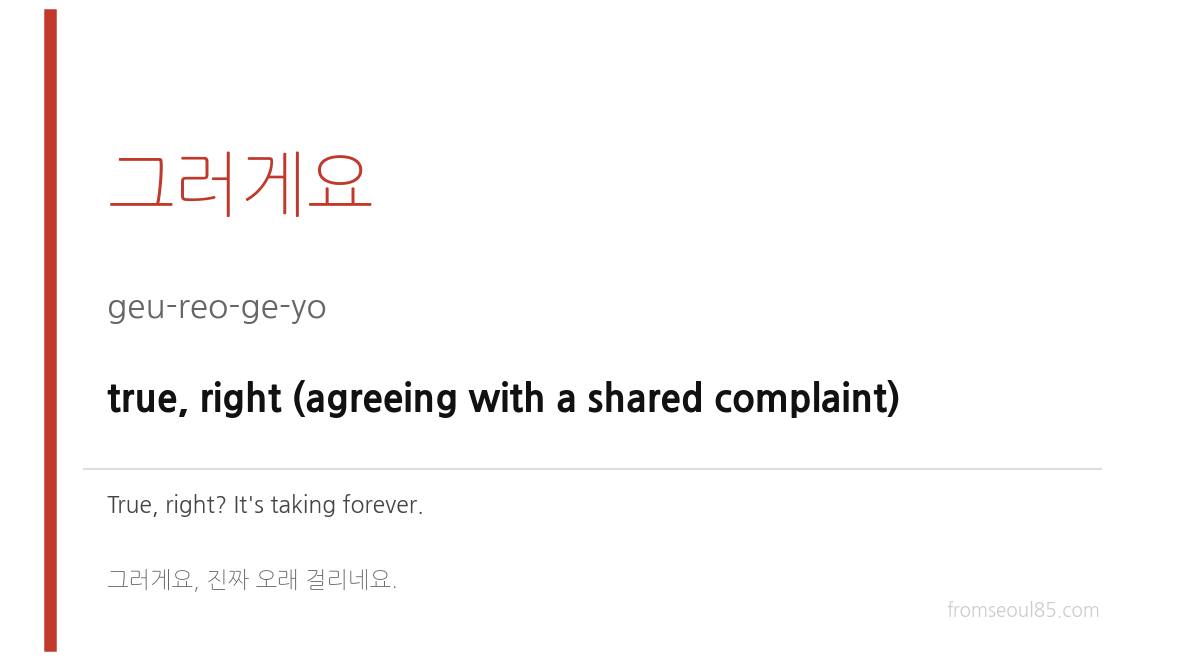
- 그러게요 (geu-reo-ge-yo) — true, right (agreeing with a shared complaint). Example: 그러게요, 진짜 오래 걸리네요. (“True, right? It’s taking forever.”)
A couple of practical tips before you go stand at a bus stop yourself. First, use a Korean transit app and check the countdown timer instead of guessing how long you’ll wait. Second, save 아 진짜 for yourself, and save 몇 분 남았어요 for the moment you actually need help from someone nearby. That mix will get you through almost any delay without sounding awkward or too formal. If you want more ways to react naturally in everyday situations, this guide on how to express emotions in Korean without sounding textbook is a good next read. For background on how the -요 ending works as part of Korean’s polite speech level, this overview of Korean speech levels is worth a look.
Written by a native Korean speaker born in Seoul in 1985. This is my personal experience. Other Koreans may see things differently.