You get into a taxi in Seoul. The driver glances back and says something friendly. Your mind goes blank. You know basic Korean, but taxi driver small talk in Korean feels different from textbook dialogue. It moves fast and jumps between random, everyday topics. This freeze happens to almost every learner at some point. The good news is that taxi small talk follows a small set of patterns. Learn a few phrases, and you can relax through the ride.
Why Taxi Small Talk Feels Different Now
Honestly, thinking about it, drivers rarely start a conversation these days. Some still do, but if I don’t feel like talking, I just say 네네 (ne-ne, “yeah yeah”) and let it drop. Or I look at my phone before the driver even says anything, which is its own kind of signal that I don’t want to chat. When a driver does start talking, it’s usually not because they need something from you. It’s mostly small talk to pass the time on the drive, not a meaningful conversation. Keeping that in mind takes the pressure off. You don’t need a deep answer. You just need a few small tools.

Backchanneling: Your Easiest Tool
The easiest tool for taxi small talk is backchanneling. You don’t need long answers. Short reactions keep the chat moving without much effort. Use 네, 맞아요 (ne, ma-ja-yo) to simply agree. It means “yes, that’s right.” Try 아 그러세요? (a geu-reo-se-yo) when you’re mildly surprised. It means “oh, is that so?” Both phrases buy you time to think.
If a driver says something like “it’s really hot these days, right?”, I usually answer with 그러게요 (geu-reo-ge-yo). It’s a natural response. Other times I say 네 덥네요 (ne, deop-ne-yo, “yeah, it’s hot”) or 너무 더워요 (neo-mu deo-wo-yo, “it’s so hot”). But here’s the thing about 그러게요. It’s not that I don’t want to talk. If I only say it and stop there without adding anything, the conversation naturally cuts off. It doesn’t feel rude, it just quietly ends the topic.

Talking About Traffic
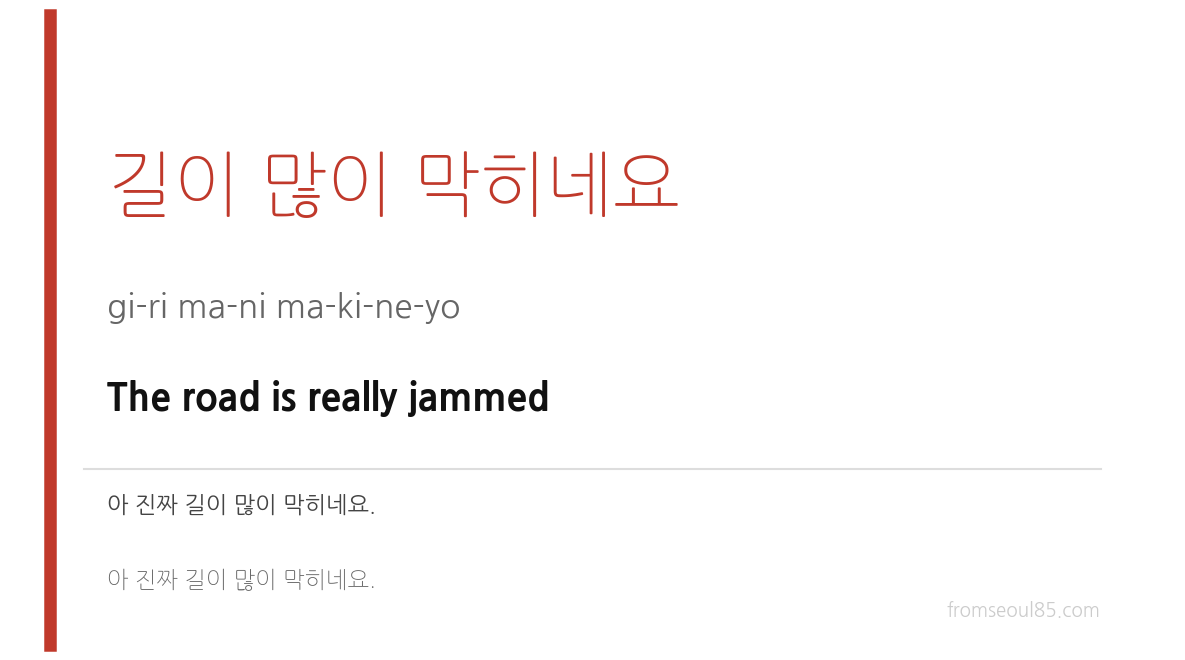
Traffic is a very common taxi small talk topic. Drivers often say 길이 많이 막히네요 (gi-ri ma-ni ma-ki-ne-yo). It means “the road is really jammed.” You can simply agree: 네, 그러네요 (ne, geu-reo-ne-yo). That means “yeah, it really is.” If traffic is light, try 오늘은 안 막히네요 (o-neu-reun an ma-ki-ne-yo). That means “today it’s not jammed.”
I don’t think this is always pure small talk, though. When a driver says the road is jammed, I think they’re often just describing the situation out loud. The meter keeps running but the car isn’t moving, so maybe they feel a little awkward about that in front of the passenger. It can feel like they’re saying, “I want to get there fast too, but look how bad the traffic is.” It might be a real complaint more than chit-chat. And sometimes a driver brings up the traffic first, then keeps talking about other things afterward, almost like the traffic comment is just the door they use to start a longer chat.
Answering “Where Are You From?”
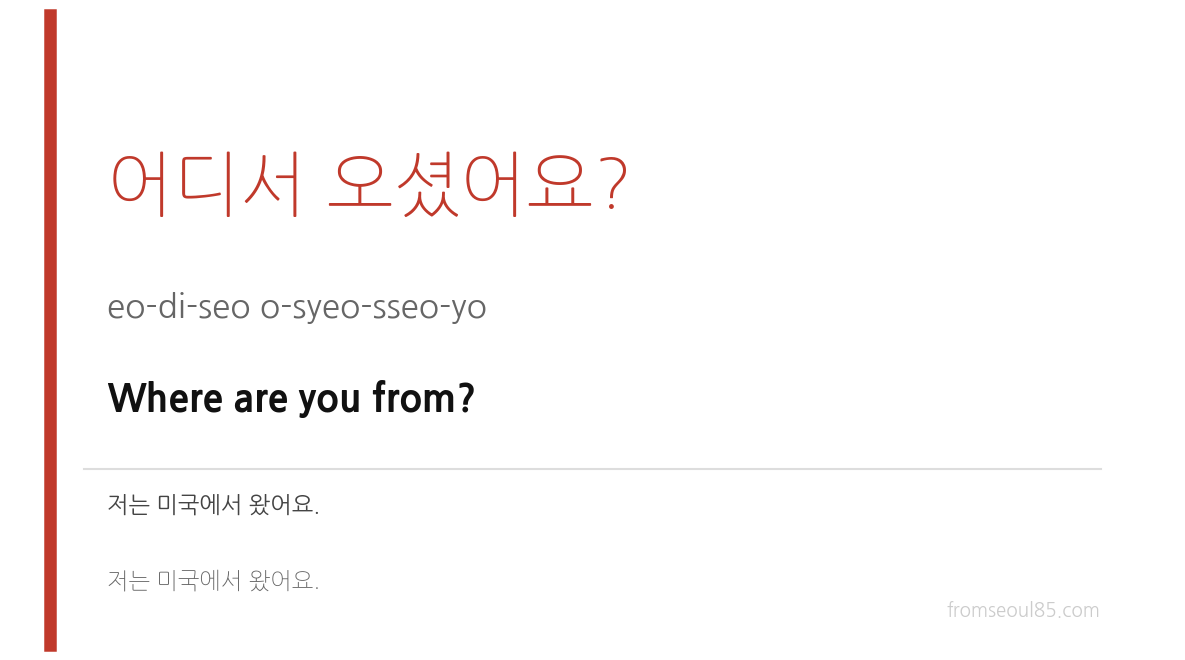
Drivers sometimes get curious about foreign passengers. This is one part of Korean phrases for taxi conversation that comes up a lot for visitors. They may ask 어디서 오셨어요? (eo-di-seo o-syeo-sseo-yo). It means “where are you from?” Answer simply: 저는 미국에서 왔어요 (jeo-neun mi-gu-ge-seo wa-sseo-yo). That means “I’m from the United States.” If you’re traveling, add 여행 왔어요 (yeo-haeng wa-sseo-yo). That means “I came for travel.”
In my experience, this question comes up more from drivers outside Seoul. If you get picked up at a bus terminal, or in a region where people speak a strong local dialect, and you don’t sound like a local at all, the driver might guess you’re not from around there. So if you’re a foreigner speaking Korean, it makes sense that a driver would naturally ask this. It’s less about being nosy and more about simple curiosity.
Getting In and Out Politely
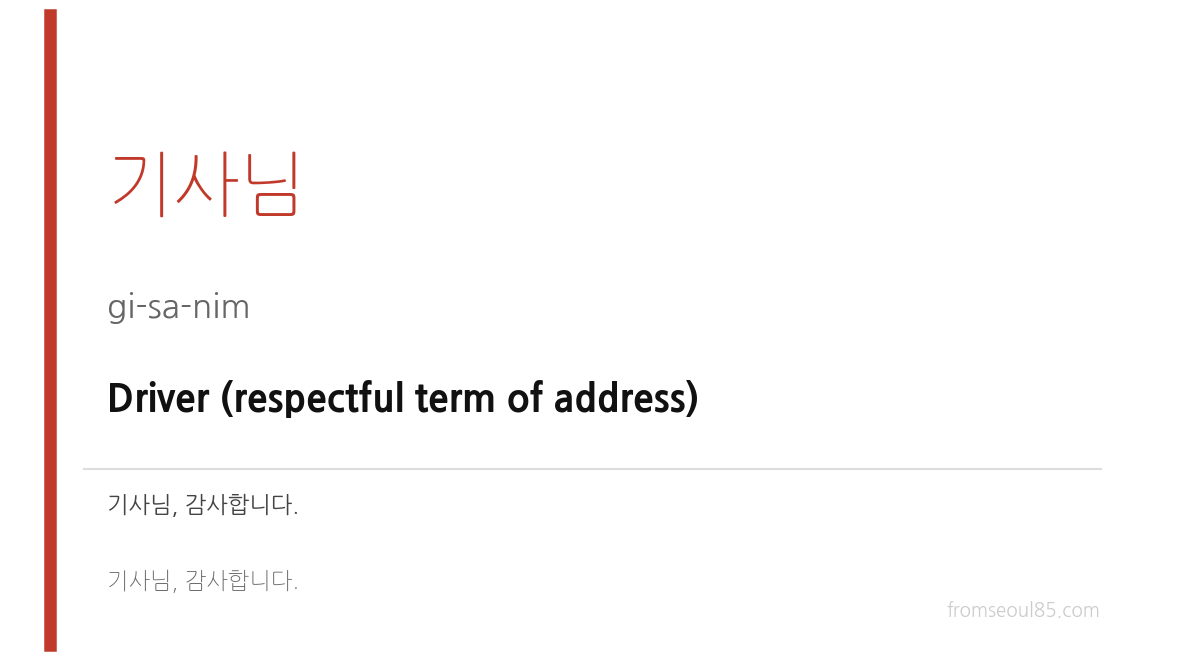
Every taxi ride ends with a short exchange too. Address the driver as 기사님 (gi-sa-nim). It’s respectful and roughly means “driver” or “sir.” This is one of the first things learners ask about, since gi-sa-nim meaning isn’t obvious from a dictionary alone. It’s a title of respect, not a name, and it works for any driver regardless of age.
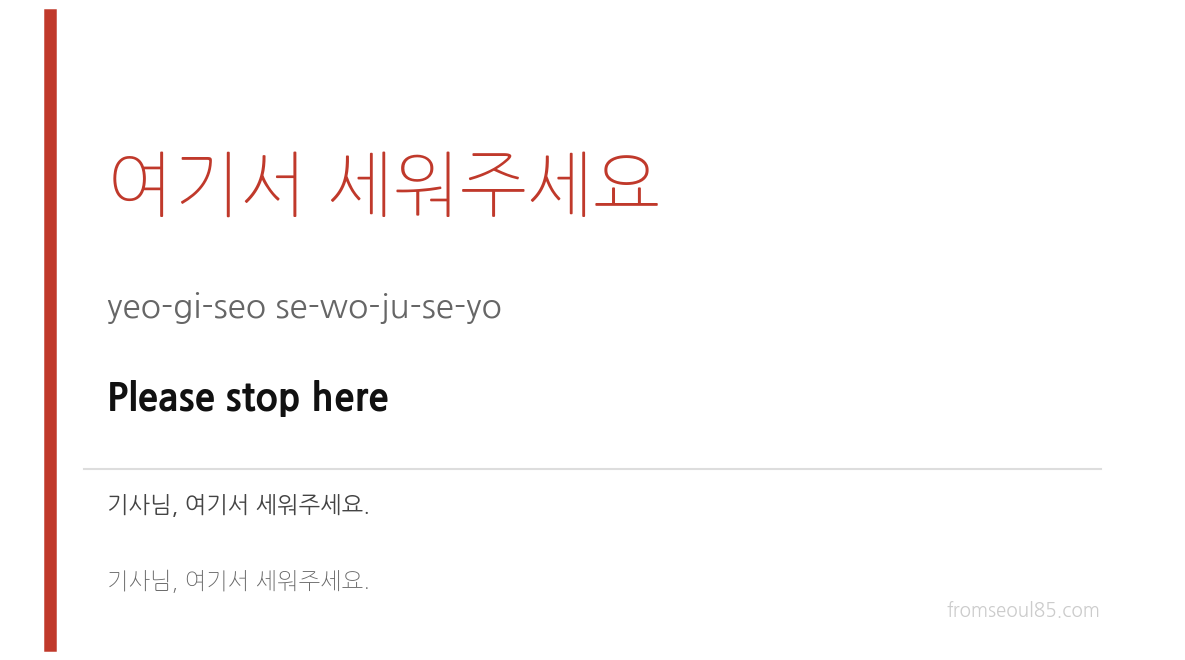
When you’re close to your stop, say 여기서 세워주세요 (yeo-gi-seo se-wo-ju-se-yo). That means “please stop here.” You might also hear or say 여기서 내릴게요 (yeo-gi-seo nae-ril-ge-yo). To me these feel almost the same. 세워주세요 focuses on asking the driver to stop the car, while 내려주세요 leans more toward “let me get off here,” but in practice they land in the same spot. These days a lot of people call a taxi through an app and set the drop-off point in advance, so this exchange happens less than before. Even so, when I get close to my stop, I still tell the driver directly, 기사님 저기서 내릴게요 (gi-sa-nim jeo-gi-seo nae-ril-ge-yo, “driver, I’ll get off over there”). Before leaving, add 감사합니다 (gam-sa-ham-ni-da), thank you. A polite goodbye leaves a good final impression.
What Not To Do, and a Few Culture Notes
One common mistake is switching to 반말 too soon. 반말 (ban-mal) is casual speech used between close friends. Drivers are usually older than the passenger, so sticking with polite 요 endings is the safer choice. If you want to understand the full picture of when each style fits, our guide on 반말 vs 존댓말 covers it in more detail. You can also read more about Korean speech levels on Wikipedia if you want the wider grammar background.
Another myth is that you must keep talking the whole ride. Silence is completely fine if you’re tired or busy. A short 네 (ne) or a small smile can end the chat without any awkwardness. Koreans don’t expect constant conversation from every passenger.
When I don’t feel like talking, I usually just say hello first, 안녕하세요 (an-nyeong-ha-se-yo), and then put in my earphones or look at my phone. If the driver still tries to chat after that, I answer in short replies instead of building the conversation further. It’s not rude. It’s just a normal way to keep the ride quiet.

Key Expressions
- 네, 맞아요 (ne, ma-ja-yo) — Yes, that’s right.
Example: 네, 맞아요, 요즘 진짜 덥네요. (“Yes, that’s right, it’s really hot these days.”) - 길이 많이 막히네요 (gi-ri ma-ni ma-ki-ne-yo) — The road is really jammed.
Example: 아 진짜 길이 많이 막히네요. (“Ah, the road is really, really jammed.”) - 어디서 오셨어요? (eo-di-seo o-syeo-sseo-yo) — Where are you from?
Example: 저는 미국에서 왔어요. (“I’m from the United States.”) - 여기서 세워주세요 (yeo-gi-seo se-wo-ju-se-yo) — Please stop here.
Example: 기사님, 여기서 세워주세요. (“Driver, please stop here.”) - 기사님 (gi-sa-nim) — Driver (respectful term of address).
Example: 기사님, 감사합니다. (“Driver, thank you.”)
A Few Practical Tips
You don’t need a big vocabulary for taxi driver small talk in Korean. A handful of short reactions and the five phrases above cover most rides. If you want to know what to say to a taxi driver in Korean and nothing more comes up, that’s normal too. Many rides end with just a greeting and a thank you.
If you’re not sure how to react to a question, start with 네 or 그러게요 and watch how the conversation moves from there. If you’d rather ride in silence, a polite hello followed by quiet is a completely normal choice in Seoul. For more everyday conversation patterns like this, check out our intermediate Korean phrase guides.
Written by a native Korean speaker born in Seoul in 1985. This is my personal experience. Other Koreans may see things differently.