If you spend any time listening to Korean conversations, you will probably hear someone say 어쩐지 (eo-jjeon-ji) right after a small mystery gets solved. The eojjeonji meaning in Korean is tricky, because English does not have one single word that covers it. Depending on the moment, it can mean “no wonder,” “I knew it,” or just “something felt off.” That flexibility is exactly what makes it confusing for learners. It is also exactly what makes it worth learning properly.
What Does Eojjeonji Mean in Korean?
I use eojjeonji almost every day. It usually pops out the second I find out the reason behind something I already noticed. For example, if a coworker tells me she was sick, I might say 어쩐지 오늘 얼굴이 안 좋아 보이더라 (eo-jjeon-ji o-neul eol-gu-ri an jo-a bo-i-deo-ra — no wonder you looked unwell today). It feels automatic, almost like a reflex, the moment a missing piece of information clicks into place.
That reflex quality is the heart of the eojjeonji meaning. You noticed something odd earlier. Later, someone hands you the missing fact. Eojjeonji is the word that connects those two moments out loud. If you want a broader linguistic view of how Korean sentence enders work like this, the Wikipedia entry on Korean grammar is a useful starting point.
No Wonder in Korean: When You Learn the Real Reason

Picture this. Your friend shows up late, completely out of breath. A few minutes later, you learn the subway broke down. Suddenly the whole delay makes sense. This is exactly when Koreans reach for eojjeonji.
In my own life, this situation comes up all the time. Casually, I just say 아 어쩐지~ (a eo-jjeon-ji) and let my voice trail off at the end. If I want to add more, I might say 어쩐지 좀 이상하다 했어 (eo-jjeon-ji jom i-sang-ha-da hae-sseo — I thought something felt a little off). With someone I need to speak politely to, I would say 아, 어쩐지 그러시더라고요 (a, eo-jjeon-ji geu-reo-si-deo-ra-go-yo — ah, no wonder that was the case).
None of these sentences translate word for word into “no wonder” in English. The Korean word for no wonder is really a whole pattern. You notice something. You learn the reason. Then you say eojjeonji to close the loop.
Eojjeonji Alone: The Korean Word for “I Knew It”
Sometimes you already had a hunch. Then that hunch turns out to be right. In that moment, Koreans often just say the word by itself.
For me, it comes out almost without thinking. I blurt out 어쩐지! (eo-jjeon-ji — I knew it!) the second I am proven right. Often I pair it with a friend’s reaction, something like 거봐, 어쩐지 (geo-bwa, eo-jjeon-ji — see, I told you, I knew it). When I need to speak more politely, I switch to 아, 역시 그랬던 거군요 (a, yeok-si geu-raet-deon geo-gun-nyo — ah, I see, that’s exactly why it happened).
This use case is really the Korean word for “I knew it,” and it works well because it is so short. You do not need a full sentence. One word carries the whole feeling of being right.
When Something Just Feels Off
There is a quieter use of eojjeonji, and it comes up less often. Sometimes something feels slightly wrong, but you do not know why yet. You might hear 어쩐지 느낌이 이상했어 (eo-jjeon-ji neu-kki-mi i-sang-hae-sseo — somehow it felt off). Here, eojjeonji overlaps a lot with 왠지 (waen-ji), another word that also means “somehow.” Honestly, I am not fully sure how younger Koreans draw the line here. I think usage shifts a bit from generation to generation.
Eojjeonji for a Surprising Skill

Eojjeonji also shows up when you learn the backstory behind a skill that impressed you. Say a coworker cooks a really good meal. Later you find out she trained as a chef. That is when the word comes out again.
I use this pattern a lot, honestly. If a friend draws something really well, I will say 어쩐지 잘 그리더라, 미대 나왔다며 (eo-jjeon-ji jal geu-ri-deo-ra, mi-dae na-wat-da-myeo — no wonder you draw so well, I heard you studied art). In a more polite setting, I just say 아 어쩐지 잘하시더라고요 (a eo-jjeon-ji jal-ha-si-deo-ra-go-yo — ah, no wonder you are so good at this).
Eojjeonji vs Waenji Meaning: What’s the Difference?
Many learners mix up eojjeonji (어쩐지) and waenji (왠지), and honestly, I do not blame them. Waenji usually means “for some reason,” used before you know why something happened. Eojjeonji is more often used after you learn the reason. It is a bit like the shift in feeling I described in my post about the gwaenhi meaning in Korean, where one small word carries a lot of context depending on timing.
I will be honest here. I do not split these two 100 percent cleanly myself. But by feel, once I know the reason, eojjeonji comes out more naturally. When I am just talking about a vague feeling with no explanation yet, waenji feels more natural on my tongue, like 오늘 왠지 느낌이 안 좋더라 (o-neul waen-ji neu-kki-mi an jo-a-deo-ra — somehow I had a bad feeling about today). If you mix these two up sometimes, do not worry too much. Native speakers blur the line too.
How to Use Eojjeonji in a Sentence
If you want a simple rule to start with, try this. First, notice something a little strange. Second, find out the reason later. Third, drop eojjeonji into your sentence right when the pieces connect. It can stand alone as 어쩐지! or lead into a fuller sentence like 어쩐지 요리를 잘하더라 (eo-jjeon-ji yo-ri-reul jal-ha-deo-ra — no wonder she cooks so well). For polite speech, just add the 시 and 라고요 endings, the way I did above with coworkers and people I am not close with.
One Thing to Watch Out For
Be a little careful with tone. Eojjeonji can sound smug if you say it too sharply right after someone shares bad news or admits a mistake. In my experience, keeping your voice soft, almost like you are talking to yourself, keeps it sounding natural instead of judgmental. This is just my personal read on it. Other Koreans might feel differently about how strong the word sounds.
Key Expressions
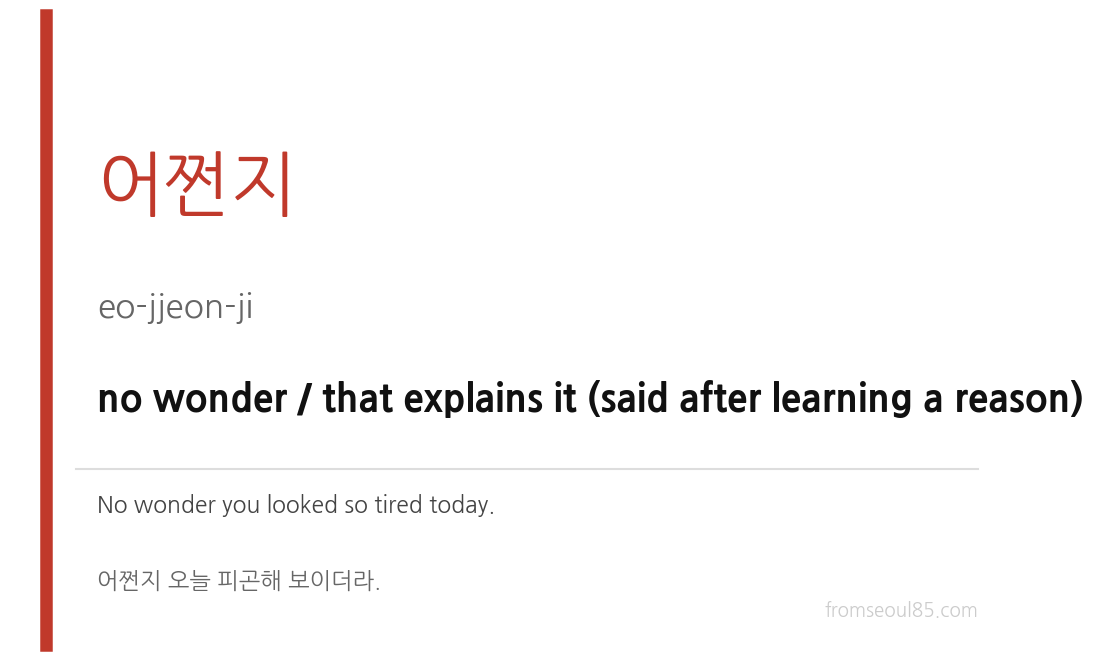 어쩐지 (eo-jjeon-ji) — no wonder / that explains it (said after learning a reason).
Example: 어쩐지 오늘 피곤해 보이더라. (No wonder you looked so tired today.)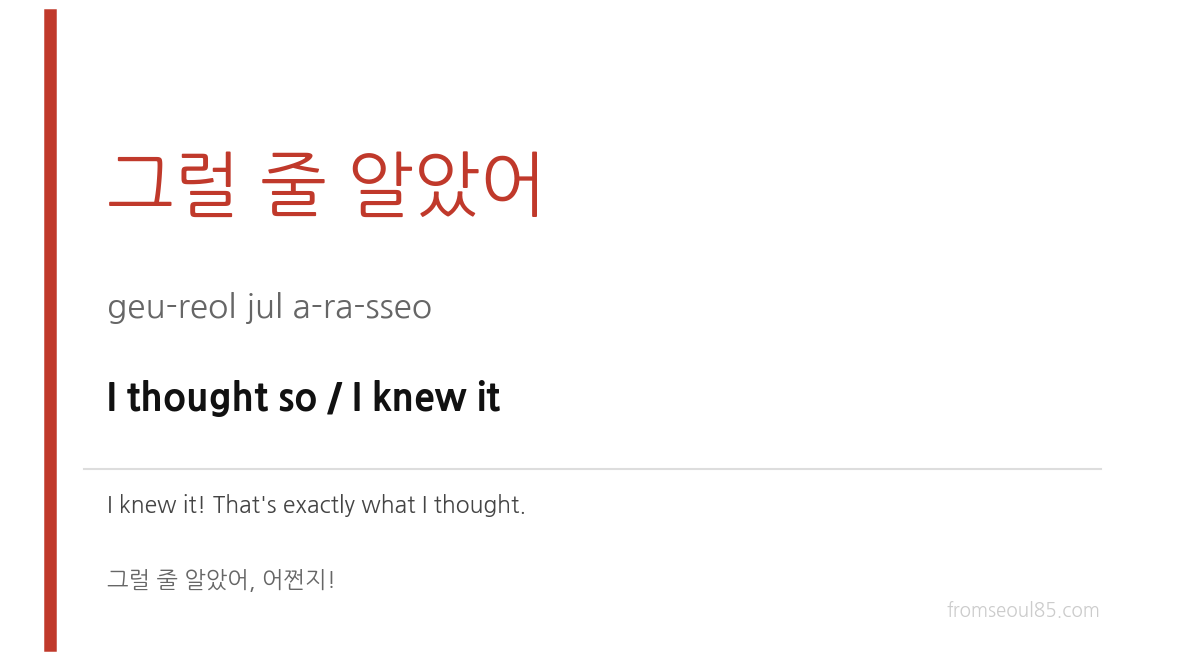 그럴 줄 알았어 (geu-reol jul a-ra-sseo) — I thought so / I knew it.
Example: 그럴 줄 알았어, 어쩐지! (I knew it! That’s exactly what I thought.)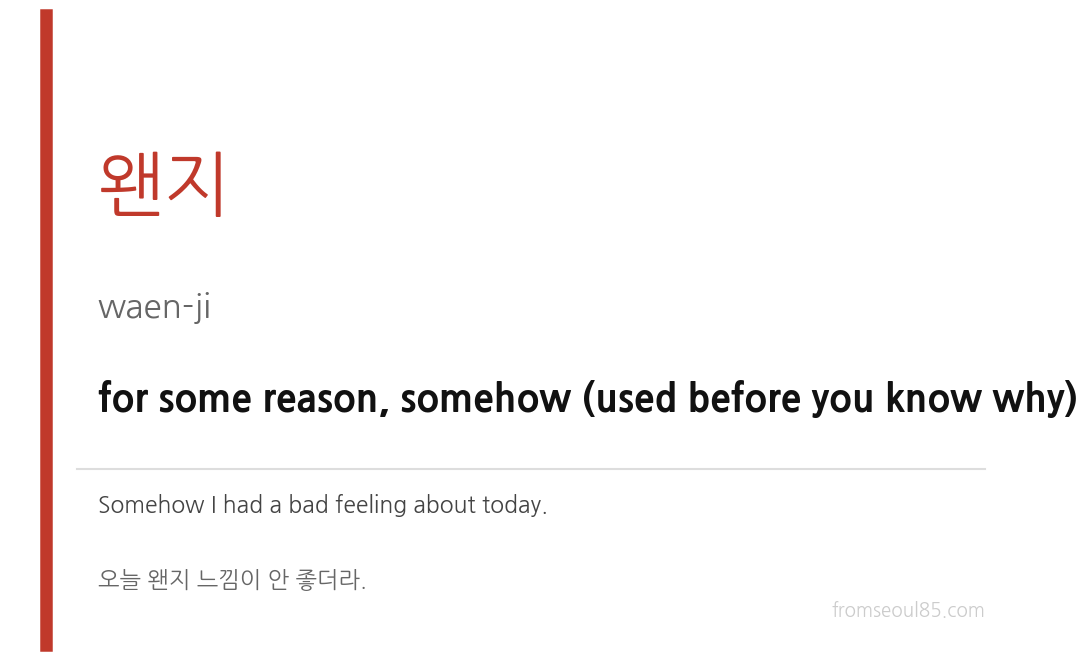 왠지 (waen-ji) — for some reason, somehow (used before you know why).
Example: 오늘 왠지 느낌이 안 좋더라. (Somehow I had a bad feeling about today.)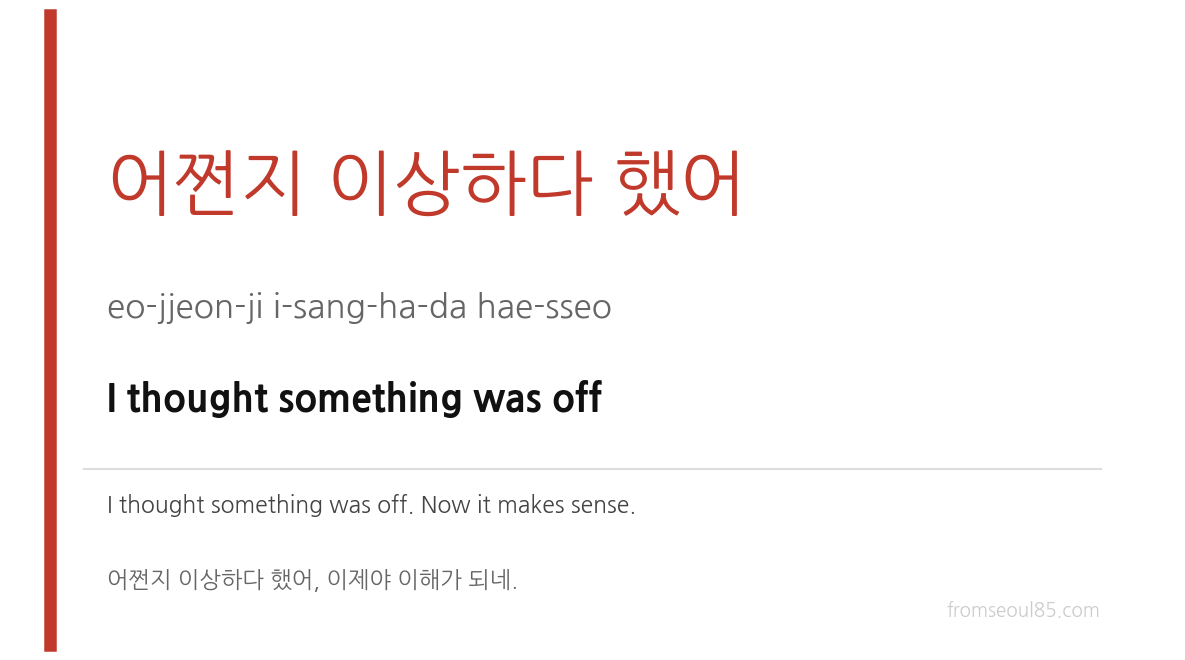 어쩐지 이상하다 했어 (eo-jjeon-ji i-sang-ha-da hae-sseo) — I thought something was off.
Example: 어쩐지 이상하다 했어, 이제야 이해가 되네. (I thought something was off. Now it makes sense.)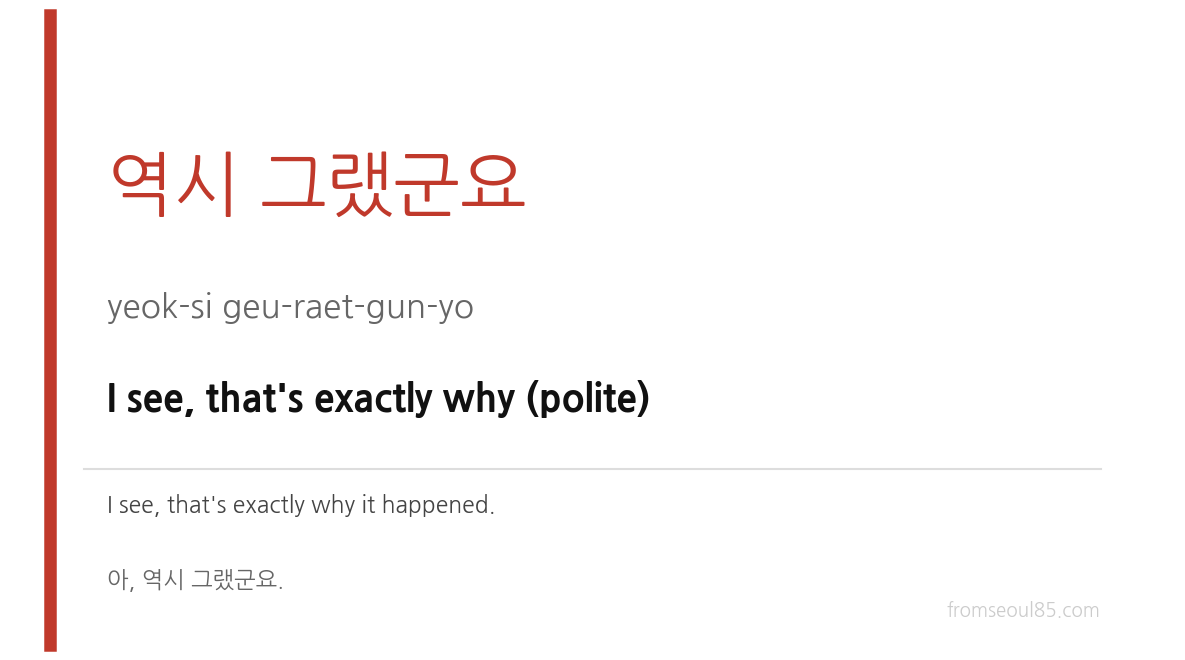 역시 그랬군요 (yeok-si geu-raet-gun-yo) — I see, that’s exactly why (polite).
Example: 아, 역시 그랬군요. (I see, that’s exactly why it happened.)
Final Thoughts
If you only remember one thing, remember this. Eojjeonji is the word that comes out after a mystery gets solved, not before. Try listening for it the next time a Korean friend explains a delay, a surprising skill, or a hunch that turned out true. Once you notice the pattern, you will start hearing it everywhere. If you want to keep building this kind of everyday vocabulary, my intermediate Korean posts cover more small words like this one.
Written by a native Korean speaker born in Seoul in 1985. This is my personal experience. Other Koreans may see things differently.