Korean has one small word that shows up everywhere. Koreans say 아이고 (a-i-go) many times a day. If you want the real aigo meaning in Korean, forget one fixed translation. This word covers pain, bad news, mild frustration, and relief, all at once. Learners often ask why do Koreans say aigo so much. The honest answer is that no single English word matches it. “Oh my,” “ugh,” “oof,” and “phew” are all correct sometimes. None of them cover the whole word by itself.
I am a Seoul-born Korean man, and I probably say 아이고 more than ten times a day. Right when I wake up, I groan 아이고 삭신이야 (a-i-go sak-sin-i-ya — oof, my whole body aches). When I mess something up, I say 아이고 이걸 어떻하냐 (a-i-go i-geol eo-tteo-ka-nya — oh no, what do I do about this). When I finally get home from work, I sigh 아이고 힘들다 (a-i-go him-deul-da — oof, that was tiring). Those three moments alone fill up a good part of my day.
Aigo When Your Body Aches
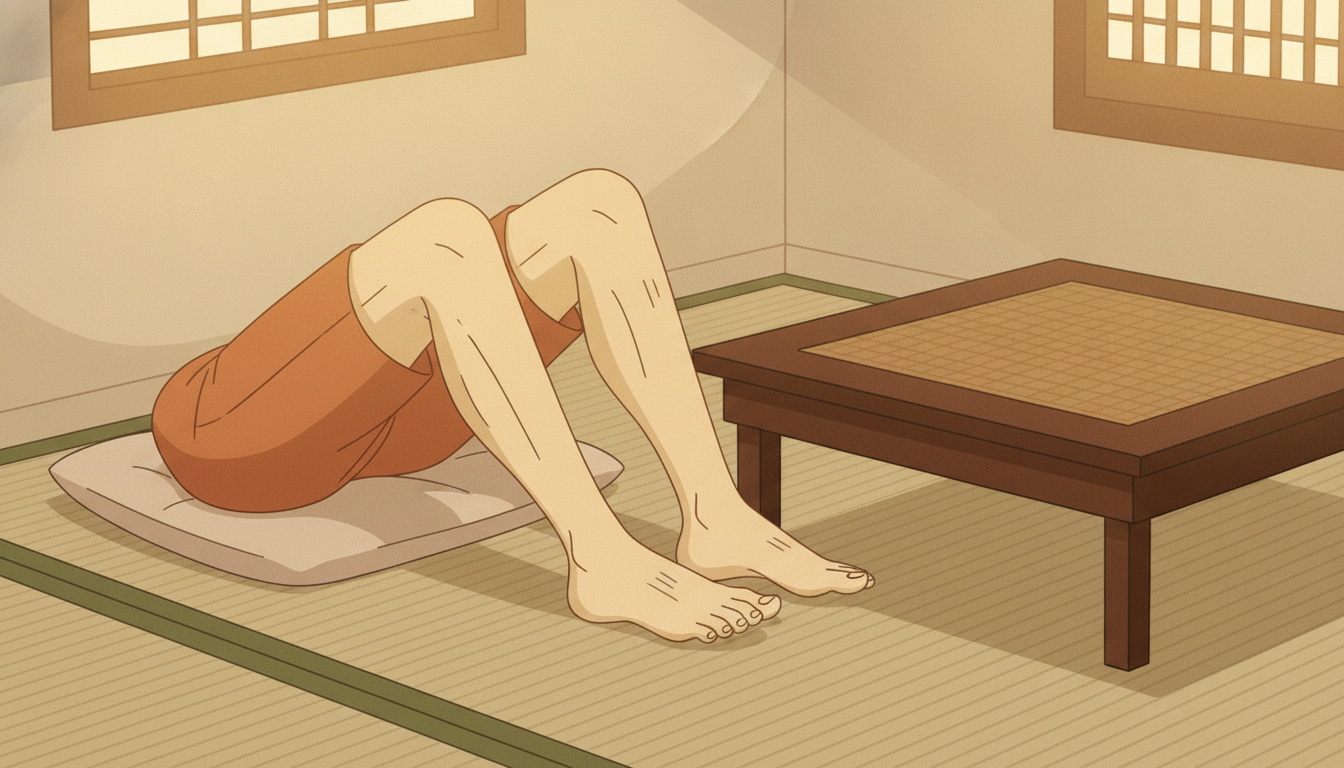
Picture sitting on the floor for an hour at a Korean BBQ place. You finally stand up and your knees ache. This is a classic moment for 아이고 (a-i-go — oof, ouch). Koreans reach for it the second their body reminds them it is not twenty anymore.
For me, when my knees hurt, I say 아이고 무릅이야 (a-i-go mu-reup-i-ya — ouch, my knees). If I am carrying something heavy, I say 아이고 무거워 죽겠네 (a-i-go mu-geo-wo juk-get-ne — ugh, this is so heavy, I could die). And after sleeping in a bad position, my back gets me almost every week. I say 아이고 허리야 (a-i-go heo-ri-ya — oh my back). If you spend time around Korean parents or grandparents, this will be one of the first korean exclamation words you notice.
Aigo When You Hear Bad News
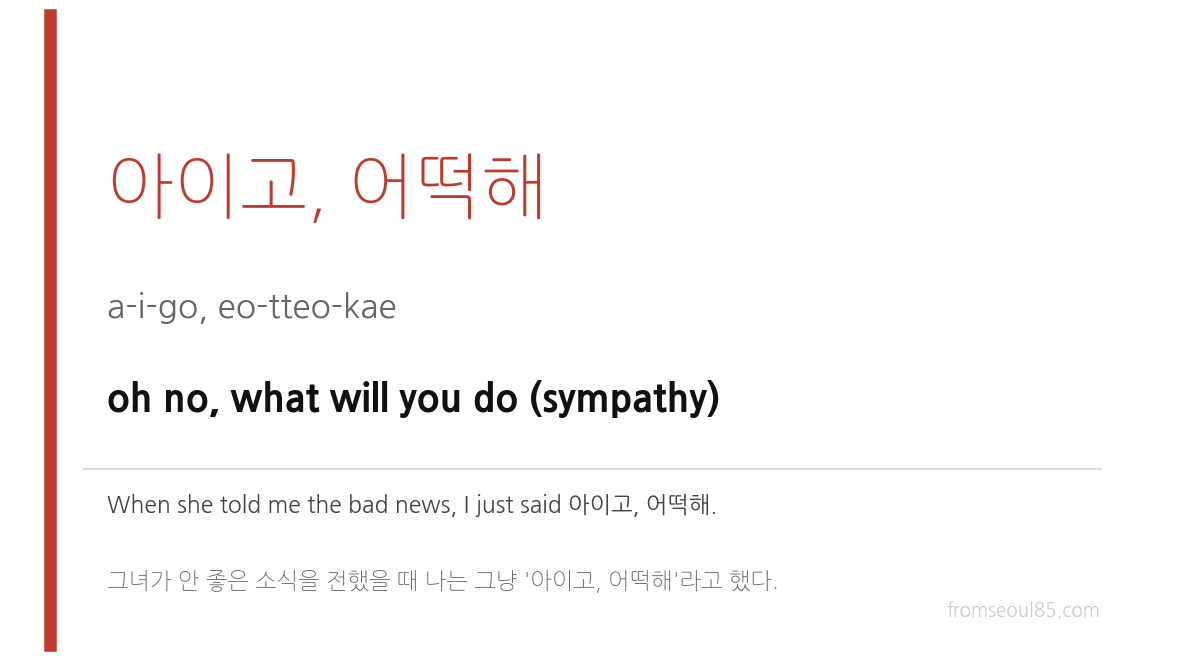
Now imagine a friend calls and says they lost their wallet on the subway. The natural reply starts with 아이고. With a close friend, I just say 아이고 어떻하냐 진짜 (a-i-go eo-tteo-ka-nya jin-jja — oh no, what are you going to do, seriously). If it is someone older, or someone I am not close with, I switch to 아이고 어떻해요, 큰일이네요 (a-i-go eo-tteo-kae-yo, keun-il-i-ne-yo — oh no, what will you do, that is a big problem). The word itself stays the same. What changes is the ending, depending on how close you are to the person.

Aigo When Someone Makes a Mistake
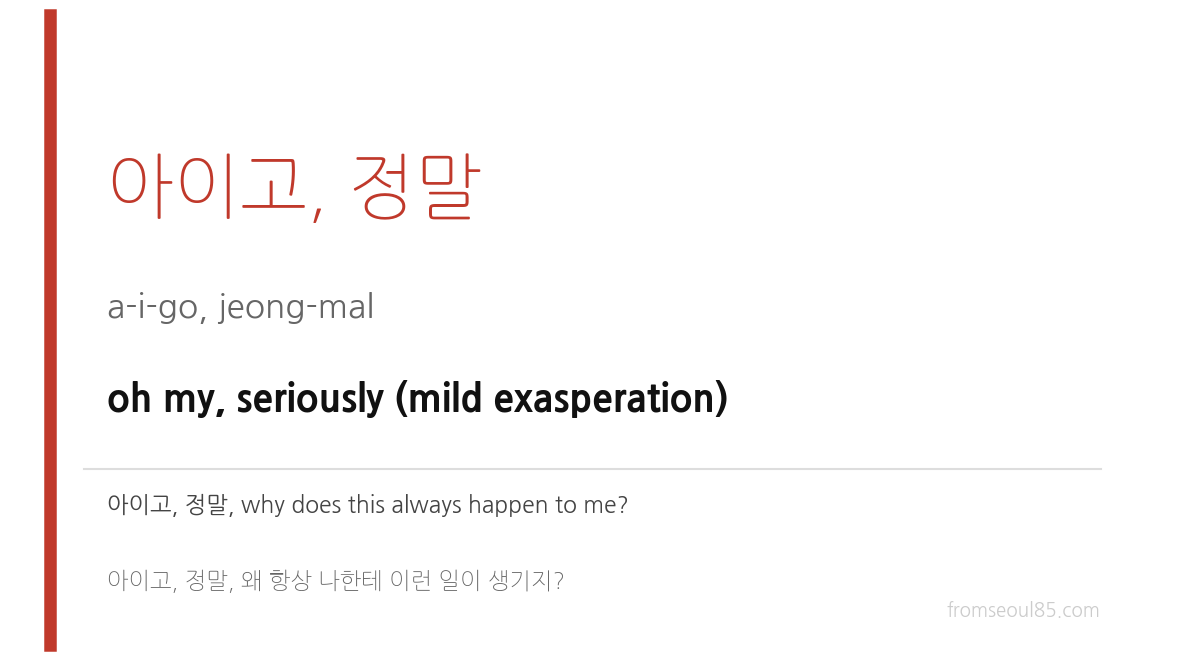
Say your kid knocks over a glass of juice on the table. You are not furious, just tired. When my kid spills something, I say 아이고 정말 (a-i-go jeong-mal — oh my, seriously) while I clean it up. It is not anger. It is more like a tired sigh with words attached.
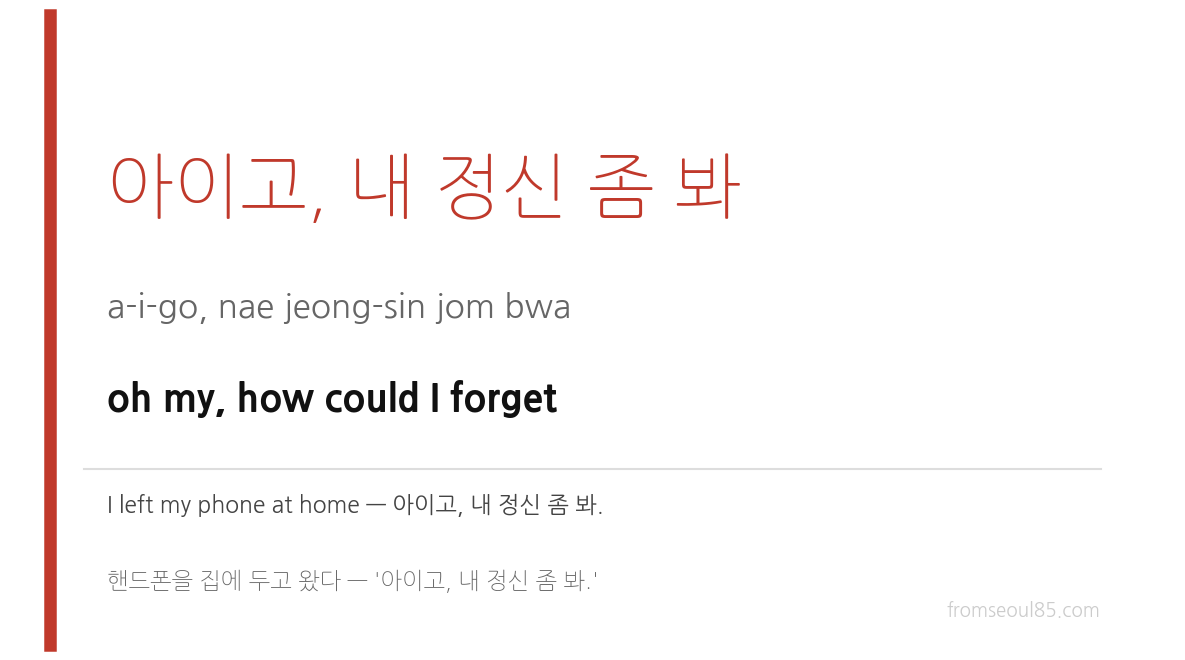
When I am the one who messes up, like forgetting my phone at home, I say 아이고 내 정신 좀 봐 (a-i-go nae jeong-sin jom bwa — oh my, how could I forget). Sometimes I just say 아이고 미치겠다 (a-i-go mi-chi-get-da — oh man, I am losing it), especially for a bigger mistake. Both work. The second one is a little stronger.
Aigo When You Feel Relieved
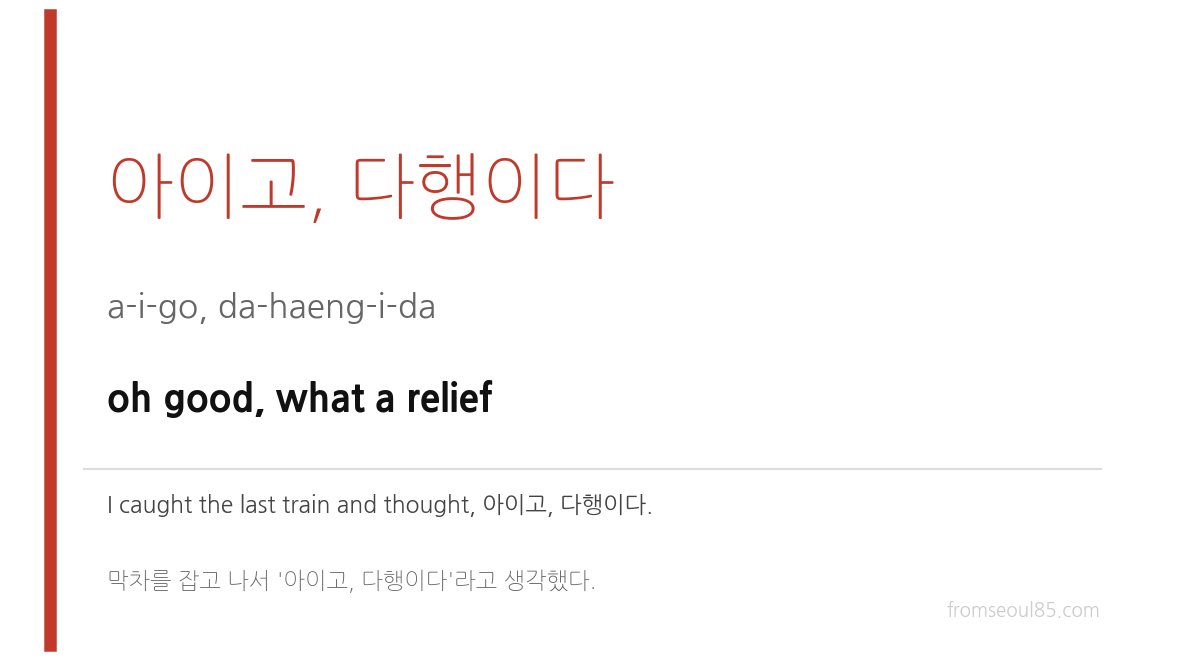
Now picture sprinting to catch the last subway train, and the doors open just in time. That relief comes out as 아이고 다행이다 (a-i-go da-haeng-i-da — oh good, what a relief). I use this exact line when I catch the last train.
After finishing a stressful deadline, I sigh 아이고 드디어 끝났다 (a-i-go deu-di-eo kkeut-nat-da — oh, it is finally over). Sometimes I just say 아이고 살았다 (a-i-go sal-at-da — oh, I survived that). All three phrases share the same relief, just with a slightly different flavor.
Is Aigo Old-Fashioned?
One honest note: 아이고 can feel a bit old-fashioned to some younger Koreans. In my experience, my parents’ generation uses it even more than mine does. But I still use it constantly, and so do my friends. It has not disappeared from casual speech at all.
Where it does disappear is formal writing. You will not see 아이고 in a company email or a business report. It belongs in speech, not text. Outside of that, it is simply a comfortable, relaxed word people reach for without thinking much about it. This is my personal experience. Other Koreans, especially from different regions or age groups, may see it a little differently.
If you want to compare it with another everyday Korean exclamation, check out how Koreans sigh, vent, and complain with eohyu. Aigo and eohyu often show up in the same conversations, but they carry different weights. Linguists generally group words like these under interjections, a category Wikipedia explains in more general terms if you want the bigger linguistic picture.
Key Expressions
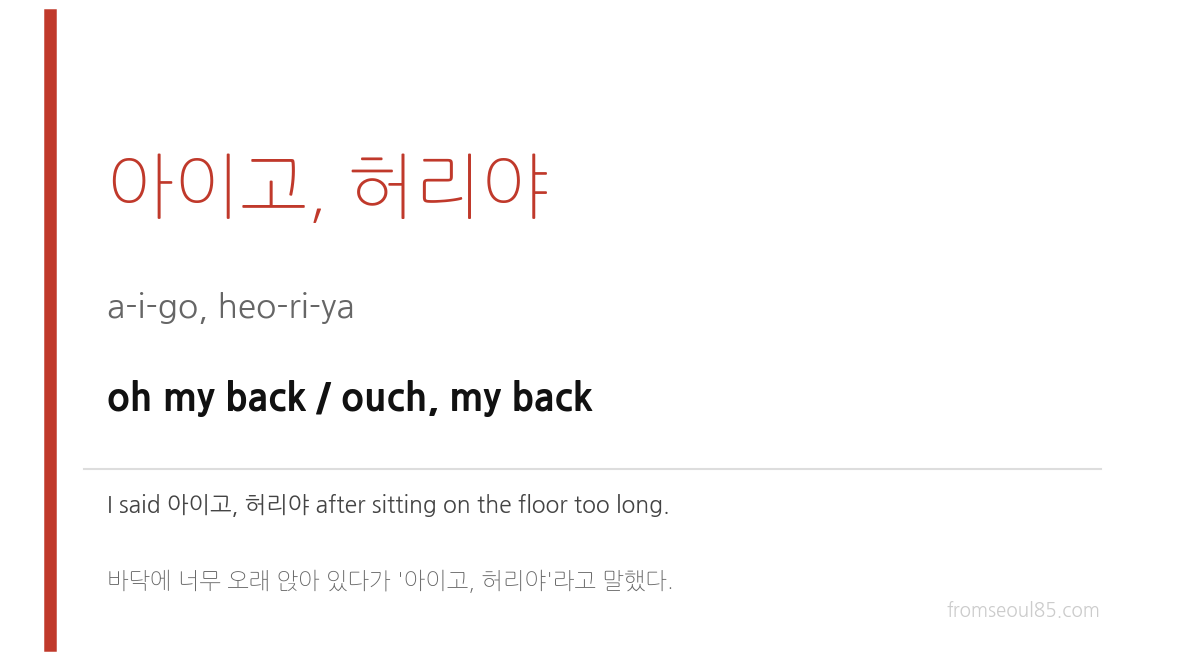
- 아이고, 허리야 (a-i-go, heo-ri-ya) — oh my back, ouch my back. Example: I said 아이고, 허리야 after sitting on the floor too long.
- 아이고, 어떻해 (a-i-go, eo-tteo-kae) — oh no, what will you do. Example: When she told me the bad news, I just said 아이고, 어떻해.
- 아이고, 정말 (a-i-go, jeong-mal) — oh my, seriously. Example: 아이고, 정말, why does this always happen to me?
- 아이고, 다행이다 (a-i-go, da-haeng-i-da) — oh good, what a relief. Example: I caught the last train and thought, 아이고, 다행이다.
- 아이고, 내 정신 좀 봐 (a-i-go, nae jeong-sin jom bwa) — oh my, how could I forget. Example: I left my phone at home. 아이고, 내 정신 좀 봐.
How to Use Aigo Naturally
If you search for aigo korean meaning or the aigo meaning in English, forget one fixed translation. Learn it by situation instead. Pain, sympathy, mild frustration, and relief all trigger the same word. The ending you attach after 아이고 tells the listener which one you mean.
A simple way to start is to pick one phrase from each situation above and practice it out loud. Say 아이고 허리야 the next time you stand up from a low chair. Say 아이고 다행이다 the next time something works out at the last second. Small, repeated use like this teaches you the feel of the word faster than any list of definitions ever could. For more everyday Korean words like this, browse the intermediate section of this blog.
Written by a native Korean speaker born in Seoul in 1985. This is my personal experience. Other Koreans may see things differently.