Written by a native Korean speaker born in Seoul in 1985. This is my personal experience. Other Koreans may see things differently.
The jaechok meaning in Korean is close to “pushing someone to hurry or act sooner.” Koreans use 재촉 (jae-chok) all the time, at home and at work. It trips up a lot of learners, because English doesn’t have one clean match for it. Sometimes it feels like plain “hurry up.” Other times it feels closer to nagging, or quiet pressure. The feeling shifts with tone and context, not just the word itself. I want to walk you through how I actually use it in daily life, not just the dictionary version.
What Jaechok Hada Means in Korean
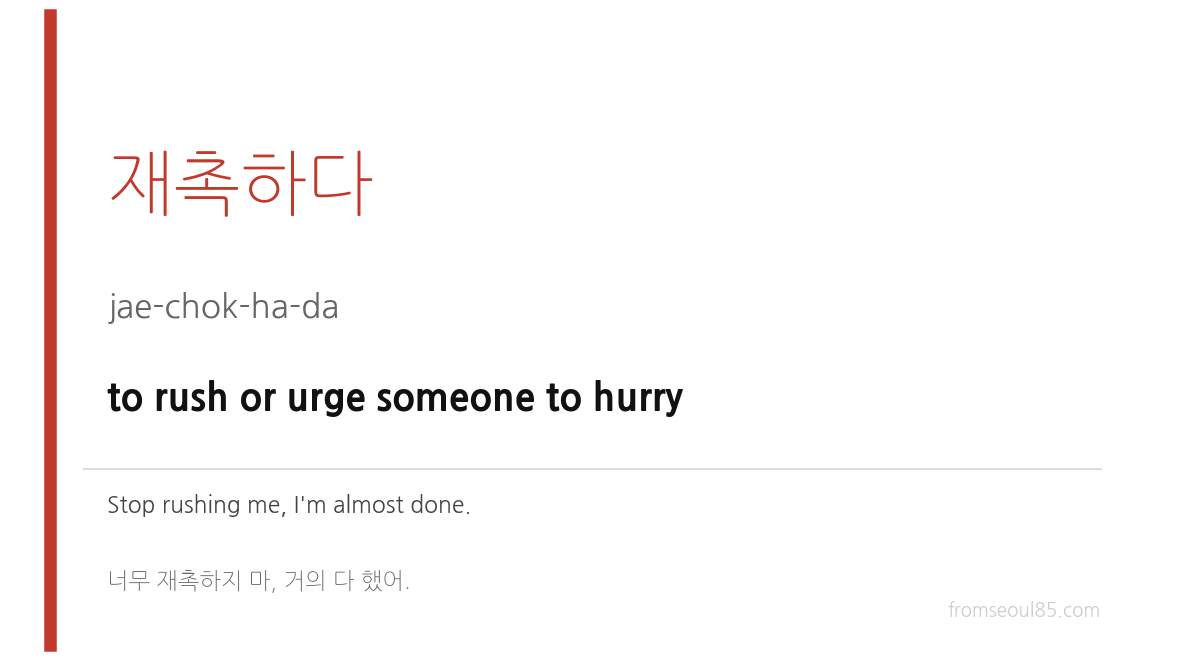
The verb form is 재촉하다 (jae-chok-ha-da), and the jaechok hada meaning is basically “to rush or urge someone to hurry.” It’s the Korean word for nagging someone to hurry, but it’s not always negative. If my kid is dragging their feet, I might snap, “빨리 좀 해, 자꾸 재촉하게 하지 마” (bbal-li jom hae, ja-kku jae-chok-ha-ge ha-ji ma), meaning “hurry up, stop making me nag you.” That’s the casual, at-home version. At work, I soften it a lot. I might start an email with something like “자꾸 재촉드려서 죄송한데요…” (ja-kku jae-chok-deu-ryeo-seo joe-song-han-de-yo), which means “sorry for pushing you again, but…” The word stays the same. The politeness level and the emotion around it change everything.
Rushing Your Kids Out the Door in the Morning
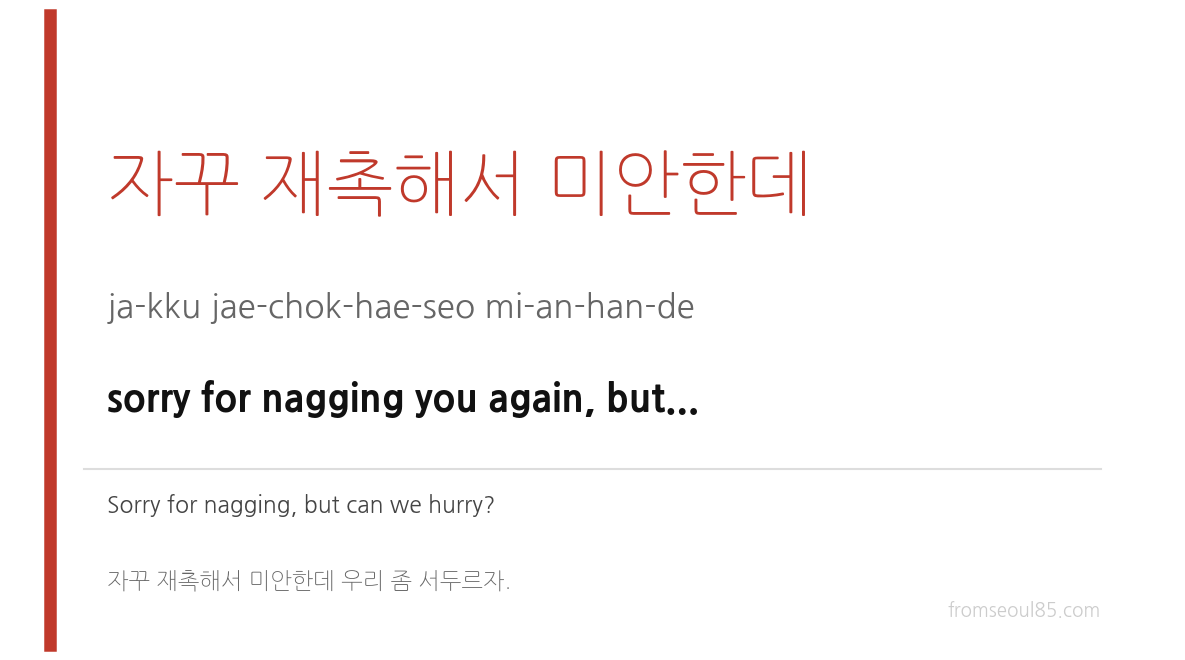
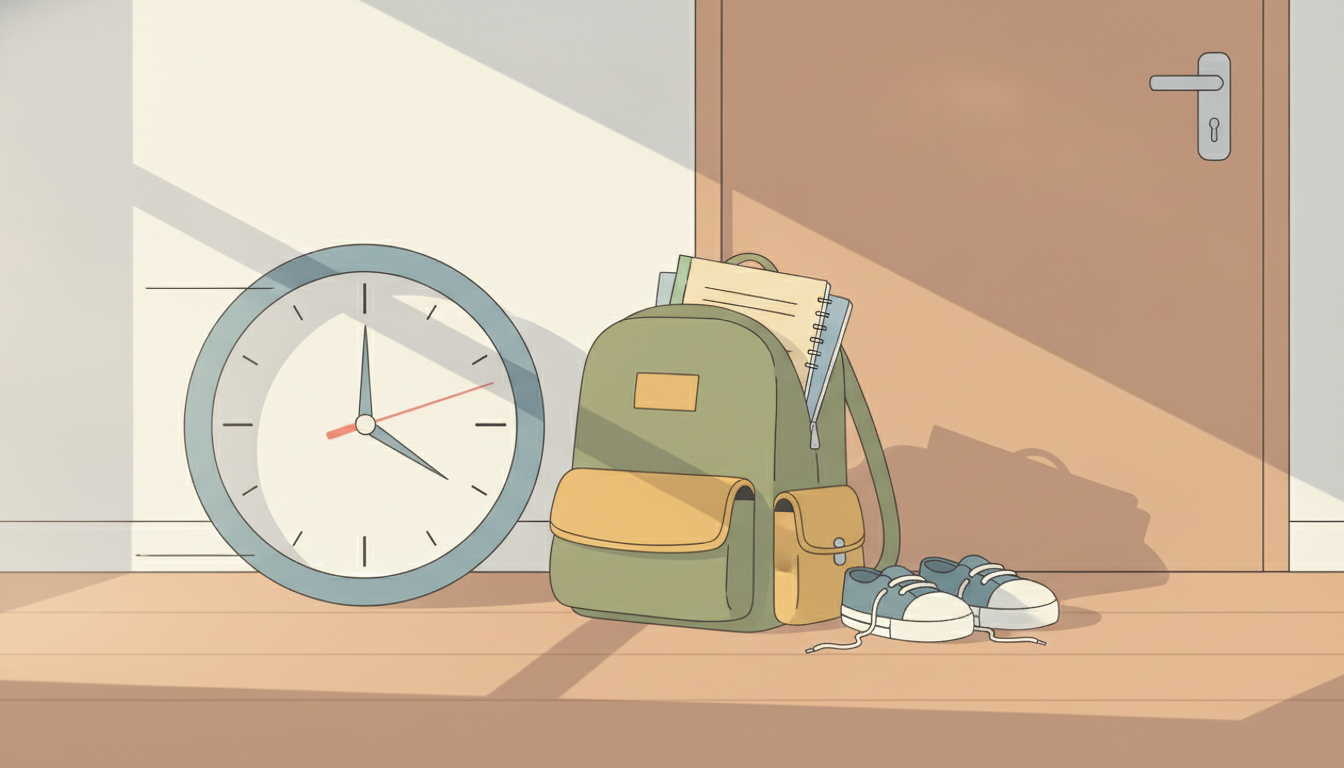
When I hear the word 재촉, the first thing I picture is a busy school morning. My kid is moving too slowly, breakfast isn’t finished, and the clock is not on our side. In that moment, I usually just say something short and blunt, like “빨리빨리, 시간 없어!” (bbal-li-bbal-li, si-gan eop-seo!), which means “hurry, hurry, there’s no time!” It’s not angry, it’s just fast and direct. On calmer mornings, I try a gentler line instead: “자꾸 재촉해서 미안한데 우리 좀 서두르자” (ja-kku jae-chok-hae-seo mi-an-han-de u-ri jom seo-du-reu-ja), meaning “sorry for nagging, but let’s hurry a little.” Honestly, I almost never use polite speech in this exact situation. It’s family, early morning, and there’s no time for formal grammar. Both lines carry care underneath the pressure. They’re not about anger. They’re about a parent trying to get everyone out the door on time.
Nagging a Friend Who Won’t Text Back
Texting is another place this word shows up a lot. Say you sent a message hours ago and you still need an answer. With close friends, I keep it short, sometimes almost lazy. I might just send “야 답 좀ㅋㅋ” (ya dap jom-kk-kk), which roughly means “hey, reply already lol.” If it’s more urgent, I’ll write “미안 근데 답 좀 빨리 줘” (mi-an geun-de dap jom bbal-li jwo), meaning “sorry, but reply quick.” Work chats need a completely different tone. There, I usually go around the direct word entirely and say something like “바쁘신데 죄송한데 답변 한번 부탁드려도 될까요?” (ba-ppeu-sin-de joe-song-han-de dap-byeon han-beon bu-tak-deu-ryeo-do doel-kka-yo?), which means “I know you’re busy, sorry, but could I ask for a reply?” I notice I almost never actually say the word 재촉 out loud at work. Koreans tend to soften the pressure with apology words instead of naming it directly.
Bringing Up Money Someone Still Owes You
This might be the most awkward version of jaechok for me. If a friend borrowed money weeks ago and still hasn’t paid me back, bringing it up feels uncomfortable even between close friends. I usually laugh it off a bit to soften the request: “아 맞다 그때 돈… 언제 줄 수 있어?ㅎㅎ” (a mat-da geu-ttae don… eon-je jul su i-sseo? ha-ha), meaning “oh right, that money… when can you give it back? (haha).” The laughing sound at the end is doing a lot of work there. It tells my friend I’m not mad, just reminding them. If you want more phrases for money situations like this, our post on how to say no to borrowing money in Korean covers a related side of the same topic. At work, chasing a deadline sounds much more formal. I’ll usually say, “자료 언제쯤 주실 수 있을까요?” (ja-ryo eon-je-jjeum ju-sil su i-sseul-kka-yo?), meaning “when could you get me the materials?” Again, the word 재촉 rarely leaves my mouth in a professional setting. It sounds a bit too blunt for office language.
When Someone Rushes You Instead
Sometimes I’m the one getting pushed, not the one pushing. If someone leans on me too hard, I push back a little. Casually, I’ll say, “아 좀만 기다려봐, 나도 하고 있잖아” (a jom-man gi-da-ryeo-bwa, na-do ha-go it-jan-a), which means “just wait a bit, I’m already doing it.” In a polite setting, I switch to something softer, like “조금만 시간 주시면 안 될까요?” (jo-geum-man si-gan ju-si-myeon an doel-kka-yo?), meaning “could you give me a little more time?” Both lines admit that the other person has a point, while still asking for space to finish the task.
Jaechok vs Dokchok: Two Levels of Pressure
Learners often ask me about jaechok vs dokchok, since both get translated as “pressure to hurry” in a dictionary. To me, 재촉 usually stays fairly gentle. It’s the word for a parent, a friend, or a coworker nudging you along. 독촉 (dok-chok) feels much heavier. It shows up in serious situations, especially demanding overdue payment. If a debt collector calls someone to demand money back, Koreans call that a 독촉전화 (dok-chok-jeon-hwa), a collection call. I’ve never once heard anyone call that a 재촉전화 instead. The stronger word belongs to situations with real consequences, like unpaid bills or legal deadlines, while the softer word covers everyday nagging between people who care about each other.
A Few Notes Before You Use Jaechok
Watch your speech level closely. I use casual jaechok phrases with my own kids and close friends, but I rarely say the word itself in front of my boss. Softening words like 미안한데 (sorry, but) or 죄송한데 (I’m sorry, but) usually come first in polite speech, before the actual request. Tone matters more than grammar here. The exact same sentence can sound caring or annoyed depending on how fast or sharp you say it. If you’re not sure which version fits your situation, start with the polite, softened phrases. You can always relax into casual speech once you know someone better. According to the National Institute of Korean Language, 재촉하다 is defined simply as urging someone to do something faster, which matches how it’s used across generations in everyday speech.
One more thing worth knowing: younger Koreans might lean on shorter texting slang more than my generation does, especially in casual chats like “야 답 좀ㅋㅋ.” I can’t speak for every age group, since this is just how I use the language myself. If you want to see how other everyday Korean words carry hidden emotion the same way, our post on eohyu and how Koreans sigh, vent, and complain is a good next read.
Key Expressions
- 재촉하다 (jae-chok-ha-da) — to rush or urge someone to hurry.
Example: 너무 재촉하지 마, 거의 다 했어. (Stop rushing me, I’m almost done.) - 자꾸 재촉해서 미안한데 (ja-kku jae-chok-hae-seo mi-an-han-de) — sorry for nagging you again, but…
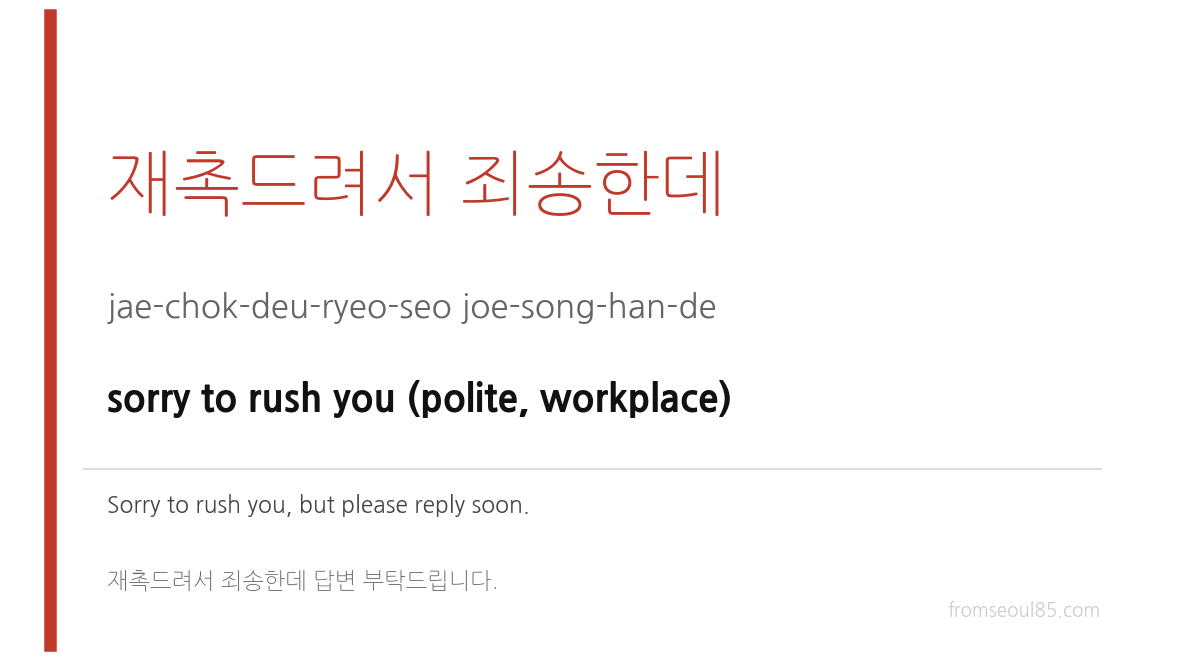
Example: 자꾸 재촉해서 미안한데 우리 좀 서두르자. (Sorry for nagging, but can we hurry?) - 재촉드려서 죄송한데 (jae-chok-deu-ryeo-seo joe-song-han-de) — sorry to rush you (polite, workplace).
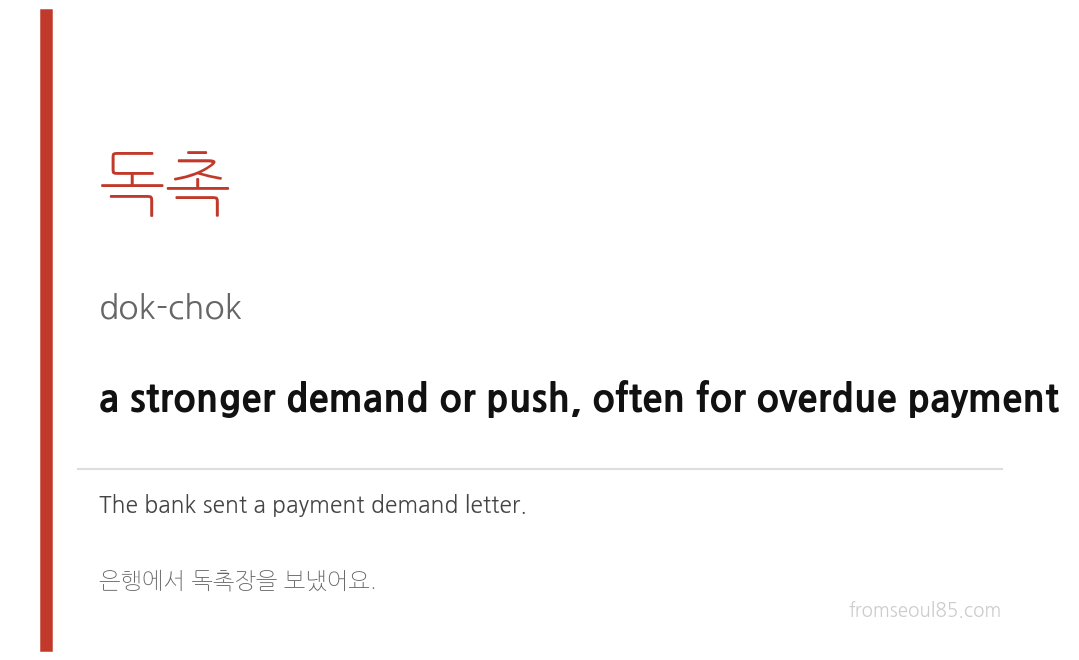
Example: 재촉드려서 죄송한데 답변 부탁드립니다. (Sorry to rush you, but please reply soon.) - 독촉 (dok-chok) — a stronger demand or push, often for overdue payment.
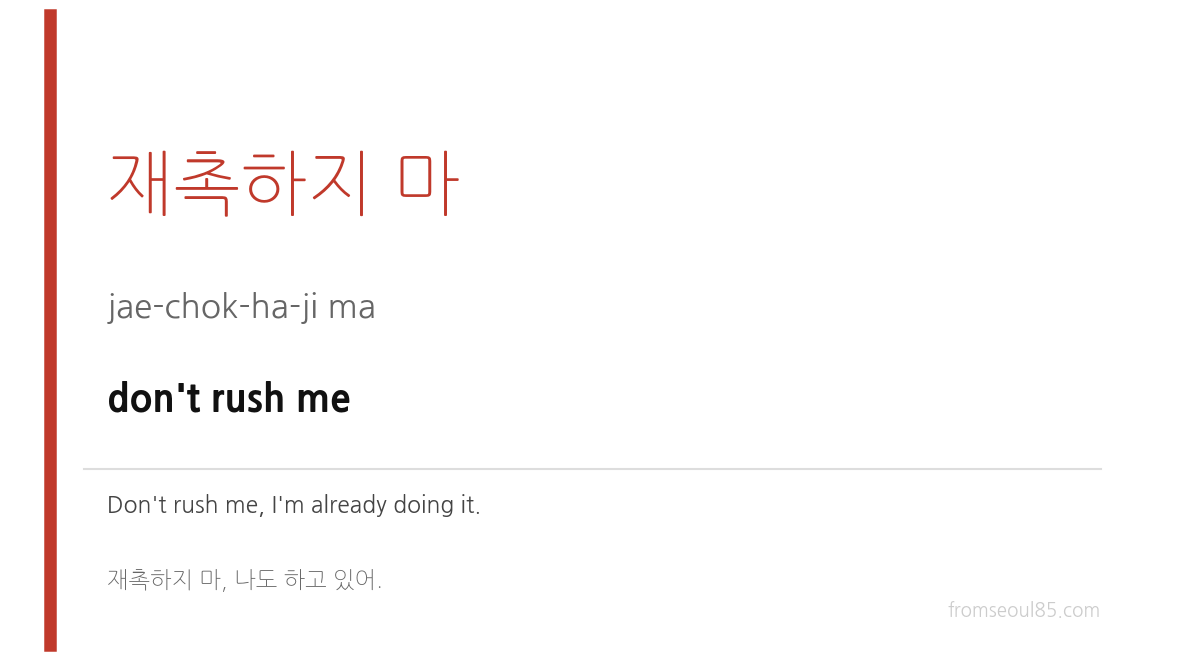
Example: 은행에서 독촉장을 보냈어요. (The bank sent a payment demand letter.) - 재촉하지 마 (jae-chok-ha-ji ma) — don’t rush me.
Example: 재촉하지 마, 나도 하고 있어. (Don’t rush me, I’m already doing it.)
This is my personal experience with jaechok in daily Korean life. Other Koreans, especially younger speakers, might use slightly different phrases for the same feeling. If you want more everyday Korean words like this one, check out our intermediate Korean vocabulary posts for more real-life examples.