
You will hear 하필 (ha-pil) all the time once you start listening for it. The hapil meaning in Korean has no single clean English match. The closest feel is “of all things” or “why does it have to be.” Koreans say it when something unlucky lines up by pure coincidence. It carries a small sigh of frustration, sometimes a bit of irony mixed in. Once you notice hapil, you start hearing it in almost every daily complaint.
I use it myself more than I realized until I sat down to think about it. For me, it usually comes out when something’s timing is just bad. If traffic is jammed on the one day I’m already late, I’ll say 아 하필 오늘 차가 이렇게 막히냐 (a ha-pil o-neul cha-ga i-reoh-ge mak-hi-nya — ugh, of all days, why is traffic this bad today). In a more polite setting, with a coworker or someone older, I’d soften it to 하필 오늘 이런 일이 생기네요 (ha-pil o-neul i-reon i-ri saeng-gi-ne-yo — of all days, this had to happen today). Same feeling, different politeness level.

Hapil When You Forgot Your Umbrella and It Starts Raining
Picture this. You forgot your umbrella, and it starts raining right now. That kind of small, annoying timing is exactly what hapil was made for. When it happens to me, I don’t even finish the sentence half the time. I just sigh and say 아 하필… (a ha-pil…) and trail off, because everyone already knows what I mean. If I want to be more specific, I’ll say 아 진짜 하필 지금 비가 오냐 (a jin-jja ha-pil ji-geum bi-ga o-nya — seriously, why does it have to rain right now, of all times).
Around a coworker or someone I’m not that close with, I switch to 하필 오늘 비가 오네요 (ha-pil o-neul bi-ga o-ne-yo — it just had to rain today, of all days). It’s the same complaint, but the polite ending makes it sound less like whining and more like a shared, mild observation about bad luck.
Hapil When Extra Work Lands on You: “Why Me?”
Now imagine extra work lands on you, out of everyone on your team. This is where 왜 하필 나야 (wae ha-pil na-ya — why me, of all people) comes in, and I use it a lot. Sometimes it’s half a joke. I’ll say 아 왜 하필 나야ㅋㅋ (a wae ha-pil na-ya, laughing as I say it) even when I’m not that upset. But if I’m actually annoyed, it turns into 아 진짜 왜 하필 나한테 이래 (a jin-jja wae ha-pil na-han-te i-rae — seriously, why does this keep happening to me).
The polite version is trickier. I don’t really use a polite form with hapil attached in this exact phrase. If I need to say something formal, I’ll often just drop hapil entirely and say 왜 저한테 이런 일이… (wae jeo-han-te i-reon i-ri… — why does this kind of thing happen to me…), letting the sentence trail off instead. That’s worth knowing: hapil leans casual in this particular use, even though it works fine formally in other sentences.

Hapil When Bad Timing Hits on an Important Day
Say you catch a cold right before a big interview. That kind of timing feels almost personal, like the universe picked today on purpose. I usually start with 아 하필 오늘… (a ha-pil o-neul…) and then finish the sentence based on whatever actually went wrong. For a cold before an interview, I’d say something like 아 하필 면접 날 목이 쉬냐 (a ha-pil myeon-jeop nal mo-gi swi-nya — of all days, why does my voice have to go hoarse on interview day).
For a more polite version, I’d keep it simple: 하필 중요한 날 이렇게 됐네요 (ha-pil jung-yo-han nal i-reoh-ge dwaess-ne-yo — of all days, it had to turn out like this on such an important day). Hapil does a lot of work in a short sentence like that. It tells the listener the timing itself is the problem, not just the bad event.
Hapil When You Sympathize with a Friend’s Bad Luck
A friend tells you their wallet got stolen, right on their birthday. You react with shared disbelief, not blame. My honest reaction is usually 헐 왜 하필 그때ㅋㅋㅋ (heol wae ha-pil geu-ttae — ugh, why did it have to happen right then), and we end up laughing about how absurd the timing is together. If I want to sound more comforting instead of just reacting, I’ll say 아 진짜 하필… (a jin-jja ha-pil…) and let the sentence trail off, which lets my friend fill in the rest.
This is one of the more useful things to notice about hapil. It’s not really about blaming anyone, including the person telling the story. It’s about pointing at the coincidence itself and saying, out loud, that the timing was unfair.
When Not to Use Hapil
Hapil almost always signals bad luck or irony, not good news. If you happen to run into a friend on the street, Koreans usually say 마침 너 만났네 (ma-chim neo man-nan-ne — I just happened to run into you, perfect timing), not hapil. I tried imagining using hapil there, and honestly it sounds off to me. Saying 하필 너 만났네 would come across as if meeting that person was the unlucky part, which is a strange thing to imply about a friend. For good coincidences, 마침 (ma-chim) is the word that fits. Save hapil for the annoying, unlucky timing, not the happy accidents.
This is my personal experience with how I use hapil day to day. Other Koreans may see it a bit differently, especially depending on age or region, but the core feeling of “unlucky timing” stays the same across most speakers I know.
If you want to see how another everyday frustration word works in real conversation, this piece on how Koreans sigh, vent, and complain with eohyu pairs well with hapil, since both carry that same small burst of everyday annoyance. For a more formal reference on how Korean adverbs like this are defined, the National Institute of Korean Language is a solid place to check standard usage.
Key Expressions
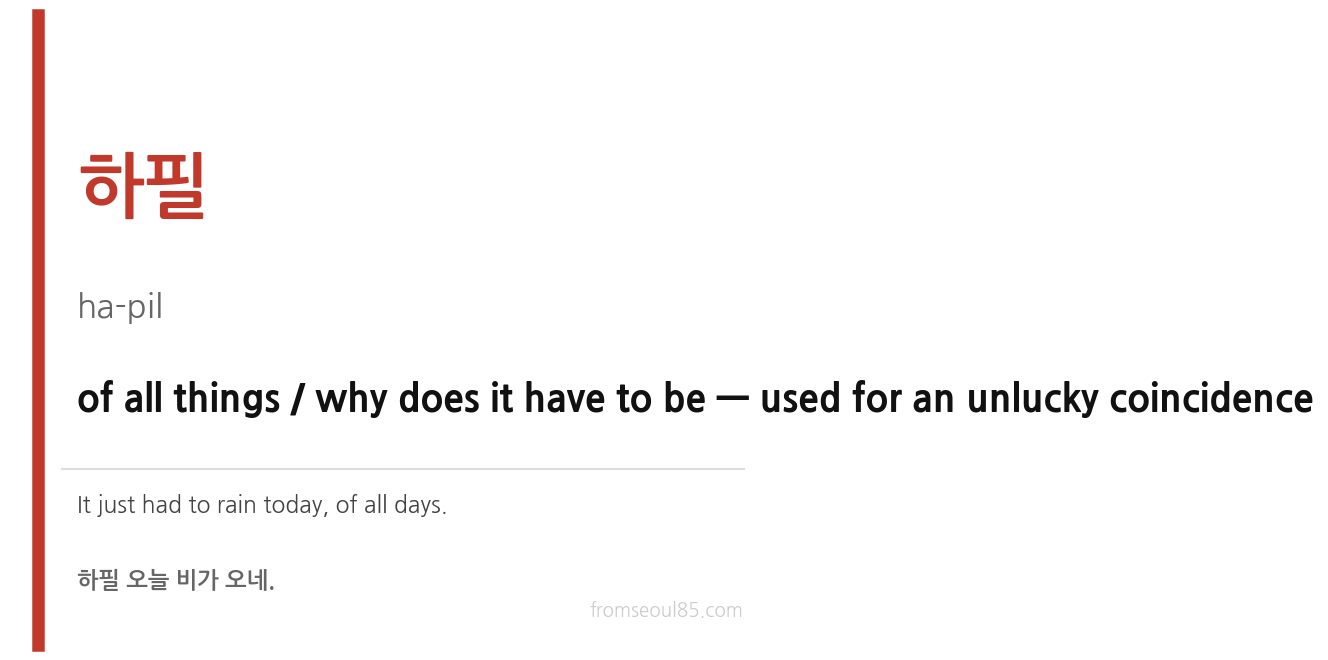
- 하필 (ha-pil) — of all things / why does it have to be, used for an unlucky coincidence. Example: 하필 오늘 비가 오네. (It just had to rain today, of all days.)
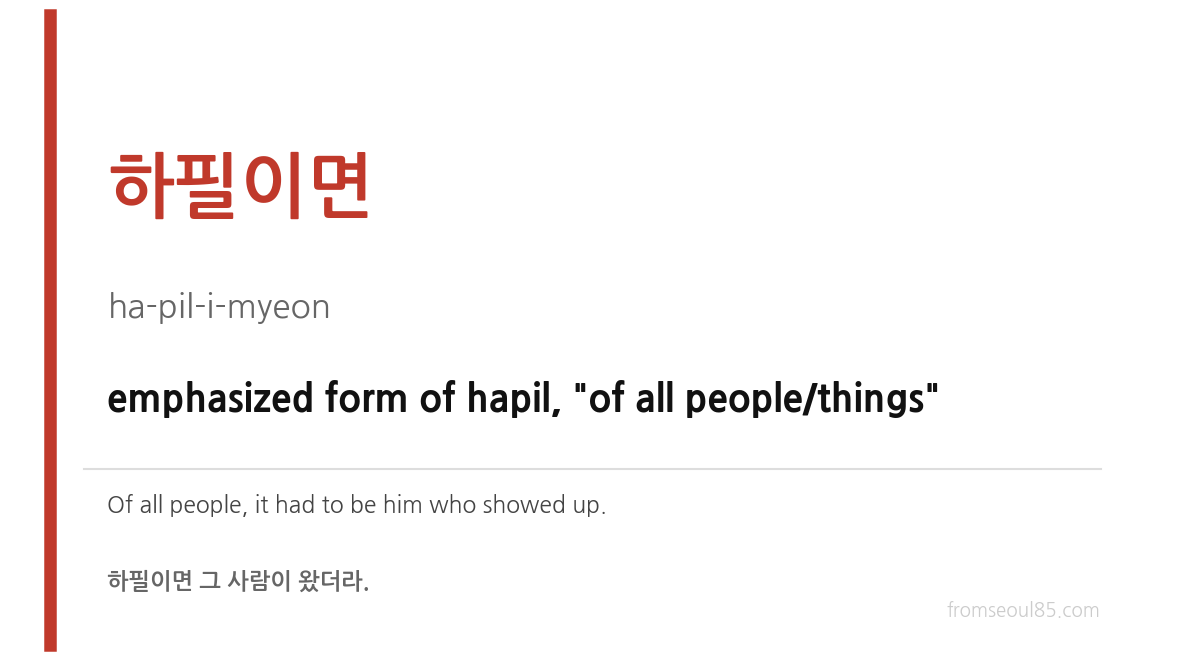
- 하필이면 (ha-pil-i-myeon) — emphasized form of hapil, “of all people/things.” Example: 하필이면 그 사람이 왔더라. (Of all people, it had to be him who showed up.)
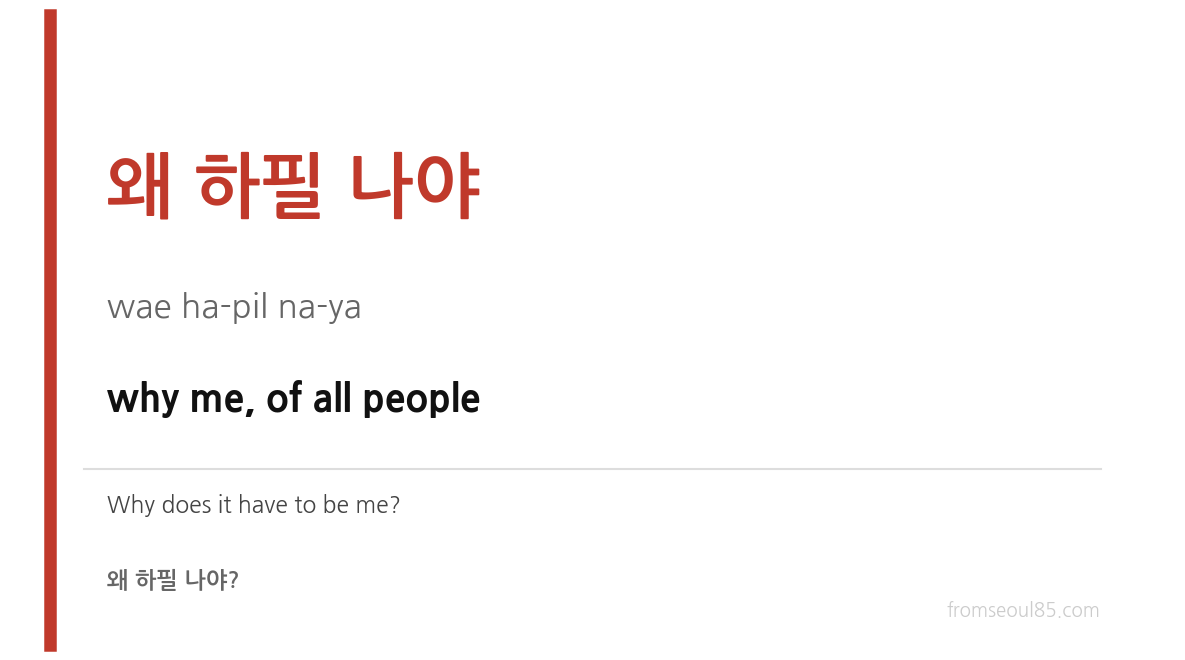
- 왜 하필 나야 (wae ha-pil na-ya) — why me, of all people. Example: 왜 하필 나야? (Why does it have to be me?)
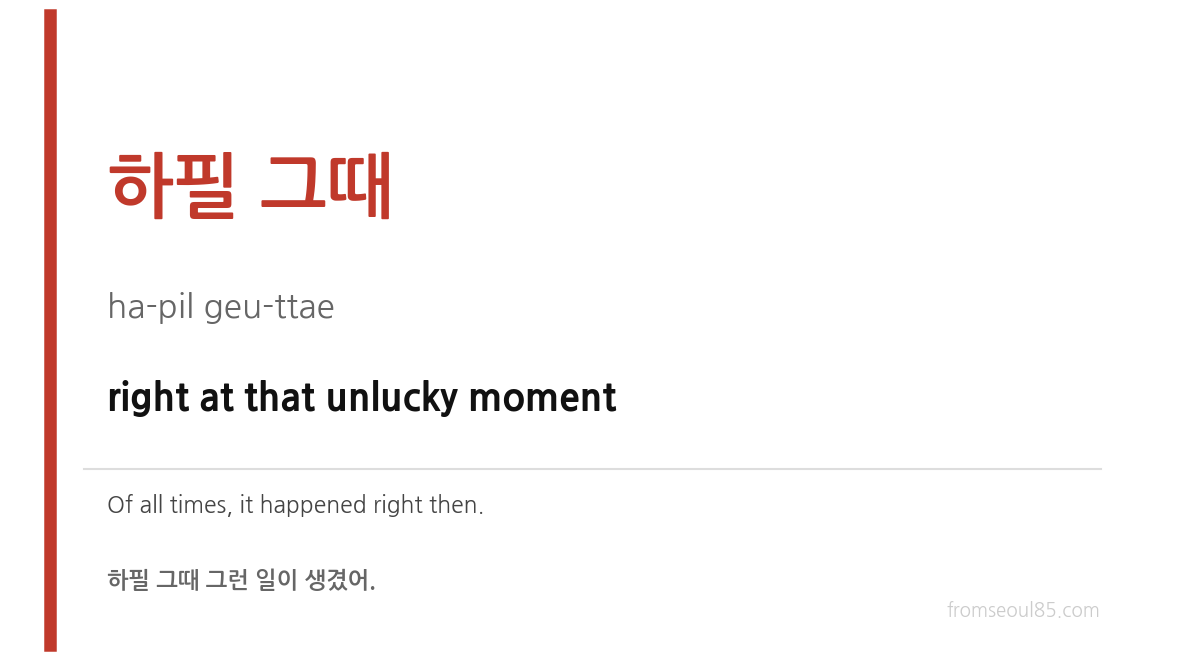
- 하필 그때 (ha-pil geu-ttae) — right at that unlucky moment. Example: 하필 그때 그런 일이 생겼어. (Of all times, it happened right then.)
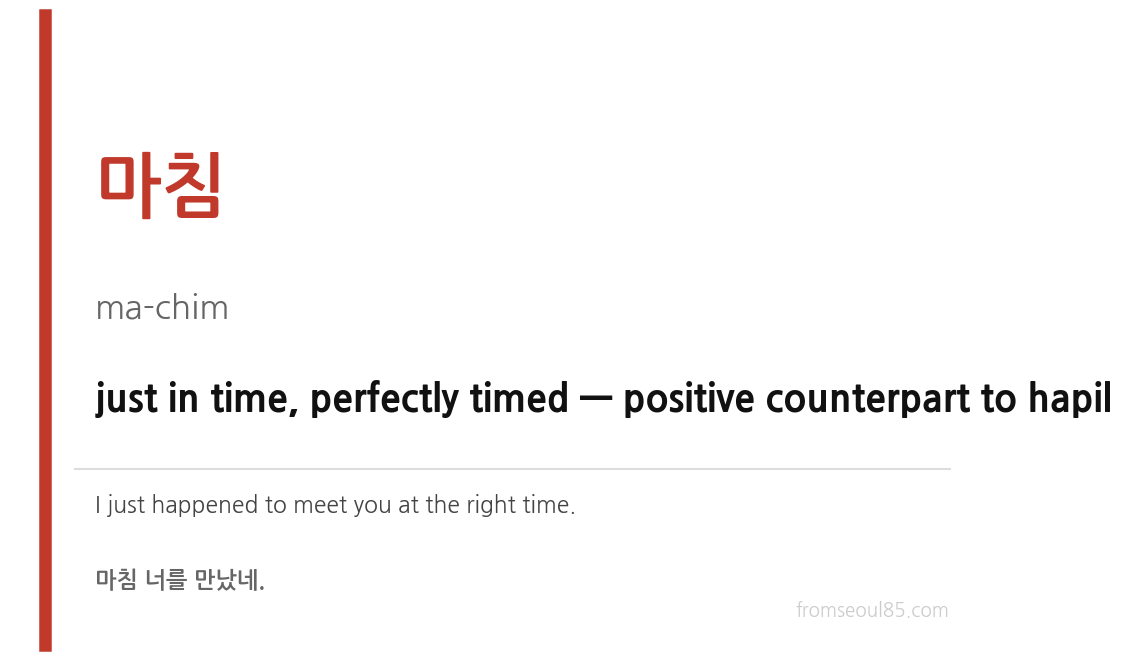
- 마침 (ma-chim) — just in time, perfectly timed, the positive counterpart to hapil. Example: 마침 너를 만났네. (I just happened to meet you at the right time.)
A Couple of Practical Tips
If you’re trying to add hapil to your own Korean, start with the casual form first. 아 하필… trailing off works in almost any unlucky situation, and native speakers use it that way constantly. Once that feels natural, add the polite ending 하필 [situation] 됐네요 or 생기네요 for coworkers and people you’re not close with.
The other tip is simpler: don’t force hapil into good news. If something lucky happens, reach for 마침 instead. Mixing them up is the kind of mistake that makes a sentence sound backward, even if every word in it is correct.
Written by a native Korean speaker born in Seoul in 1985. This is my personal experience. Other Koreans may see things differently.