You ask a Korean friend what to do first. They answer, 일단 (il-dan — first, for now). You look it up in a dictionary, and you get five different translations: “first,” “for now,” “once,” “anyway,” “tentatively.” None of them feel complete on their own. That’s because the ildan meaning doesn’t point to one clean English word. It marks something as temporary, or not fully decided yet. Koreans use it constantly, in almost every kind of conversation, from ordering food to answering the boss.
I’m not sure how to explain it perfectly, but for me, 일단 carries a feeling of “I haven’t decided this completely, but let’s go with it for now.” It’s less about the specific word and more about the attitude behind it. This morning I was deciding what to eat, and I just said, “일단 커피부터 마시자” (il-dan keo-pi-buteo masija — let’s drink coffee first). Honestly, it wasn’t even a planned sentence. It just came out of my mouth out of habit, the way certain words do when you’ve said them your whole life.

Ildan Bapbuteo Meokja: Deciding What Comes First
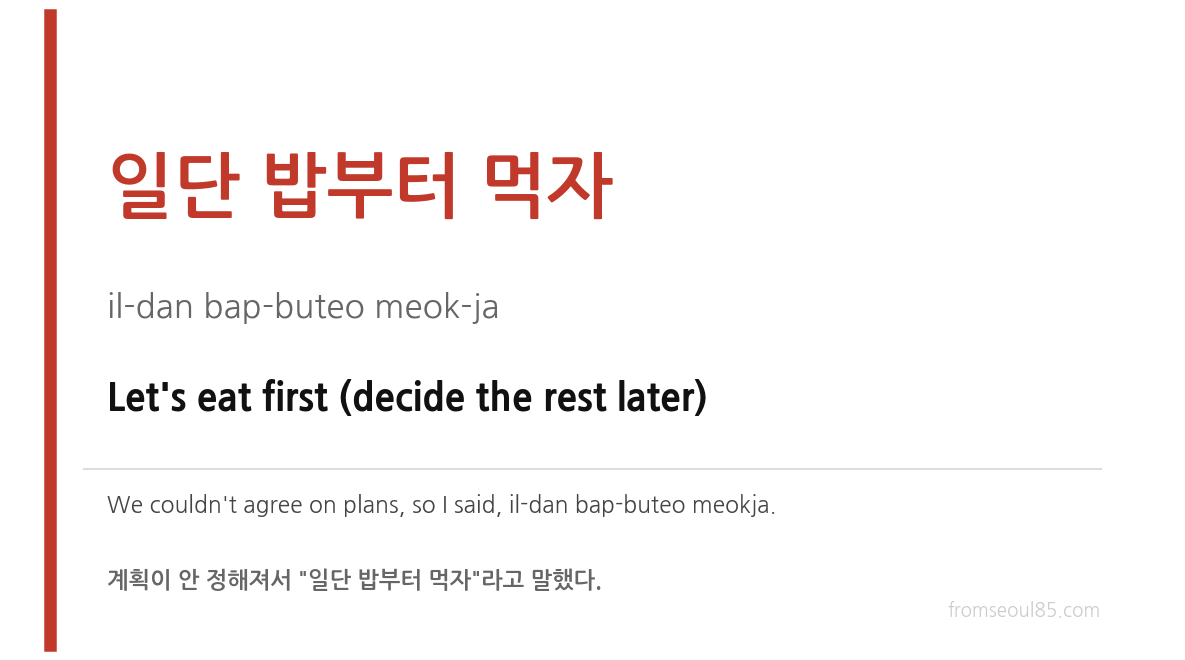
Picture this. It’s 7 PM and you just left work with a friend. You’re hungry, but they want to check three different restaurants before deciding. You might say, 일단 밥부터 먹자 (il-dan bap-buteo meokja — let’s eat first, decide the rest later). It puts one action ahead of everything else, without shutting out the other options.
When I use this kind of sentence with a close friend, I usually just say it in casual speech: “일단 밥부터 먹자.” With coworkers or people I’m not that close with, I switch it to something more polite, like “일단 식사부터 하시죠” (il-dan siksa-buteo hasijyo — let’s eat first, shall we). But honestly, I use the casual version way more often in real life. The polite version shows up mostly at work, when I want to sound respectful but still move the group forward.
Picking a Starting Point When Nothing Is Set
Now imagine you’re planning a trip with friends, but nobody has booked anything yet. Someone in the group says, 일단 이 날짜로 하자 (il-dan i nal-jja-ro haja — let’s go with this date for now). Nothing is locked in, but the group needs a starting point to move from.
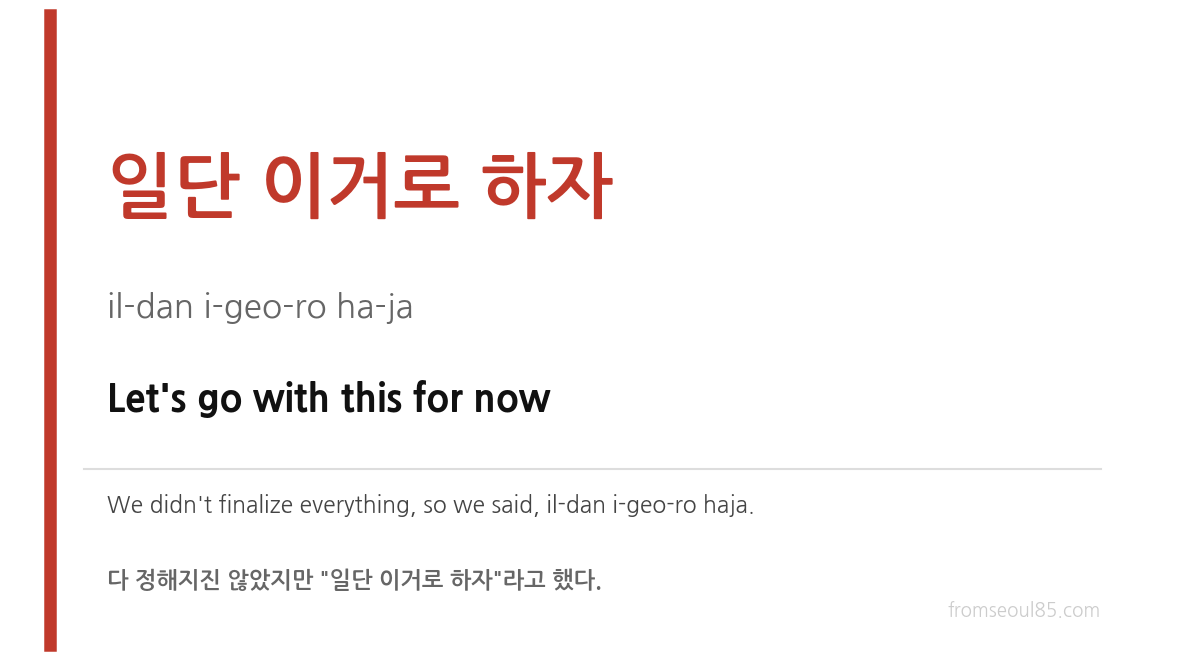
When things feel too open-ended, I often say something like “일단 이걸로 정하고 나중에 바꾸자” (il-dan i-geol-lo jeonghago najunge bakkuja — let’s decide on this for now, and change it later if we need to). Sometimes I keep it even shorter: just “일단 이거로 하자” (il-dan i-geo-ro haja — let’s go with this for now). It’s not a real commitment. It’s more like agreeing to stop debating so the plan can actually move somewhere.
Using Ildan to Buy Time with Your Boss
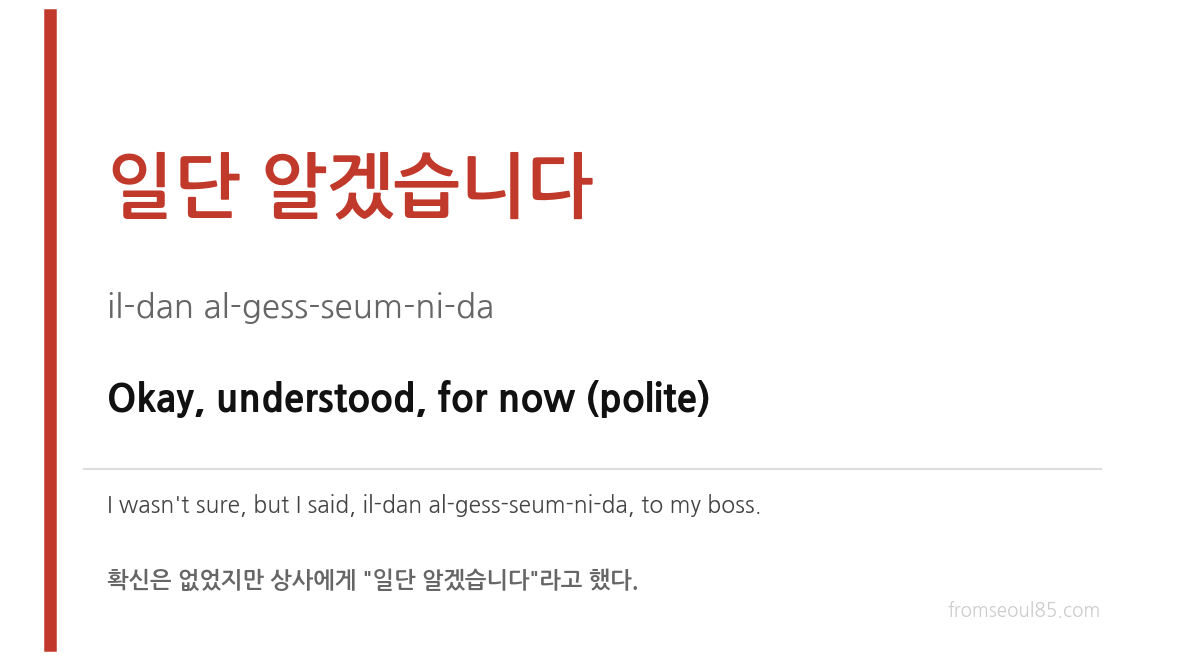
Your boss suggests a plan you’re not totally sure about. Arguing on the spot feels risky, so instead you might say, 일단 알겠습니다 (il-dan al-gess-seum-ni-da — okay, understood, for now). It buys you time without fully committing to the idea.
In these moments, if it’s a polite setting, I’ll say “일단 알겠습니다” and bring up my concerns later, once I’ve had time to think it through. With friends, the tone drops completely. I just say “일단 알겠어” (il-dan al-gess-eo — okay, got it for now) or “일단 그렇게 해” (il-dan geureoke hae — let’s just do it that way for now). Neither version means full agreement. It just means “let’s not fight about this right now.”
Ildan Haeboja: Just Start and See
Sometimes a project feels too big to plan out completely before you begin. A friend tells you, 일단 해보자 (il-dan hae-boja — let’s just start and see). It gives you permission to begin without knowing the whole path yet.
I say this one to myself a lot, almost as a small pep talk. Something like “일단 해보자 뭐” (il-dan hae-boja mwo — let’s just try it, whatever), usually when I’m stuck overthinking something. When I say it to someone else, it’s usually softer: “일단 한번 해보자” (il-dan han-beon hae-boja — let’s just give it a try). Both versions carry the same idea: stop waiting for a perfect plan and just move.

Don’t Overuse Ildan: The Difference Between Ildan and Useon
Some learners start almost every sentence with 일단, trying to sound natural. But leaning on it as a filler word can actually feel awkward, not fluent. If you use it too many times in a row, it starts to sound a bit scattered, like you can’t finish a thought before moving to the next one.
일단 also has a close cousin: 우선 (woo-seon — first, more formal). The two overlap, but they’re not identical. 우선 feels stiffer and more formal, the kind of word you’d expect in a report or a formal announcement. 일단 feels relaxed and conversational, the word you’d use with friends or coworkers in everyday speech. If you’re speaking casually, 일단 usually fits better. If you’re writing something formal, 우선 tends to sound more appropriate.
A Quick Cultural Note
일단 shows up so often in Korean because a lot of daily decisions here aren’t made all at once. Plans shift, people change their minds, and conversations move fast. 일단 gives everyone a way to move forward without pretending anything is final. It’s not about being indecisive. It’s more about keeping things flexible while still making progress. If you’re learning Korean, don’t treat 일단 as a fixed translation of “first.” Treat it as a small signal that says, “this part isn’t locked in yet.”
Key Expressions
- 일단 밥부터 먹자 (il-dan bap-buteo meok-ja) — Let’s eat first (decide the rest later).
Example: We couldn’t agree on plans, so I said, il-dan bap-buteo meokja. - 일단 이거로 하자 (il-dan i-geo-ro ha-ja) — Let’s go with this for now.
Example: We didn’t finalize everything, so we said, il-dan i-geo-ro haja. - 일단 알겠습니다 (il-dan al-gess-seum-ni-da) — Okay, understood, for now (polite).
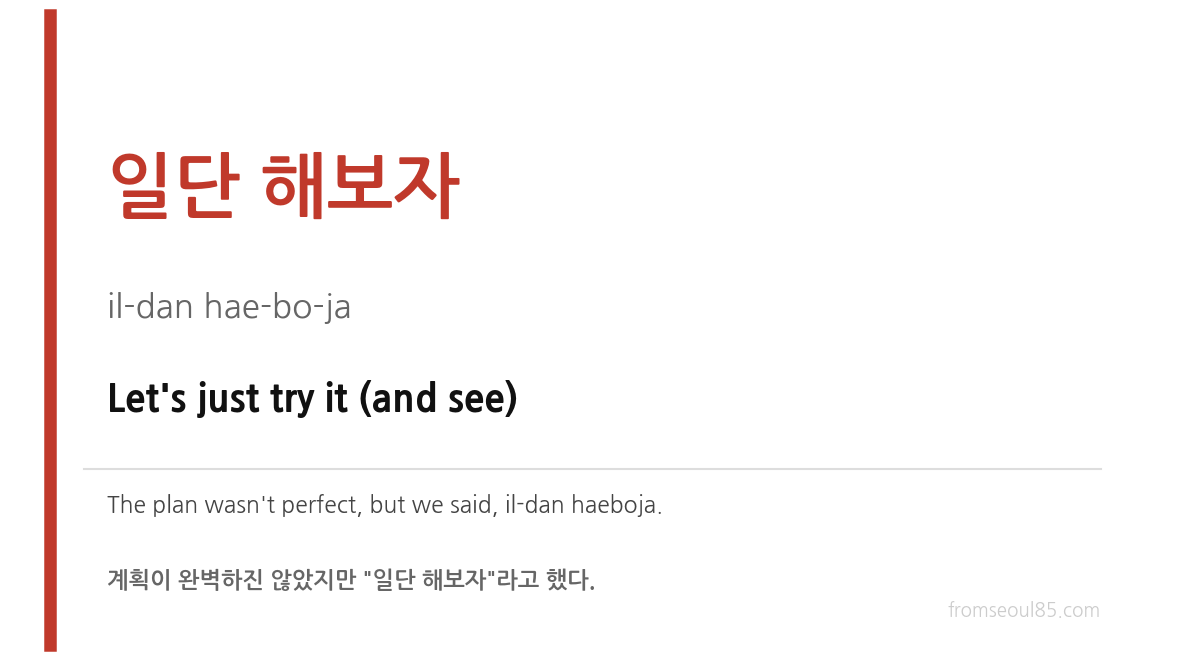
Example: I wasn’t sure, but I said, il-dan al-gess-seum-ni-da, to my boss. - 일단 해보자 (il-dan hae-bo-ja) — Let’s just try it (and see).
Example: The plan wasn’t perfect, but we said, il-dan haeboja.
A Few Practical Tips
If you want to sound natural, try using 일단 once per conversation, not once per sentence. Pair it with a clear action, like 일단 밥부터 먹자 or 일단 해보자, rather than dropping it in alone. And if you’re speaking to someone above you at work, remember that 일단 alone can sound a bit blunt. Adding 알겠습니다 or 하시죠 softens it into something respectful. If you want to go deeper into words Koreans use to soften or delay a decision, the post on daechung meaning covers a related idea, roughly doing something without full commitment. For a broader reference on how Korean adverbs and connective words function in real sentences, the Wikipedia entry on Korean grammar is a solid starting point.
Written by a native Korean speaker born in Seoul in 1985. This is my personal experience. Other Koreans may see things differently.