If you spend any time listening to Korean conversations, you will hear one word over and over: 일단 (il-dan). The ildan meaning in Korean is trickier than it looks, because this small word changes shape depending on the sentence. Sometimes it means “first.” Sometimes it means “for now.” Sometimes it barely means anything at all, it just keeps the conversation moving forward. Learners often translate 일단 as “first” every single time, and that is exactly why it feels confusing. One English word cannot cover everything 일단 does.
I use 일단 almost every day, often without even noticing I said it. As an ordinary Korean guy from Seoul, this word just comes out of my mouth on its own. This morning I told my kids, 일단 씻고 나와 (il-dan ssit-go na-wa, wash up first and come out), without thinking about it at all. It wasn’t really about “doing it first” in a strict order. It was more like sorting out what to do next, even when nothing is fully decided yet. That loose, in-between feeling is the real key to understanding this word.

Ildan Meaning in Korean: “Do This First, Figure Out the Rest Later”
Picture this. You and your friends are starving, but you’re still arguing about where to eat. Someone finally cuts the debate short. This is the most common use of 일단, and honestly the closest to the textbook meaning of “first.”
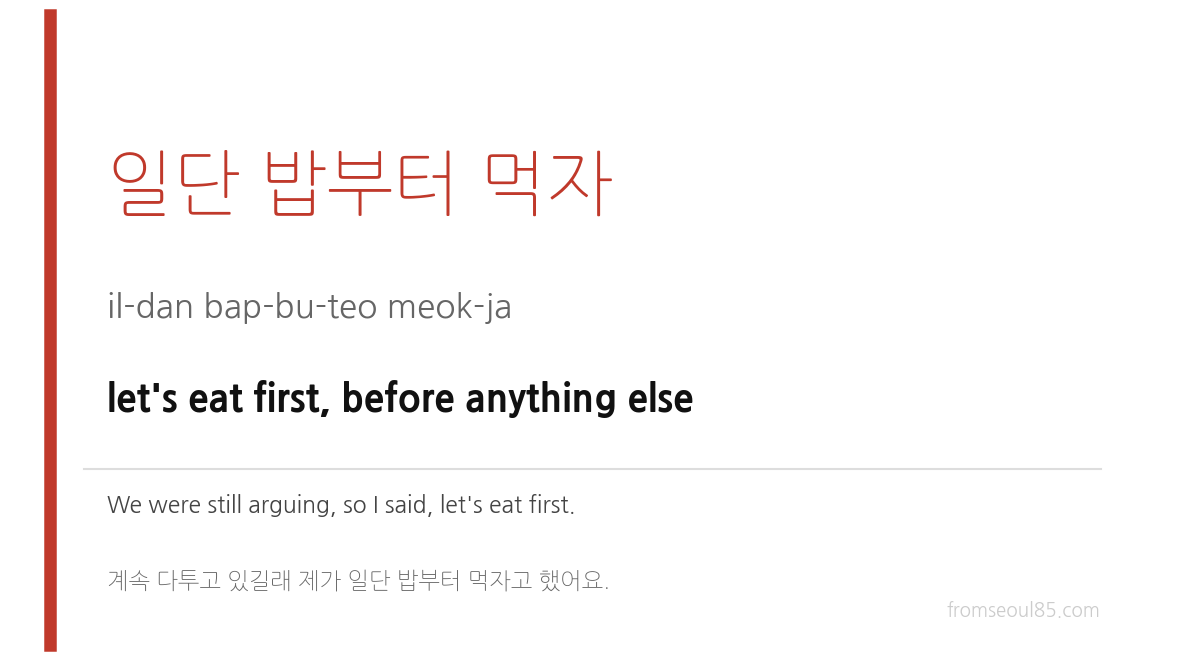
They might say 일단 밥부터 먹자 (il-dan bap-bu-teo meok-ja, let’s eat first and figure out the details later). Here, 일단 means “before anything else.” Do this one thing now, and sort out the rest after. I say some version of this constantly. When my friends and I can’t agree on a restaurant, I usually just say 일단 먹고 얘기하자 (il-dan meok-go yae-gi-ha-ja, let’s eat first and talk after that), or even simpler, 일단 아무거나 시키자 (il-dan a-mu-geo-na si-ki-ja, let’s just order something for now).
At work, it sounds more polite. If we’re at a company dinner and everyone is still browsing the menu, I might say 일단 주문부터 할까요? (il-dan ju-mun-bu-teo hal-kka-yo, shall we order first?). A more formal version you’ll hear from someone hosting a meal is 일단 식사부터 하시죠 (il-dan sik-sa-bu-teo ha-si-jyo, let’s eat first, shall we). In all of these, 일단 is doing the same job: it pushes the group past a stuck moment so things can keep moving.
Ildan as “For Now”: A Provisional Yes, Not a Final Answer
Imagine your boss asks if Friday’s meeting time works for you. You’re not fully sure yet, but you need to answer something right now. This is where 일단 stops meaning “first” and starts meaning “for now.”
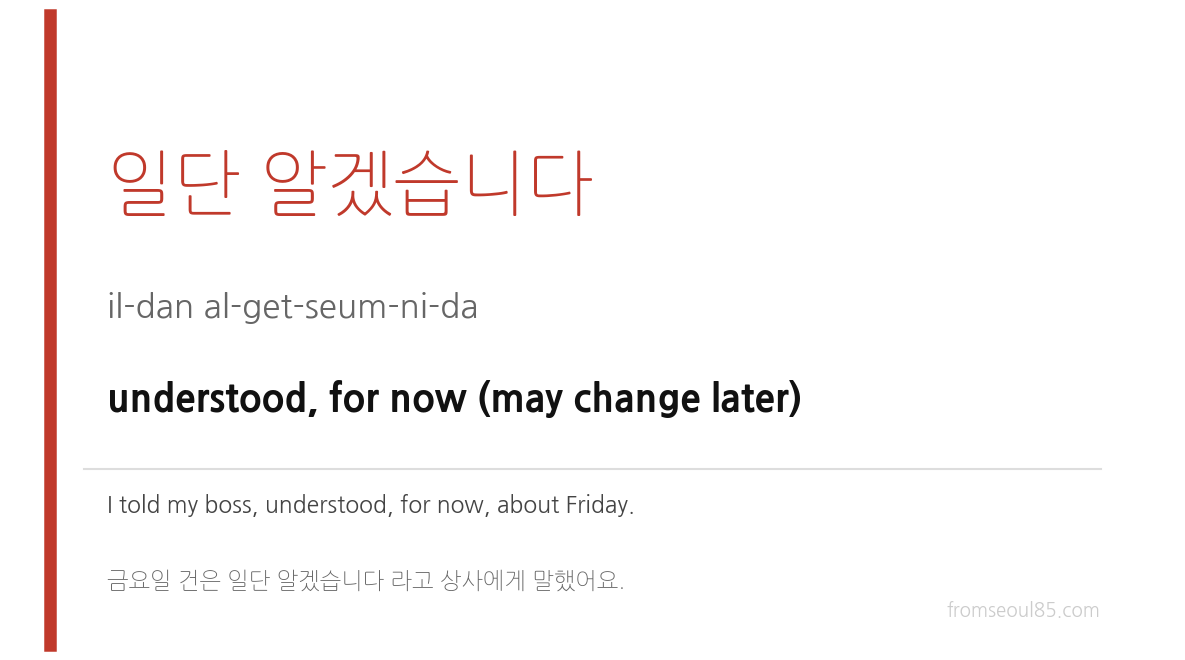
You might say 일단 알겠습니다 (il-dan al-get-seum-ni-da, understood, for now, or I’ll go with that for now). This 일단 signals your answer could change later. It is not a firm, final yes. In my own work life, I say 일단 그렇게 알고 있을게요 (il-dan geu-reo-ke al-go i-sseul-ge-yo, I’ll go with that for now) a lot in emails and messages to my boss, because it keeps the door open without sounding like I’m refusing anything.
With a friend, the same idea gets much shorter and more casual. I might just text back 일단 오케이 (il-dan o-ke-i, okay for now), or say 일단 그러자, 나중에 바뀌면 말해 (il-dan geu-reo-ja, na-jung-e ba-kki-myeon mal-hae, let’s go with that for now, tell me if it changes). If you only know 일단 as “first,” a sentence like this sounds strange in English. But once you hear it as “for now,” it clicks immediately.
Ildan for Changing the Subject: “Anyway, Setting That Aside”
Picture a conversation that has drifted way off topic. You want to steer it back to what actually matters. This is another common job for 일단, and here it works a lot like the English word “anyway.”
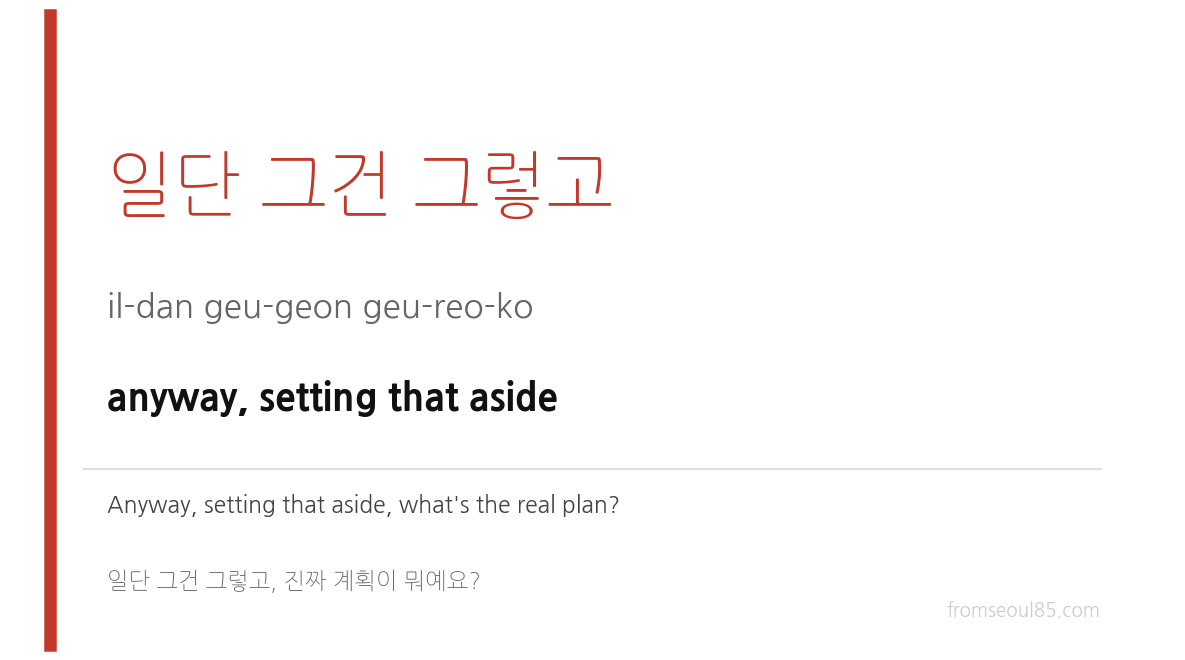
You might say 일단 그건 그렇고 (il-dan geu-geon geu-reo-ko, anyway, setting that aside). It parks one topic so you can focus on another. When a conversation goes off on a tangent with my friends, I’ll usually just cut in with 그건 일단 됐고 (geu-geon il-dan dwaet-go, forget that for now), or 일단 그 얘기는 다음에 하고 (il-dan geu i-ya-gi-neun da-eum-e ha-go, let’s leave that topic for later).
When I need to be more polite, especially in a work setting, I soften it into a question: 그 얘기는 일단 나중에 다시 할까요? (geu i-ya-gi-neun il-dan na-jung-e da-si hal-kka-yo, shall we come back to that topic later?). It gets the same result, redirecting the conversation, but it sounds much gentler than just cutting someone off.
Ildan for Pushing Past Doubt: “Just Try It”
Think about starting something risky, like a new hobby or a side project you’re not sure will work out. A friend might use 일단 to give you a small push.

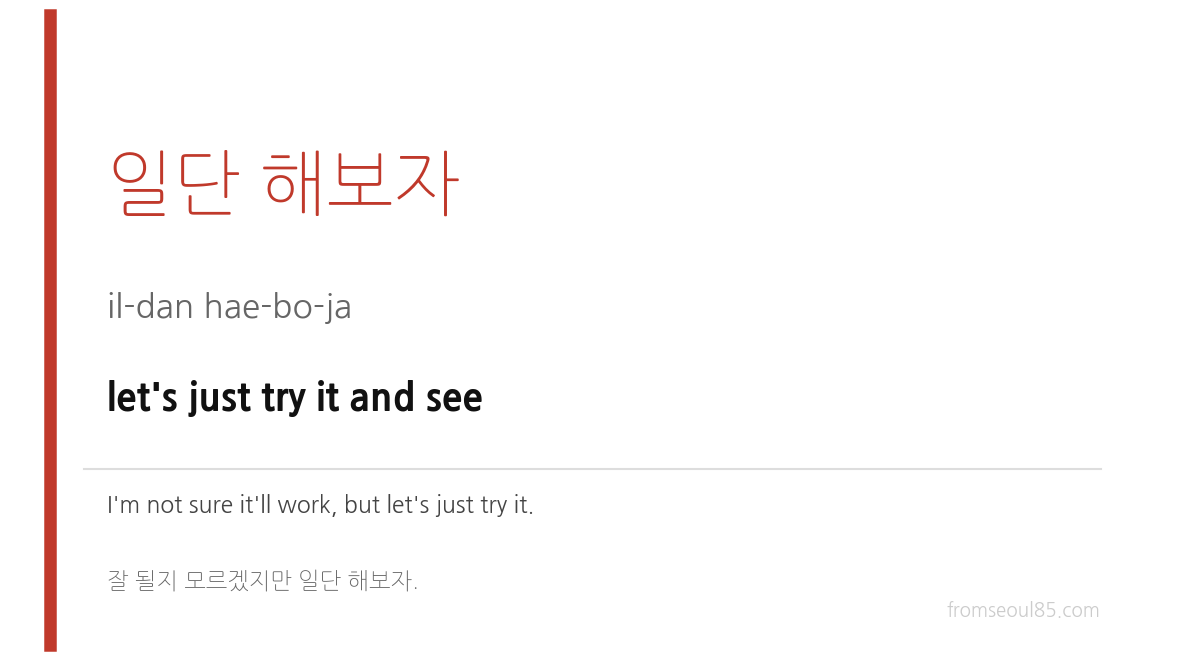
They might say 일단 해보자 (il-dan hae-bo-ja, let’s just try it and see). Here 일단 pushes you to act despite the doubt, worry about the outcome later. Among friends, I say it a bit more bluntly, something like 일단 저질러 (il-dan jeo-jil-leo, just go for it), or 일단 해봐, 안 되면 말고 (il-dan hae-bwa, an doe-myeon mal-go, just try it, and if it doesn’t work out, drop it).
A more formal, encouraging version is 일단 한번 해보시죠 (il-dan han-beon hae-bo-si-jyo, why don’t you just give it a try), or slightly gentler, 일단 한번 해보시는 게 어때요? (il-dan han-beon hae-bo-si-neun ge eo-ttae-yo, how about just giving it a try?). This use of 일단 is honestly one of my favorites, because it captures something very Korean: move first, think later, and don’t let uncertainty stop you completely.
What Ildan Doesn’t Mean, and a Note on Habit
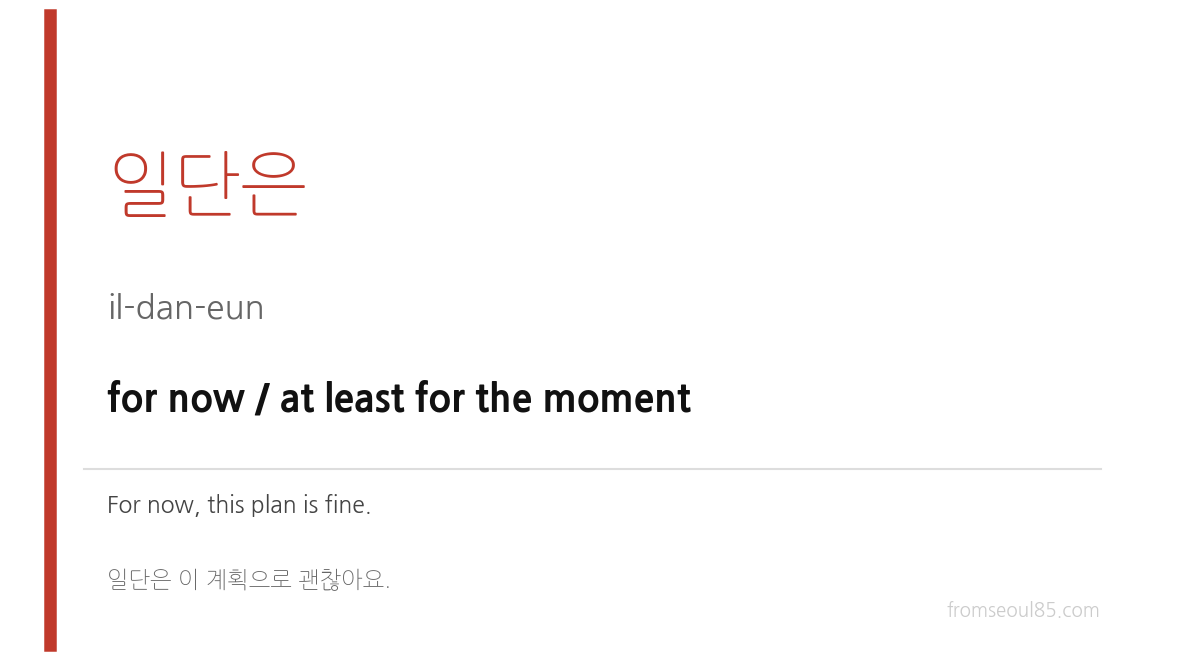
One thing worth knowing: 일단 isn’t always about order. It’s more about taking a provisional stance on something, a placeholder answer or action while the full picture is still unclear. Learners sometimes translate every 일단 as “first,” which can sound stiff or slightly off in English. A phrase like 일단은 이 계획으로 괜찮아요 (il-dan-eun i gye-hoek-eu-ro gwaen-cha-na-yo, for now, this plan is fine) isn’t saying the plan comes first in a list. It’s saying the plan is acceptable, at least for the moment.
Also, some Koreans repeat 일단 like a filler word, almost without meaning, just a habit. My team leader at work is a good example. He puts 일단 in front of nearly every sentence. He’ll say things like 일단, 일단 이거부터 보고, 일단 이따 얘기해요 (il-dan, il-dan i-geo-bu-teo bo-go, il-dan i-tta yae-gi-hae-yo, first, let’s look at this first, we’ll talk later), stacking the word two or three times in a row. At that point it isn’t really carrying meaning anymore. It’s just how he starts talking, almost like clearing his throat. This is my personal experience, and other Koreans may see it differently, but once you notice this pattern, you’ll start hearing it everywhere.
If you’re curious about another everyday word that nudges people toward action the way 일단 해보자 does, I also wrote about how Koreans use 차라리 (charari) to suggest a better option, which pairs well with what you just learned here. For the official dictionary definition and more formal usage notes, the National Institute of Korean Language’s Standard Korean Dictionary is a solid reference, though it won’t show you the casual, everyday texture that native speakers actually use.
Key Expressions
- 일단 밥부터 먹자 (il-dan bap-bu-teo meok-ja) — let’s eat first, before anything else.
Example: We were still arguing, so I said, let’s eat first. (계속 다투고 있길래 제가 일단 밥부터 먹자고 했어요.) - 일단 알겠습니다 (il-dan al-get-seum-ni-da) — understood, for now (may change later).
Example: I told my boss, understood, for now, about Friday. (금요일 건은 일단 알겠습니다 라고 상사에게 말했어요.) - 일단 그건 그렇고 (il-dan geu-geon geu-reo-ko) — anyway, setting that aside.
Example: Anyway, setting that aside, what’s the real plan? (일단 그건 그렇고, 진짜 계획이 뭐예요?) - 일단 해보자 (il-dan hae-bo-ja) — let’s just try it and see.
Example: I’m not sure it’ll work, but let’s just try it. (잘 될지 모르겠지만 일단 해보자.) - 일단은 (il-dan-eun) — for now / at least for the moment.
Example: For now, this plan is fine. (일단은 이 계획으로 괜찮아요.)
A Couple of Practical Tips
If you want to sound natural, don’t try to translate 일단 into a fixed English word every time. Instead, ask yourself what job it’s doing in that sentence: pushing an action first, holding a provisional answer, changing the subject, or just encouraging someone to move. Once you can spot which job it’s doing, the rest of the sentence usually makes a lot more sense.
Second, don’t be afraid to use 일단 even when you’re not fully sure what to say next. That’s actually the whole point of the word. Koreans reach for it exactly in moments of uncertainty, when a decision isn’t fully made but you still need to say something and keep going. If you’re just starting to notice patterns like this, browsing more intermediate-level posts on everyday Korean expressions is a good next step.
Written by a native Korean speaker born in Seoul in 1985. This is my personal experience. Other Koreans may see things differently.