Some words are everywhere in Korean conversation. 그냥 (geu-nyang — just / no reason / whatever) is one of them. You will hear it at cafes, in offices, and at home. But most textbooks skip it or give a weak definition. So let me share the real 그냥 Korean meaning from daily life. Honestly, I don’t say it for no reason all the time. But sometimes you ask my intention, and I have nothing to say. Then 그냥 just comes out. Someone asks, “Why did you call?” I say, “그냥 — just to see how you are doing.” Then I share small daily news, or my real reason. For me, it is almost a habit. This is my personal experience — other Koreans may see it differently.
그냥: when there is no real reason
The most common use of 그냥 is simple. It says there is no real reason. Someone asks why you did something. You did not have a big reason. You just say 그냥. A friend asks why you texted them. You answer 그냥 (just because, no reason). It ends the question without sounding rude. But this works best with friends and close people. With a boss or an older person, I am more careful. I usually don’t say 그냥 to them. Instead I say 아니에요 (a-ni-e-yo — it’s nothing) or 그게… (geu-ge — well…). The same word can feel too blunt in a formal setting.

그냥 둬, 그냥 먹어: leave it as it is
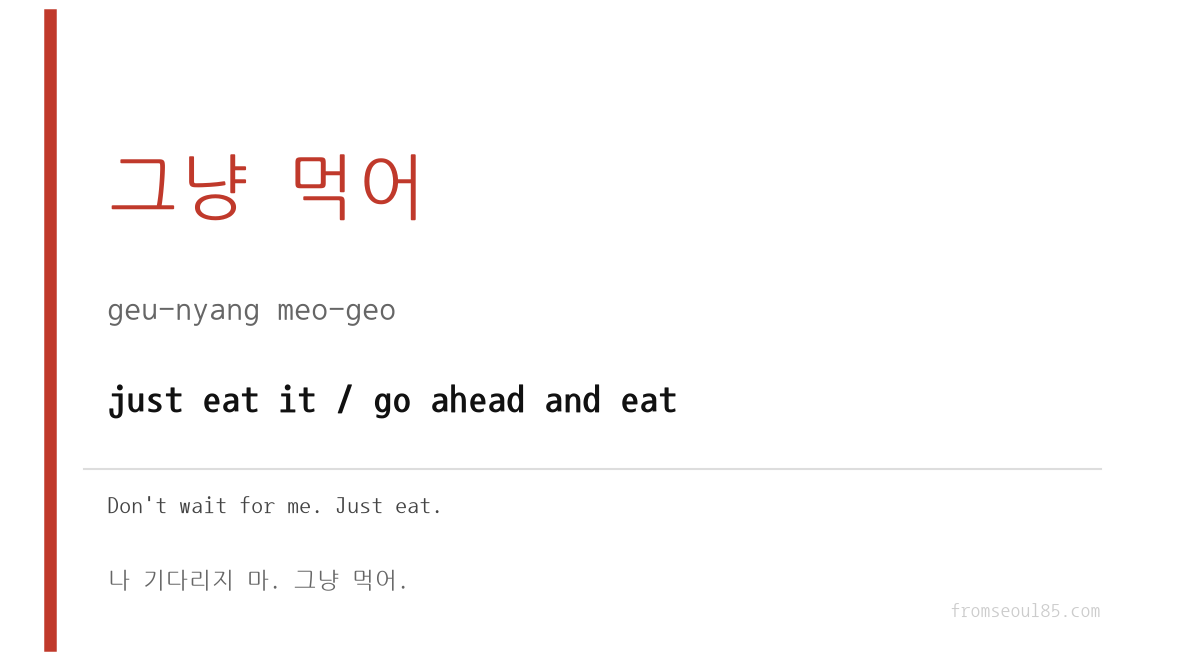
그냥 has another side too. It can mean “leave it as it is.” This feels a little different from the first meaning. When I say 그냥 둬 (geu-nyang dwo — just leave it), I mean: don’t bother. Just stay still, don’t make a fuss. When I say 그냥 먹어 (geu-nyang meo-geo — just eat it), I mean: don’t be picky. Just eat, don’t make it complicated. Here 그냥 tells the other person to relax. It says: don’t overthink this small thing.
그냥 하자: ending a hard decision
Sometimes 그냥 helps you end a hard decision. You can’t choose between this or that. Or you wonder if the choice even matters. That is when I say 그냥 하자 (geu-nyang ha-ja — let’s just do it). It means: stop overthinking, let’s go. For me, it is less about being polite. It is more about ending the worry. When a choice won’t change much, 그냥 하자 closes it.

Does 그냥 sound cold? It depends
People say 그냥 can sound cold or dismissive. But here is how I really feel about it. When I hear someone answer 그냥, I am not hurt. I think: ah, they don’t want to talk now. Maybe there is a story behind it. Tone and facial expression matter, of course. But to me, 그냥 is more of a quiet signal. It often means: not now, maybe later. So the word 그냥 itself is neutral. The feeling behind it tells you more than the word. This is my personal experience — other Koreans may see it differently.
How to learn the 그냥 Korean meaning naturally
One last thing: 그냥 can also be kind. Say a friend looks tired or doesn’t want to go out. I might say 그냥 집에서 쉬어 (geu-nyang jip-e-seo swi-eo — just rest at home). It means: don’t push yourself, let’s meet next time. So 그냥 is not only about having no reason. Sometimes it shows that you care. If you want to sound natural, start noticing 그냥 in real talk. You will hear it again and again. Watch for the moment a speaker pauses and says 그냥. That pause, instead of a long reason, is the real lesson.
Key Expressions
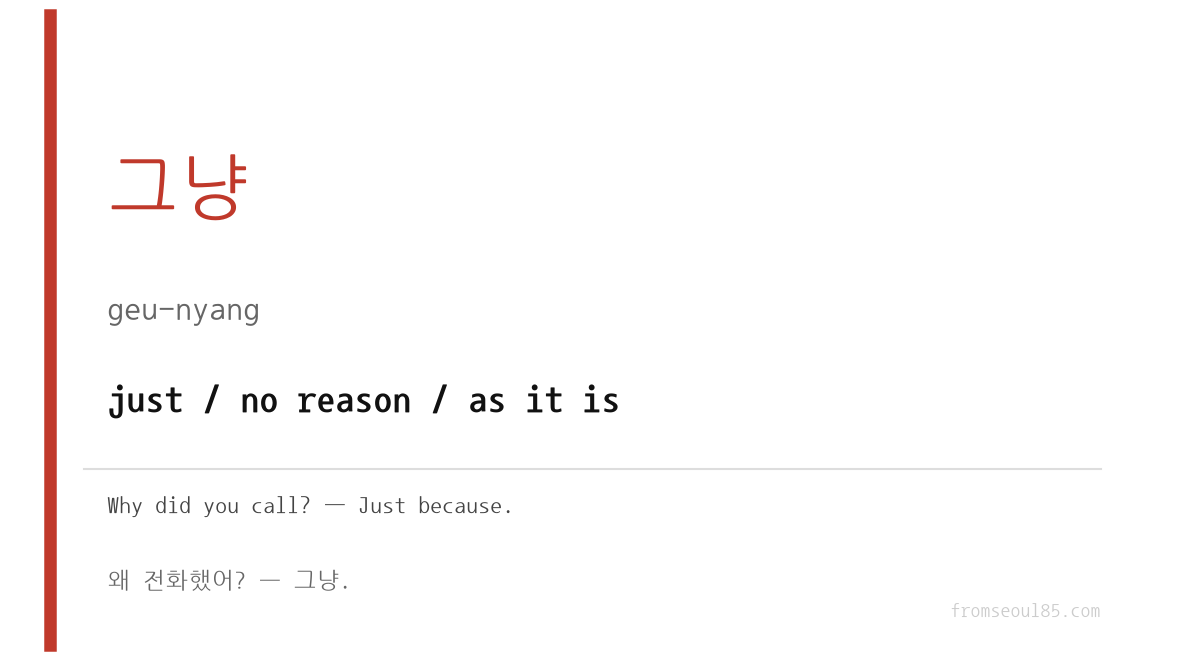
그냥 (geu-nyang — just / no reason / as it is)
Why did you call? — Just because.
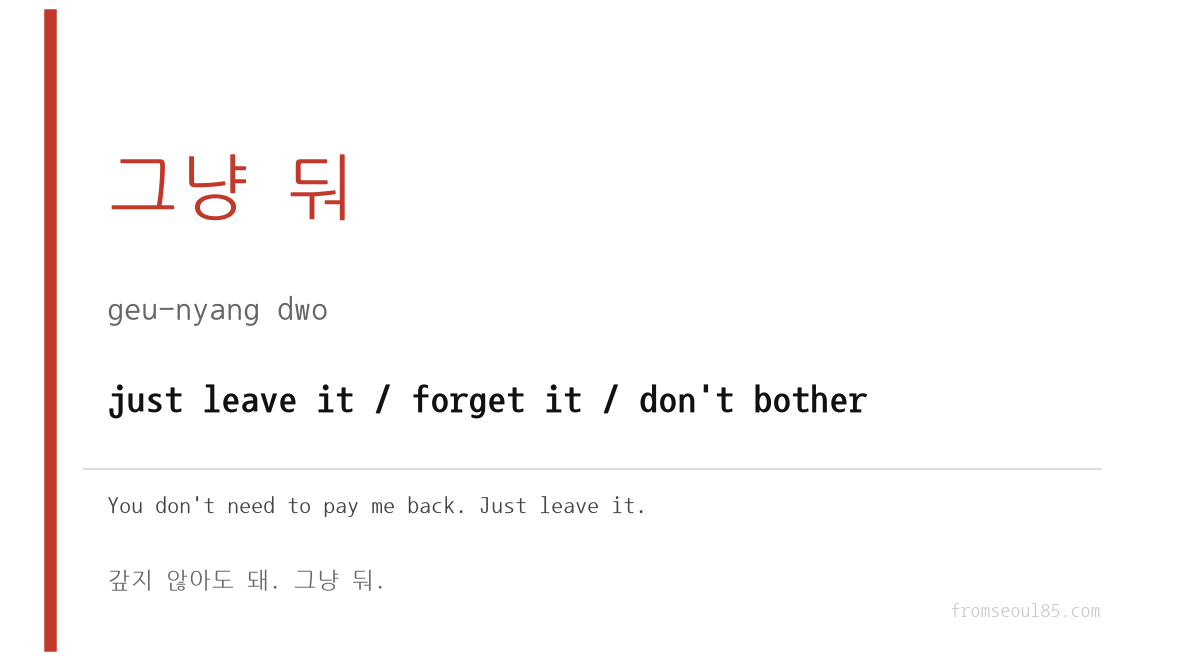
그냥 둬 (geu-nyang dwo — just leave it / forget it / don’t bother)
You don’t need to pay me back. Just leave it.
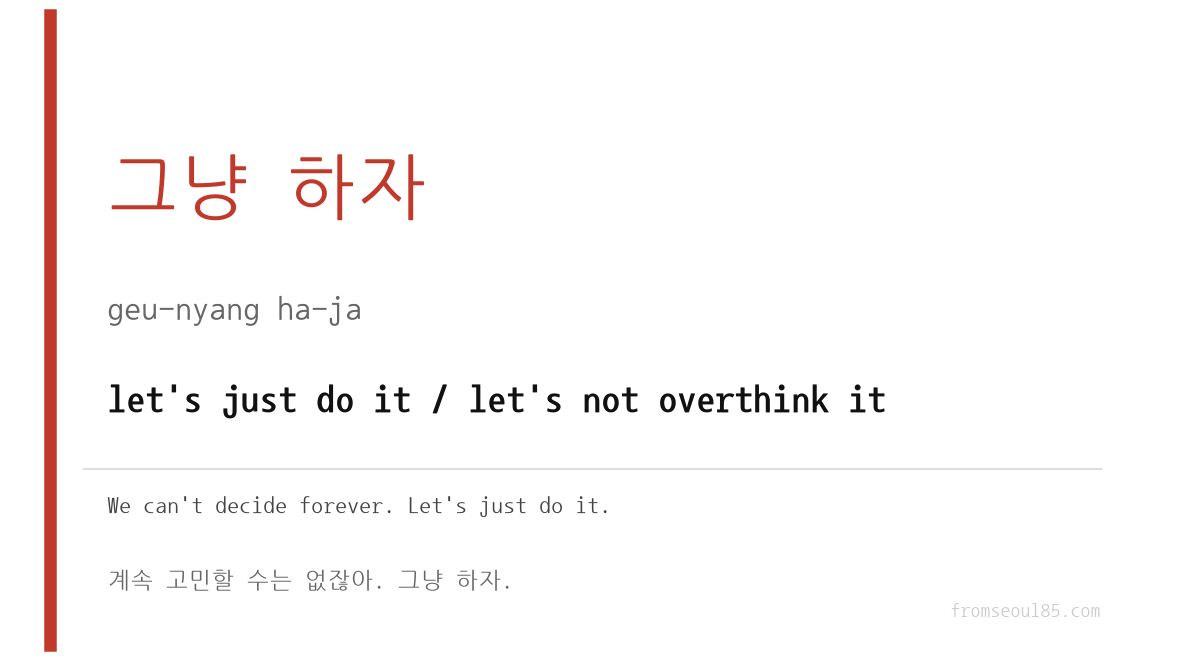
그냥 하자 (geu-nyang ha-ja — let’s just do it / let’s not overthink it)
We can’t decide forever. Let’s just do it.
그냥 먹어 (geu-nyang meo-geo — just eat it / go ahead and eat)
Don’t wait for me. Just eat.
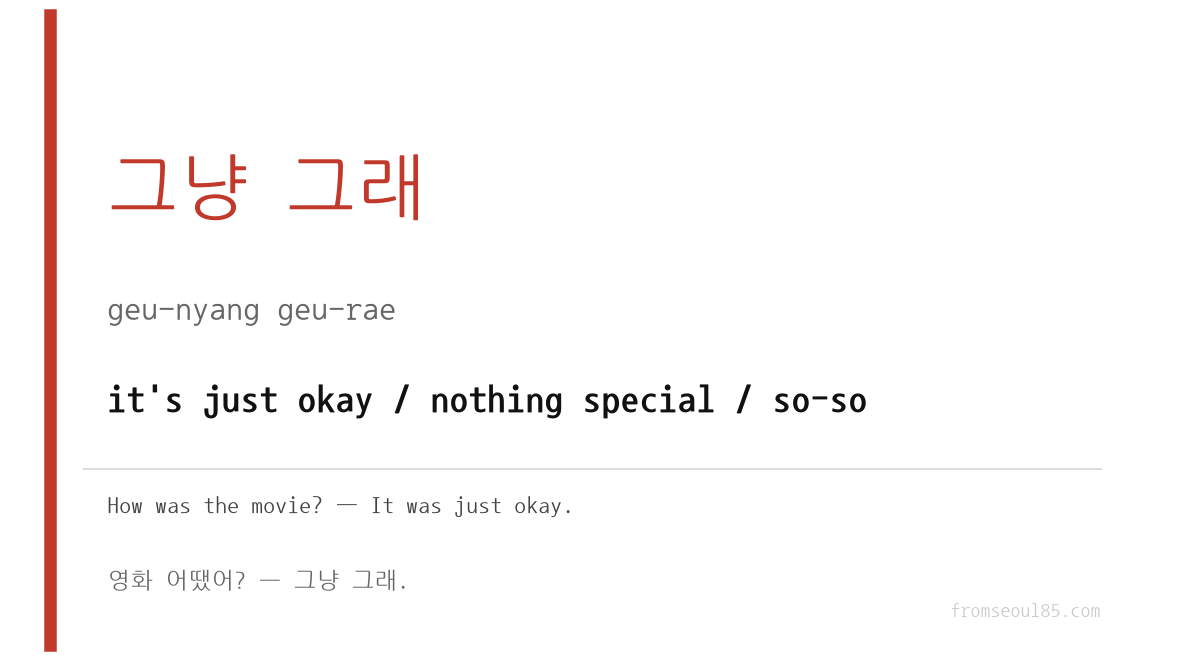
그냥 그래 (geu-nyang geu-rae — it’s just okay / nothing special / so-so)
How was the movie? — It was just okay.
Written by a native Korean speaker born in Seoul in 1985. This is my personal experience. Other Koreans may see things differently.