You’re watching a Korean drama. A character sighs and says 차라리 죽고 싶다 (cha-ra-ri jug-go sip-da). Your dictionary shows the charari meaning as simply “rather.” But that translation feels flat here.
In real life, Koreans use 차라리 (cha-ra-ri) constantly. We use it for hard choices, for frustration, and for regret. It signals “this option beats that one,” even when both options are bad. A common line you’ll hear is 차라리 집에 있을걸 (cha-ra-ri jib-e iss-eul-geol, meaning “I should’ve just stayed home”).
For me, 차라리 shows up most when I really don’t want to do something. I’ll mutter, “아 차라리 그냥 하지 말까” (a cha-ra-ri geu-nyang ha-ji mal-kka, “ugh, maybe I should just not do it”). Or when I’m comparing two bad options, I’ll say “이럴 거면 차라리 저게 낫겠다” (i-reol geo-myeon cha-ra-ri jeo-ge nat-get-da, “if it’s going to be like this, that other one is better”). Looking back on a choice, “아 차라리 그때 갈걸” (a cha-ra-ri geu-ttae gal-geol, “ugh, I should’ve just gone then”) comes out on its own. This is my personal experience. Other Koreans may see it differently.
Charari Meaning: Choosing the Lesser Evil
Picture this. You have to pick between two things you don’t want. Maybe it’s a boring work dinner or unpaid overtime. Koreans use 차라리 to name the option that hurts less.
When I’m stuck between two bad choices like that, I’ll just say it casually: “아 차라리 야근할래” (a cha-ra-ri ya-geun-hal-lae, “ugh, I’d rather just work overtime”). In a more polite setting, I’d soften it to “차라리 야근하는 게 나을 것 같아요” (cha-ra-ri ya-geun-ha-neun ge na-eul geot ga-ta-yo, “it seems better to just work overtime”). Sometimes I skip the explanation entirely and just say “차라리 이게 낫다” (cha-ra-ri i-ge nat-da, “this one’s better”), short and direct.
Venting Frustration on a Bad Day
Now picture a day where everything goes wrong at work. You’re tired, annoyed, and ready to give up on the whole thing. Koreans reach for 차라리 here too, often with some exaggeration, just to let the frustration out.
I do this a lot. When something is really annoying, I’ll say “아 차라리 관두고 말지” (a cha-ra-ri gwan-du-go mal-ji, “ugh, I’d rather just quit”). On a really bad day, I might even say something bigger, like “차라리 나가 죽는 게 낫겠다” (cha-ra-ri na-ga jug-neun ge nat-get-da). That phrase sounds extreme in English, and it’s dramatic in Korean too. It’s not a literal wish. It’s closer to the English “I could just die” when something goes badly. It’s venting, not a real statement of intent. I only say this kind of line with close friends. It doesn’t belong in polite speech, and it would sound strange or worrying coming from someone you don’t know well.

Telling a Friend What They Should’ve Done
A friend complains, “오늘 모임 진짜 별로였어” (today’s meetup was really awkward). You respond with a 차라리 suggestion, pointing to the better path they should’ve taken.
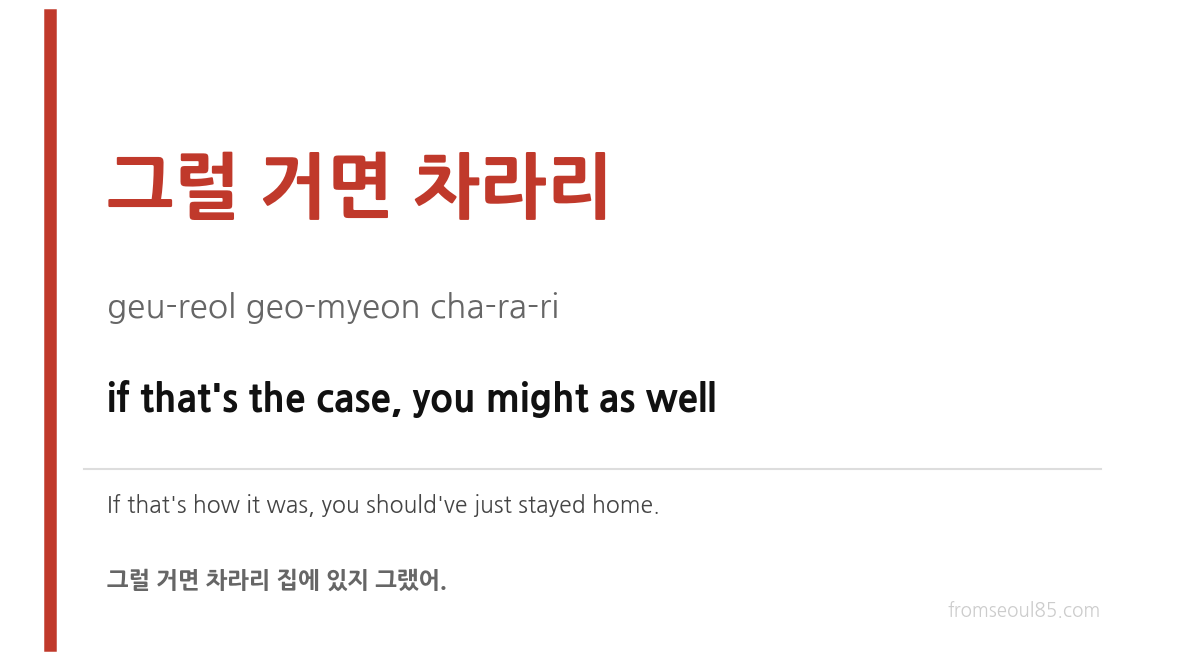
My usual response is “그럴 거면 차라리 집에 있지 그랬어” (geu-reol geo-myeon cha-ra-ri jib-e iss-ji geu-raess-eo, “if it was going to be like that, you should’ve just stayed home”). Sometimes I phrase it a little differently: “그냥 차라리 안 가는 게 나았겠다” (geu-nyang cha-ra-ri an ga-neun ge na-ass-get-da, “you probably should’ve just not gone”). If I’m speaking more politely, I’ll soften it to “차라리 안 가시는 게 나았을 것 같아요” (cha-ra-ri an ga-si-neun ge na-ass-eul geot ga-ta-yo, “it probably would’ve been better not to go”).
Regret With Charari ~Hal-geol
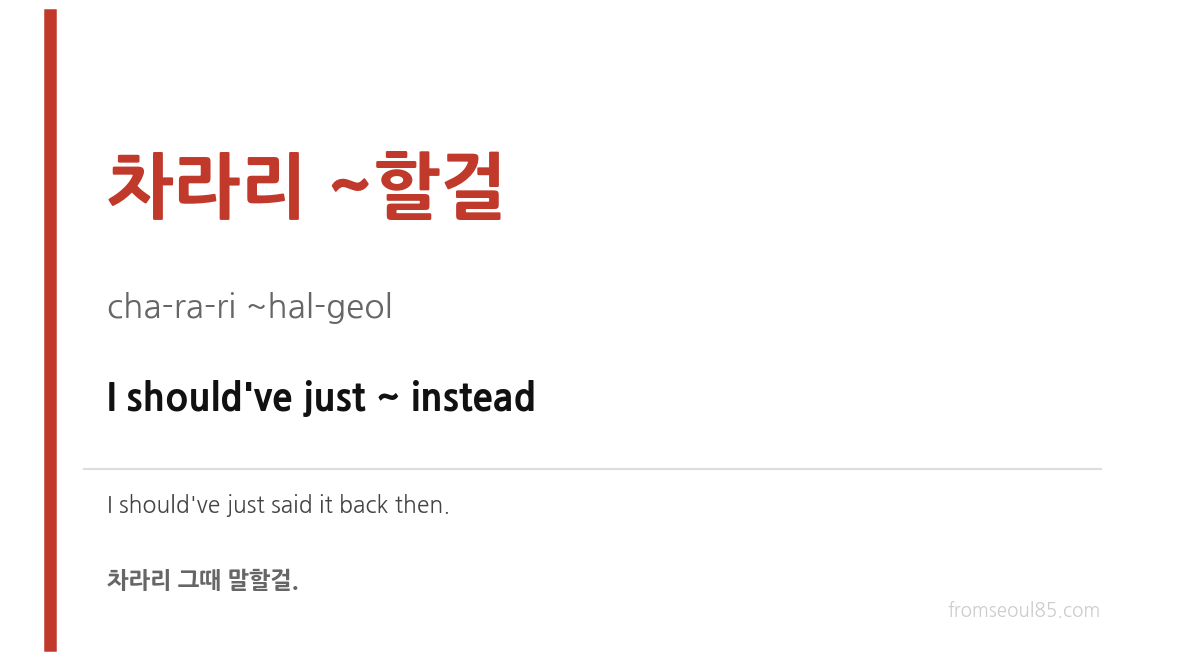
Looking back on a missed chance, you wish you’d chosen differently. Koreans pair 차라리 with the ending ~할걸 (-hal-geol) to express exactly this kind of regret.
I use this one when I’m replaying something in my head. “아 차라리 그때 말할걸” (a cha-ra-ri geu-ttae mal-hal-geol, “ugh, I should’ve just said it then”) is a line I’ve said out loud more than once. Or sometimes it’s shorter: “차라리 안 할걸” (cha-ra-ri an hal-geol, “I should’ve just not done it”). This form has a self-talk feel to it. It’s built for casual speech, almost like thinking out loud, so I almost never use it in a polite context.
Charari vs Ohiryeo Difference
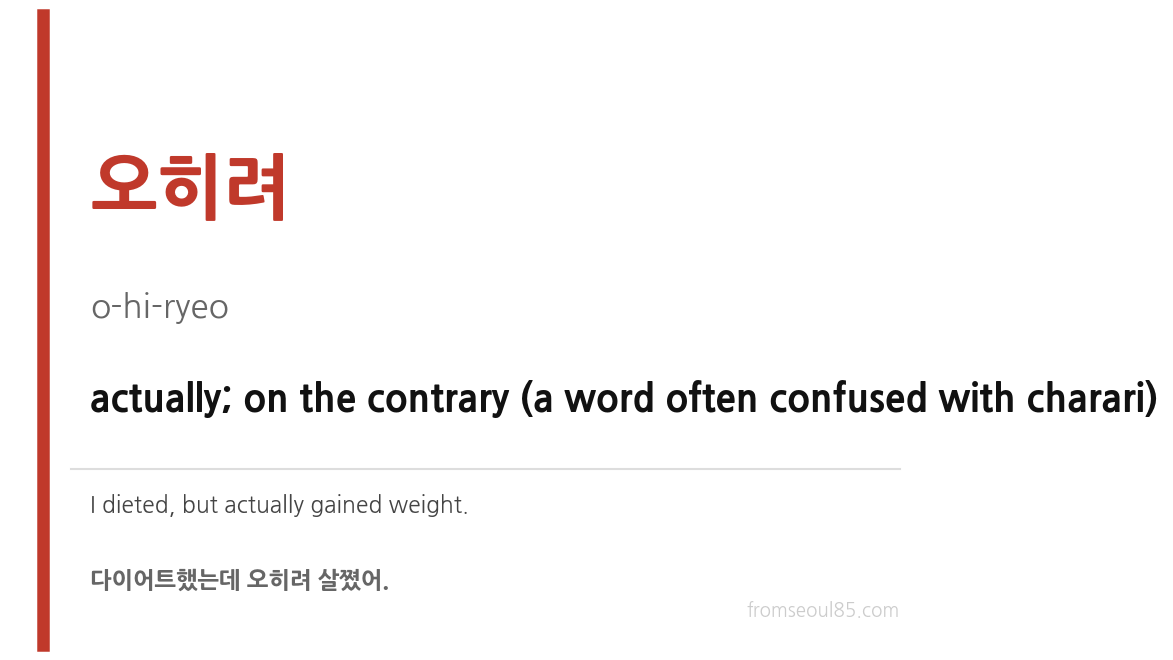
Learners often mix up 차라리 with 오히려 (o-hi-ryeo, “actually” or “on the contrary”), since both can show up in sentences that compare two things.
To me, the two feel pretty distinct. 차라리 is about choosing. It says “this option is better,” like in 차라리 굶는 게 낫다 (cha-ra-ri gum-neun ge nat-da, “I’d rather just skip eating”). 오히려 is about flipping an expectation. It says the opposite of what you’d expect happened, like in 다이어트했는데 오히려 살쪘어 (da-i-eo-teu-haess-neun-de o-hi-ryeo sal-jjeoss-eo, “I dieted, but actually gained weight”). Once you see them side by side like that, they don’t feel that confusing. One picks a winner between two options. The other points out a surprise result.
A Few Things to Keep in Mind
Most of the 차라리 phrases above are casual. The ~할걸 regret form especially sounds like talking to yourself, so save it for friends or your own inner monologue, not for a boss or someone older. Exaggerated lines, like the “rather quit” or “rather die” type of venting, only work with people who already know you’re just letting off steam. Said the wrong way to the wrong person, they can come across as more serious than you mean them to be.
It also helps to notice that 차라리 rarely stands alone. It usually shows up next to a comparison, something like “이거보다 차라리,” “그럴 거면 차라리,” or a straight 게 낫다 (ge nat-da, “is better”) ending. If you’re learning to spot 차라리 in the wild, that pattern is your best clue. For more on how Koreans vent and complain in everyday speech, the post on how Koreans sigh, vent, and complain with 어휴 covers a related habit worth knowing.

Wrapping Up
차라리 isn’t a fancy word, but it carries real feeling every time it’s used. It shows up when someone is choosing between two flawed options, letting off steam about a rough day, or replaying a choice they regret. Once you notice the 게 낫다 or ~할걸 pattern next to it, the charari meaning becomes much easier to catch in dramas, conversations, and everyday complaints. If you want a dictionary-level definition to compare against everyday use, the Standard Korean Language Dictionary from the National Institute of Korean Language is a solid reference.
Try listening for it the next time you watch something in Korean. Once you catch it once, you’ll start hearing it everywhere.
Key Expressions
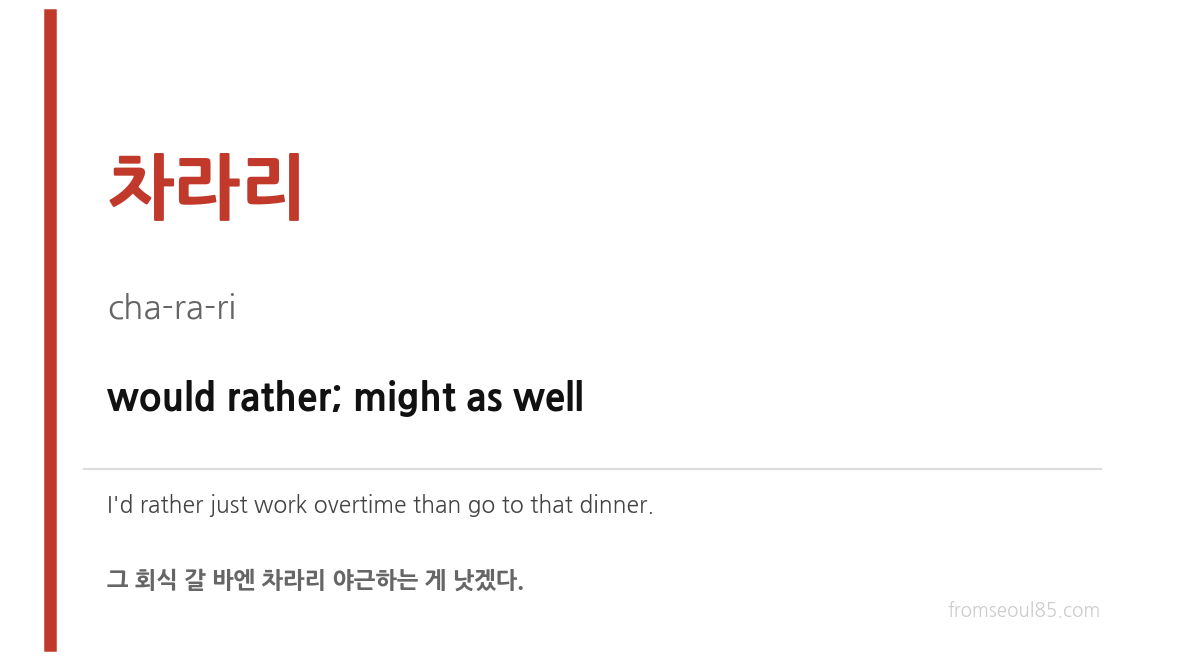
- 차라리 (cha-ra-ri) — would rather; might as well
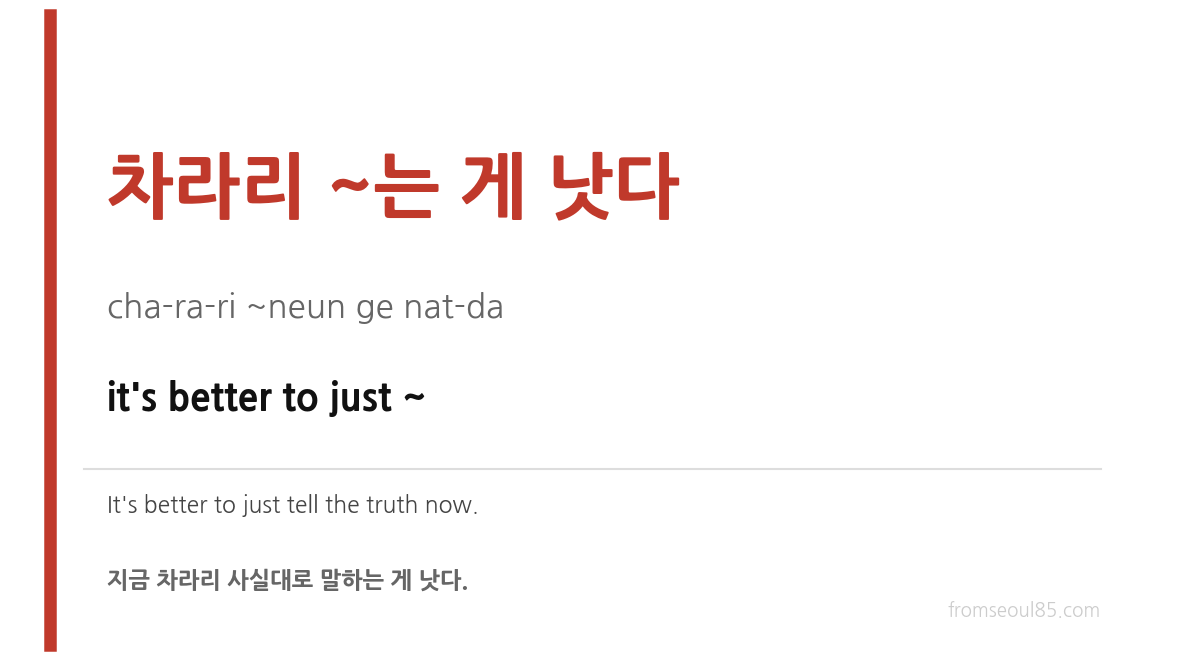
Example: 그 회식 갈 바엔 차라리 야근하는 게 낫겠다. (I’d rather just work overtime than go to that dinner.) - 차라리 ~는 게 낫다 (cha-ra-ri ~neun ge nat-da) — it’s better to just ~
Example: 지금 차라리 사실대로 말하는 게 낫다. (It’s better to just tell the truth now.) - 그럴 거면 차라리 (geu-reol geo-myeon cha-ra-ri) — if that’s the case, you might as well
Example: 그럴 거면 차라리 집에 있지 그랬어. (If that’s how it was, you should’ve just stayed home.) - 차라리 ~할걸 (cha-ra-ri ~hal-geol) — I should’ve just ~ instead
Example: 차라리 그때 말할걸. (I should’ve just said it back then.) - 오히려 (o-hi-ryeo) — actually; on the contrary (a word often confused with charari)
Example: 다이어트했는데 오히려 살쪘어. (I dieted, but actually gained weight.)
Written by a native Korean speaker born in Seoul in 1985. This is my personal experience. Other Koreans may see things differently.