Your coworker keeps talking. Your work is piling up on your screen. You want to leave, but you don’t want to seem rude. Learning how to end small talk in Korean is harder than it looks. In Korean workplaces, the way you exit a chat really matters. The wrong words can feel cold, or even rude, even when you mean well.
Here is one moment I still remember. We finished lunch, then had coffee together. I looked at the clock, and our lunch break was almost over. So I said, 죄송한데 저희 이제 가야 될 것 같아요 (joe-song-han-de jeo-hui i-je ga-ya doel geot ga-ta-yo — sorry, I think we should get going now). Then everyone stood up together. For me, the trick is simple. I don’t say “stop talking.” I give a small warning before I leave. A few minutes of notice makes it feel polite, not sudden. That said, the exact words still depend on who you are with. So let me walk you through the phrases I actually use.
저 이제 일해야 될 것 같아요: The Safe Phrase for Almost Anyone
This is the safest phrase for most situations. It works with coworkers, bosses, even people you barely know. The tone is polite and soft, not blunt. You are not saying “stop talking.” You are just stating your own situation. Try saying, 저 이제 일해야 될 것 같아요 (jeo i-je il-hae-ya doel geot ga-ta-yo — I think I need to get back to work now). Add a small smile, and it feels natural.
What about your boss? Honestly, I handle that case differently. If the work is not urgent, I usually don’t cut off a senior person at all. I just wait until they finish. For me, patience feels safer than a smooth exit line. But if I really do need to go, I keep the same soft tone and add a short apology first. The key is to sound like you are asking, not ordering.

저 잠깐 뭐 좀 처리하고 올게요: When You Need a Reason to Step Away
Sometimes a simple statement is not enough. You need a reason to leave, and you need to move your body away too. This phrase gives you that. Try, 저 잠깐 뭐 좀 처리하고 올게요 (jeo jam-kkan mwo jom cheo-ri-ha-go ol-ge-yo — I’ll go take care of something real quick).
Here I want to be honest about how I really use excuses. Many guides say to use a phone call or a bathroom break. Personally, I feel those excuses sound like you are coming right back. So I save them for short breaks, not real exits. When I truly want to leave for good, I mention actual work instead. I say I have something to finish by a deadline. For me, a work reason closes the conversation more cleanly. Other Koreans may lean on the phone excuse more than I do.
이따 다시 얘기해요: Softening the Exit
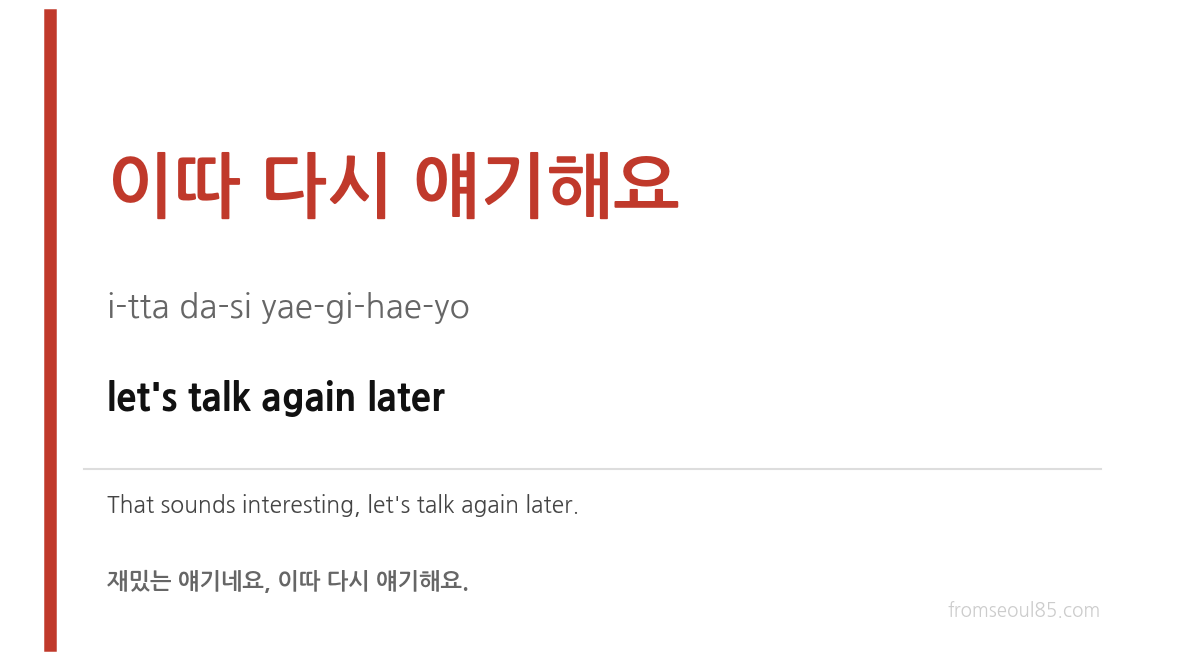
This phrase softens the exit even more. You are not ending the talk, just pausing it. It shows you still care about what they said. In theory, it works well when a coworker seems excited or emotional. Try, 이따 다시 얘기해요 (i-tta da-si yae-gi-hae-yo — let’s talk again later).
That said, I’ll be honest: I don’t really say this one myself. When a coworker is deep into an exciting story, I don’t usually promise to talk later. Instead, I step away for a moment, saying I have a quick call or need the bathroom. That short break breaks the flow gently, without any rejection. So think of 이따 다시 얘기해요 as a good tool to know, even if my own habit is a little different. Younger Koreans might use it far more comfortably than I do.

어 맞다, 나 이거 마감이라: The Casual Version
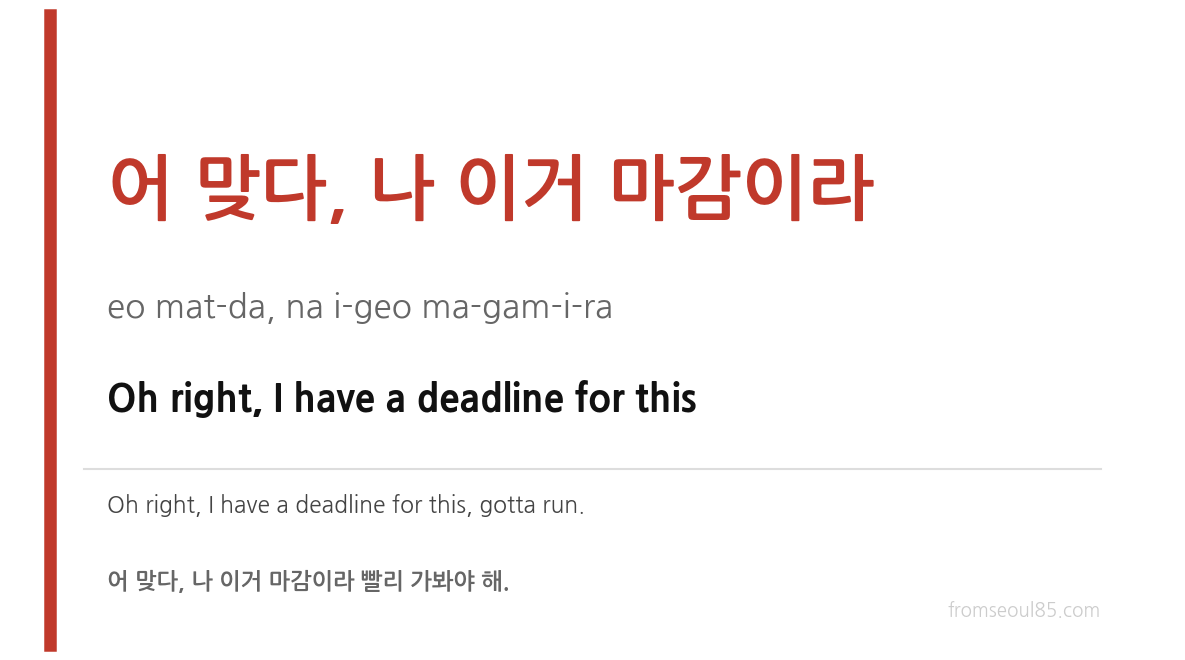
With very close coworkers, you can be more casual. This phrase sounds like a sudden memory, not a rejection. Try, 어 맞다, 나 이거 마감이라 (eo mat-da, na i-geo ma-gam-i-ra — oh right, I have a deadline for this). It feels natural between friends at work who are close in age or rank.
But here is my personal habit. I tend to use 존댓말 (jon-daet-mal — polite speech) with almost everyone at work. Even if someone is my age, I don’t rush to drop the formal tone first. For me, staying polite just feels more comfortable. So I would only use this casual phrase with people I already know very well. If you are unsure where the line sits, polite speech is the safer default. I explain that line more in my guide on when you can actually drop formalities in Korean.
What to Avoid: Being Too Direct
Please avoid saying something too direct, like 그만 얘기해요 (geu-man yae-gi-hae-yo — stop talking now). This can sound like an order, not a request. It feels rude to almost anyone, even a coworker. Koreans usually soften even small requests, so directness can hurt, even when you don’t mean it that way. Instead, add a reason or a soft ending like -것 같아요 (I think).
One more thing about tone. In my experience, requests and favors are usually made in a gentle, indirect way. Work instructions can be more direct, but they still shouldn’t feel harsh. I’ve also noticed that some older coworkers add a heavier, almost pushy tone to simple favors. For example, “이거 해줄 수 있지?” can feel a bit forced, while “이거 해줄 수 있어요?” feels softer and kinder. The difference is hard to show in text, but Koreans hear it right away. This is my personal experience. Other Koreans may see it differently. You can read more about polite speech levels in this overview of Korean honorifics on Wikipedia.
How I End Small Talk in Korean: My Practical Tips
Let me sum up how to end small talk in Korean the way I actually do it. First, give a small warning before you leave. A short “I need to go soon” softens everything. Second, add a reason, not a command. A deadline or a task works well. Third, keep polite speech as your default, especially with seniors. Fourth, a small smile does a lot of quiet work. These are simple habits, but for me, they turn an awkward exit into a natural one.
Key Expressions
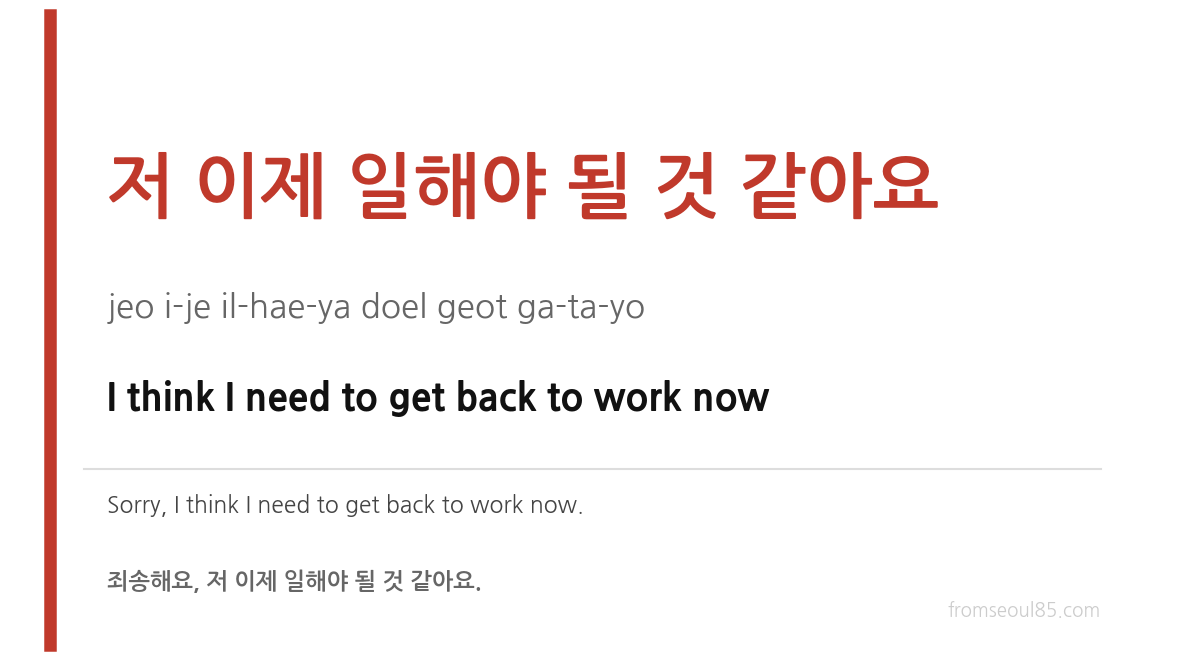
저 이제 일해야 될 것 같아요 (jeo i-je il-hae-ya doel geot ga-ta-yo — I think I need to get back to work now)
Sorry, I think I need to get back to work now.
죄송해요, 저 이제 일해야 될 것 같아요.
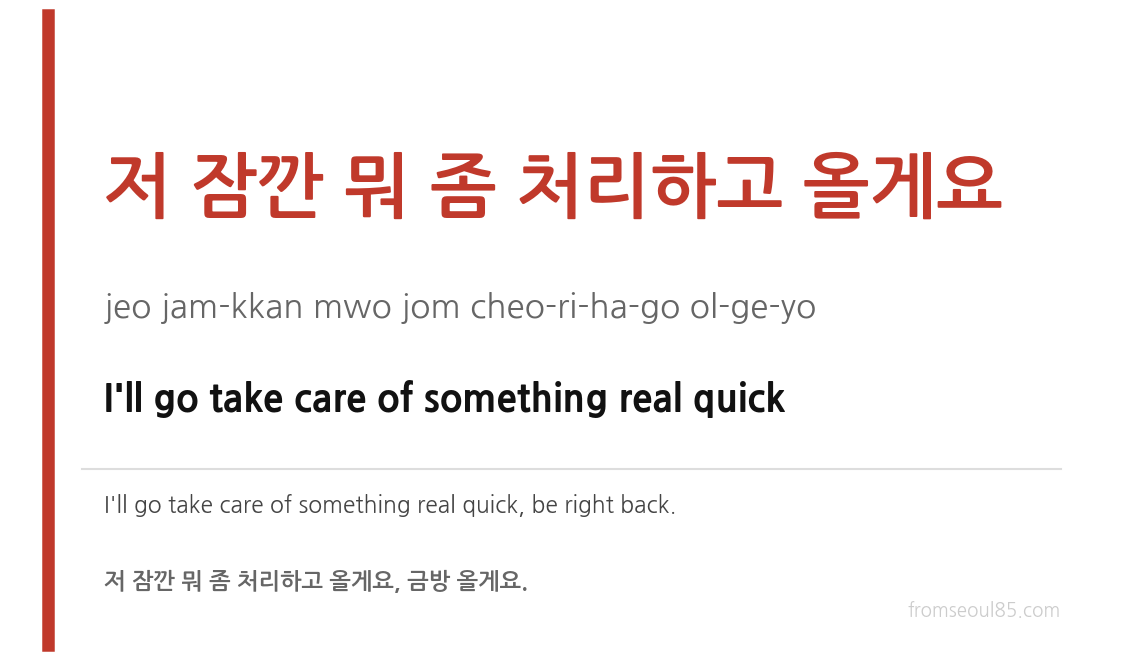
저 잠깐 뭐 좀 처리하고 올게요 (jeo jam-kkan mwo jom cheo-ri-ha-go ol-ge-yo — I’ll go take care of something real quick)
I’ll go take care of something real quick, be right back.
저 잠깐 뭐 좀 처리하고 올게요, 금방 올게요.
이따 다시 얘기해요 (i-tta da-si yae-gi-hae-yo — let’s talk again later)
That sounds interesting, let’s talk again later.
재밌는 얘기네요, 이따 다시 얘기해요.
어 맞다, 나 이거 마감이라 (eo mat-da, na i-geo ma-gam-i-ra — Oh right, I have a deadline for this)
Oh right, I have a deadline for this, gotta run.
어 맞다, 나 이거 마감이라 빨리 가봐야 해.
Written by a native Korean speaker born in Seoul in 1985. This is my personal experience. Other Koreans may see things differently.