Learning how to greet an old friend in Korean is trickier than it looks. You spot a familiar face on the street after years apart. Your brain freezes for a second. You want to sound warm, but not too intense. How deep should this conversation go, right here, on the sidewalk? Korean actually has a set of phrases built for exactly this moment, and once you know them, that frozen-brain feeling goes away.
For me, it depends on who I run into. If it’s a close friend, I usually just say a quick hello. But if I’m in a rush and can’t stop, I’ll say I’ll contact them later if I already have their number. If I don’t, I’ll ask for it on the spot. Then later, over KakaoTalk, we finish the conversation we didn’t get to have on the street, and I’ll suggest grabbing a meal or a drink sometime. That’s usually how it wraps up.
The First Reaction: A Surprised Shout
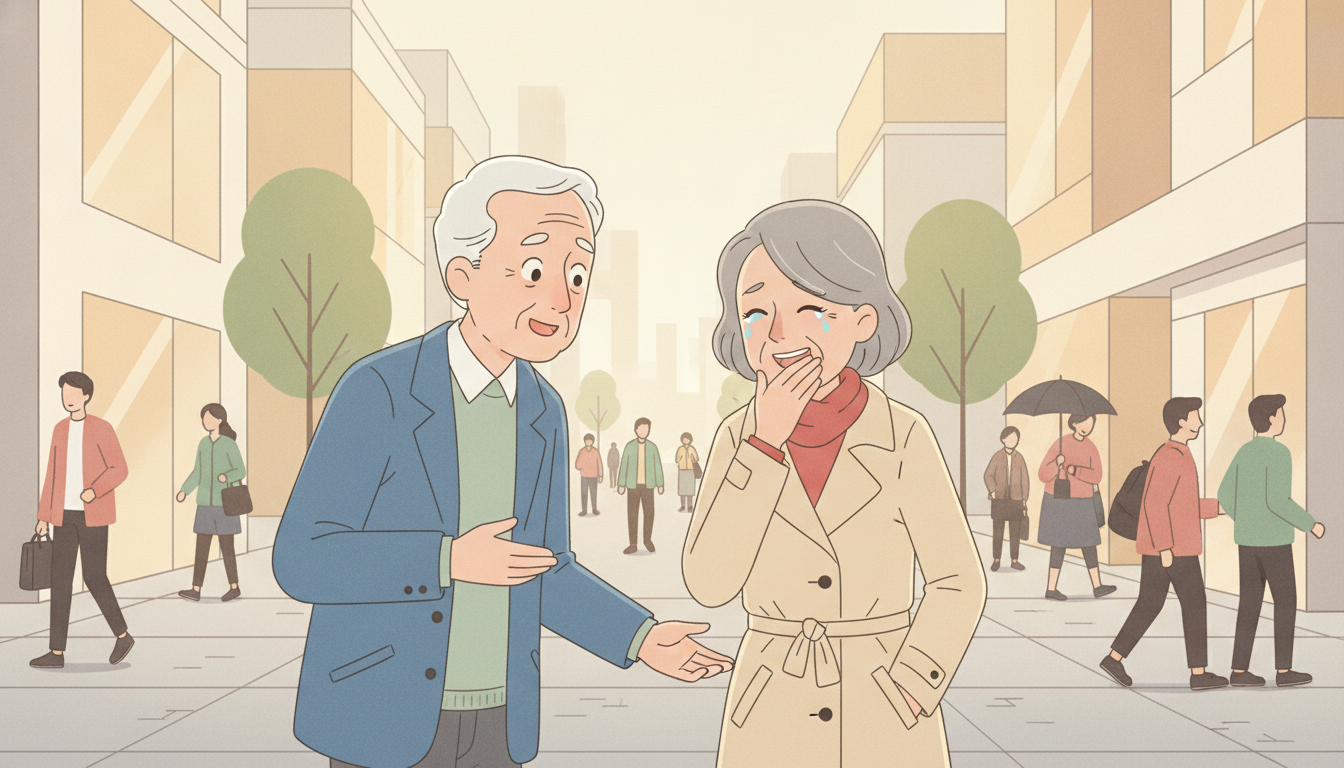
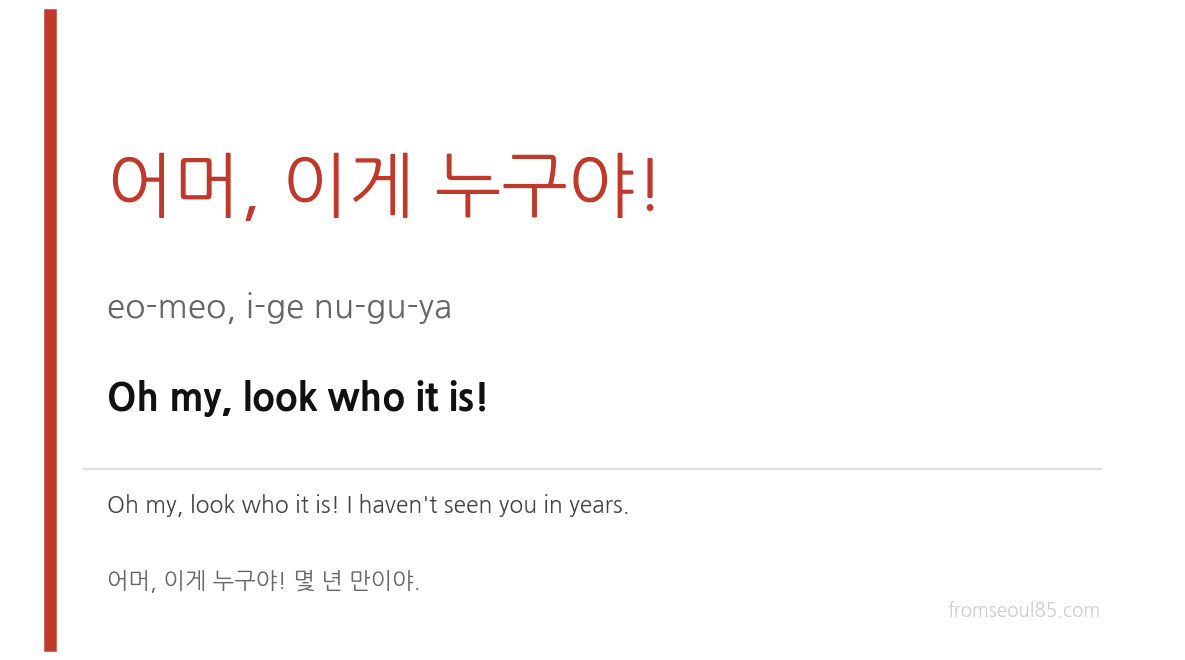
Before any real words come out, Koreans often react loudly. 어머, 이게 누구야! (eo-meo, i-ge nu-gu-ya — oh my, look who it is!) is the sound of pure surprise. It works between close friends, but it’s not something you’d say to a former boss or an older acquaintance. You say it the second you recognize the face, almost before your brain catches up.
With an old friend, I switch to casual speech without thinking twice. Something like 진짜 오랜만이다, 어떻게 지냈어? (really, long time no see, how have you been?) is usually how I start. From there I ask what they’re doing these days, whether they have kids now, how those kids are growing, and just generally whether things are okay. It’s less an interview and more a quick check on their whole life since I last saw them.
Oraenmanida: The Classic Greeting for Long Time No See
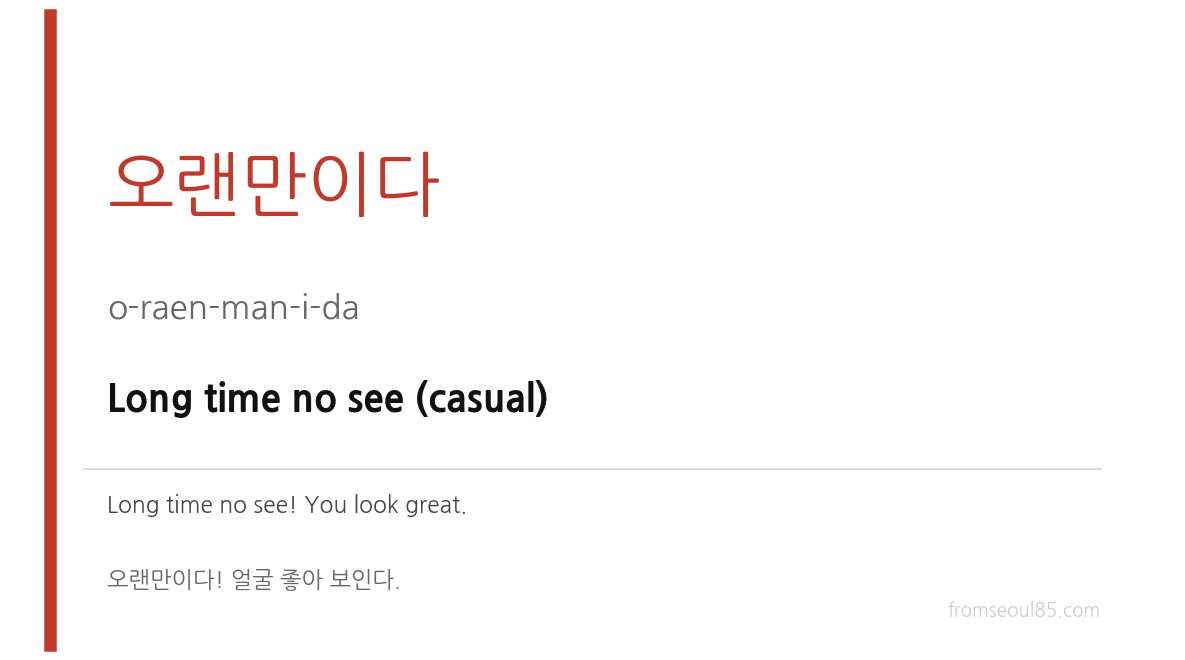
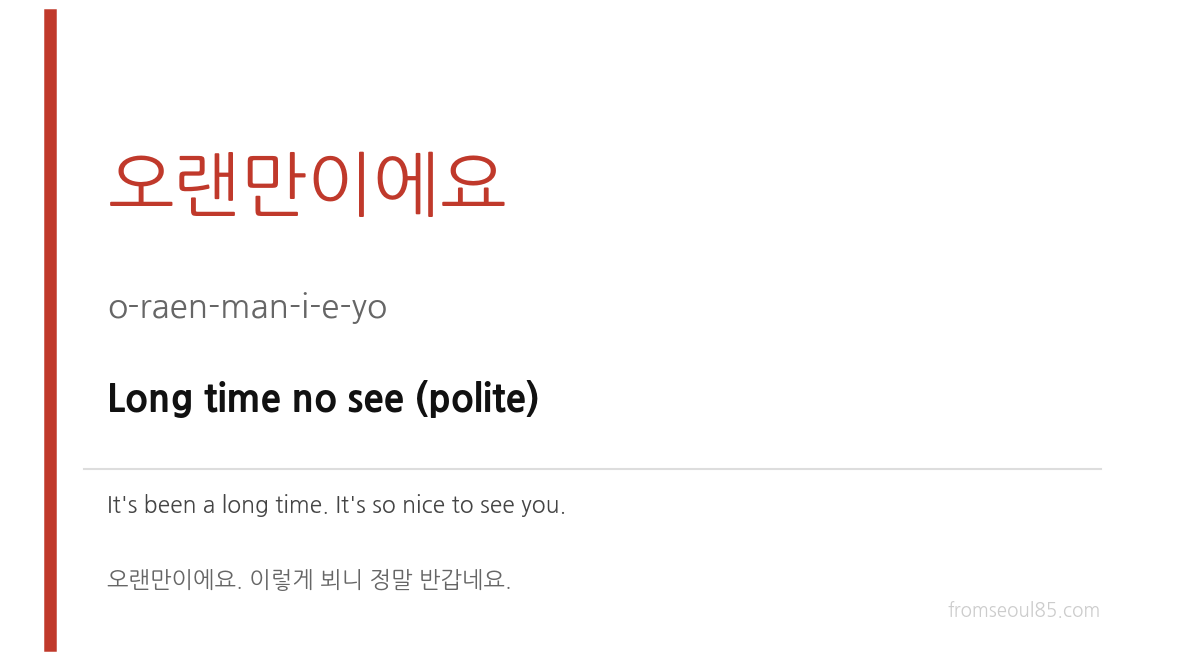
The oraenmanida meaning is basically “it’s been a long time,” and it’s the phrase most people search for first. 오랜만이다 (o-raen-man-i-da) is the casual form, used with friends around your age. 오랜만이에요 (o-raen-man-i-e-yo) is the polite version, used with someone older or someone you’re not close to. Picking the wrong one can feel a little awkward, so when you’re not sure, the polite form is the safer choice.
If the person is about my age but we were never close, I default to polite speech, no exceptions. But the tone isn’t quite the same as the politeness I’d use with someone much older or with a boss. It’s more like polite grammar without the extra weight. To an executive I might say 식사 맛있게 하셨습니까? (did you enjoy your meal?), a fairly formal line. To someone my age I don’t know well, it’s closer to 식사 하셨어요? or 밥 먹었어요? (have you eaten?), still polite, but lighter.
This is one of the reasons Korean politeness confuses learners. It’s not just one level of “formal” and one level of “casual.” If you want the fuller picture of when to switch between 반말 (banmal) and 존댓말 (jondaemal), our guide to banmal vs jondaemal breaks it down in more detail.
What to Say When You Meet an Old Friend: Asking How They’ve Been
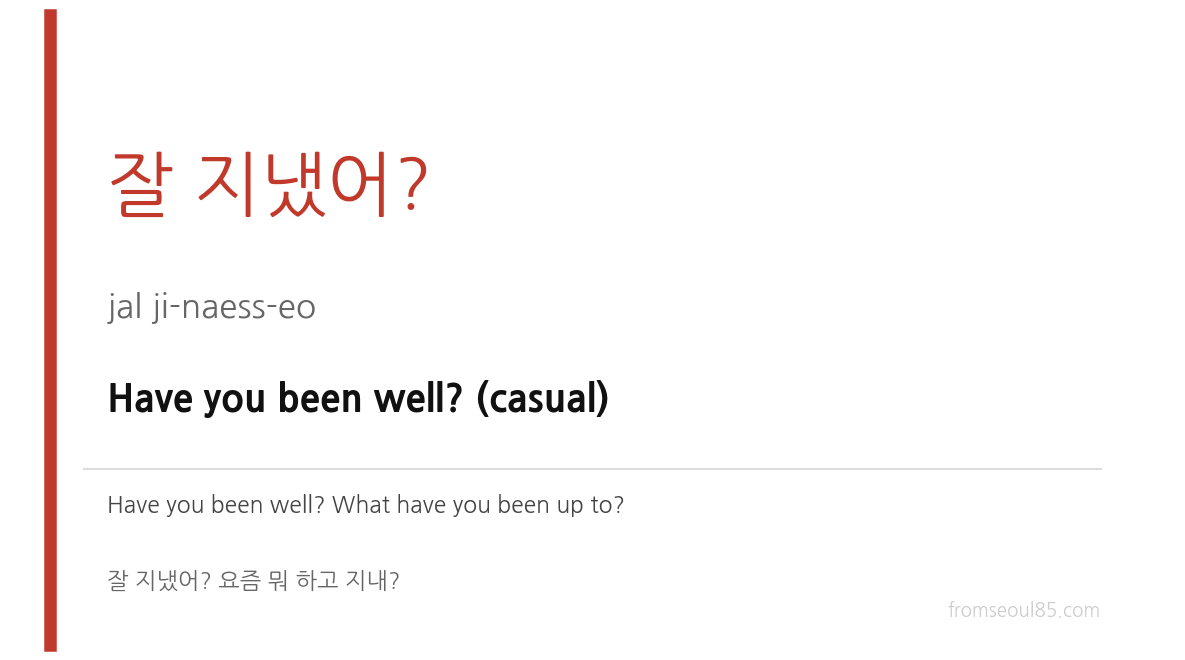
After the greeting, the next natural step in figuring out what to say when you meet an old friend in Korean is to ask how they’ve been. 잘 지냈어? (jal ji-naess-eo — have you been well?) is the casual version, and it’s extremely common. 잘 지내셨어요? (jal ji-nae-syeoss-eo-yo) is the polite form, used for elders. This question usually stays light. It’s less a real interview and more a warm way of checking in.
When someone asks me 잘 지냈어?, I usually just say something like “yeah, I’ve been fine, what about you?” and toss the question right back. Whether the conversation goes deeper after that really depends on how close we are. With a good friend, we might actually get into what’s going on in our lives. With someone I haven’t talked to in years and never was that close to, it stays surface-level, and that’s fine.
Korean Phrases for Catching Up With a Friend and Closing the Chat
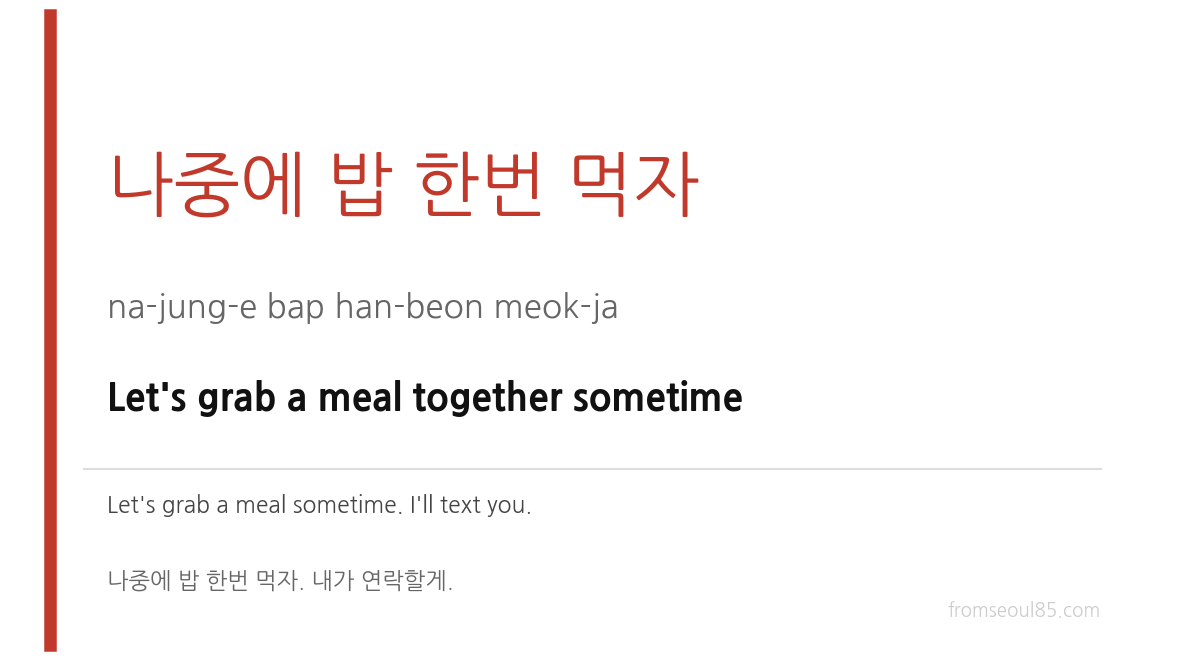
Sometimes the conversation needs a natural way to end. Among Korean phrases for catching up with a friend, 나중에 밥 한번 먹자 (na-jung-e bap han-beon meok-ja — let’s eat together sometime) is one of the most useful. It signals warmth without locking you into an actual plan. Koreans use it constantly to end conversations on a kind note. A real plan usually needs a real date and time attached to it.
With genuinely close friends, this line sometimes does lead to an actual meal. But most of the time, honestly, it’s just a farewell phrase. If people really intend to meet, the conversation usually continues with something like “let’s eat sometime, how about this week?” That kind of follow-up is what turns it into a real plan. If it just ends with “yeah, sure, I’ll text you” and nothing more, both people usually understand it as a polite goodbye, not a promise.
This pattern shows up in other parts of Korean conversation too, especially when people want to wrap things up without being blunt about it. Our post on how to end small talk in Korean covers a few more phrases that work the same way.
What to Avoid When You Meet an Old Friend
Avoid jumping straight into heavy personal questions. Asking directly whether someone got married, how much they earn, or whether they have kids can feel like an interrogation. Save those topics for when the conversation naturally goes deeper on its own.
I don’t usually ask 결혼했어? (did you get married?) directly, since that phrasing feels a bit like I’m conducting a survey. Instead I might just say 결혼은? (what about marriage?), which is softer and leaves more room for however they want to answer. That said, if I genuinely don’t know what’s going on in their life, I do ask. It’s less about avoiding the topic completely and more about how you phrase it. This is my personal experience. Other Koreans may see it differently.

Key Expressions
- 어머, 이게 누구야! (eo-meo, i-ge nu-gu-ya) — Oh my, look who it is!
Example: Oh my, look who it is! I haven’t seen you in years. (어머, 이게 누구야! 몇 년 만이야.) - 오랜만이다 (o-raen-man-i-da) — Long time no see (casual)
Example: Long time no see! You look great. (오랜만이다! 얼굴 좋아 보인다.) - 오랜만이에요 (o-raen-man-i-e-yo) — Long time no see (polite)
Example: It’s been a long time. It’s so nice to see you. (오랜만이에요. 이렇게 뵈니 정말 반갑네요.) - 잘 지냈어? (jal ji-naess-eo) — Have you been well? (casual)
Example: Have you been well? What have you been up to? (잘 지냈어? 요즘 뭐 하고 지내?) - 나중에 밥 한번 먹자 (na-jung-e bap han-beon meok-ja) — Let’s grab a meal together sometime
Example: Let’s grab a meal sometime. I’ll text you. (나중에 밥 한번 먹자. 내가 연락할게.)
A Few Practical Tips
If you’re not sure whether to use casual or polite speech, start polite. You can always loosen up once the other person signals it’s okay, usually by switching to casual speech themselves or saying something like “you can talk casually with me.” It’s much easier to move from polite to casual than the other way around.
Second, don’t treat 나중에 밥 한번 먹자 as a promise unless an actual day gets mentioned. If you want to turn it into a real plan, suggest a specific day right there in the moment, like “how about this week?” That one extra sentence is often the difference between a nice sentiment and an actual dinner. For more background on how Korean speech levels work, the Wikipedia entry on Korean speech levels is a solid starting point.
Written by a native Korean speaker born in Seoul in 1985. This is my personal experience. Other Koreans may see things differently.