You’re haggling over a scarf at a busy market stall, and the seller has already dropped the price twice. Now you want to stop and decide, but you don’t know what to say next. Do you accept the price? Walk away? Ask one more time? Knowing how to end haggling in Korean is a skill most textbooks never teach. You learn words for asking a discount, but nobody teaches you the words for closing the talk.
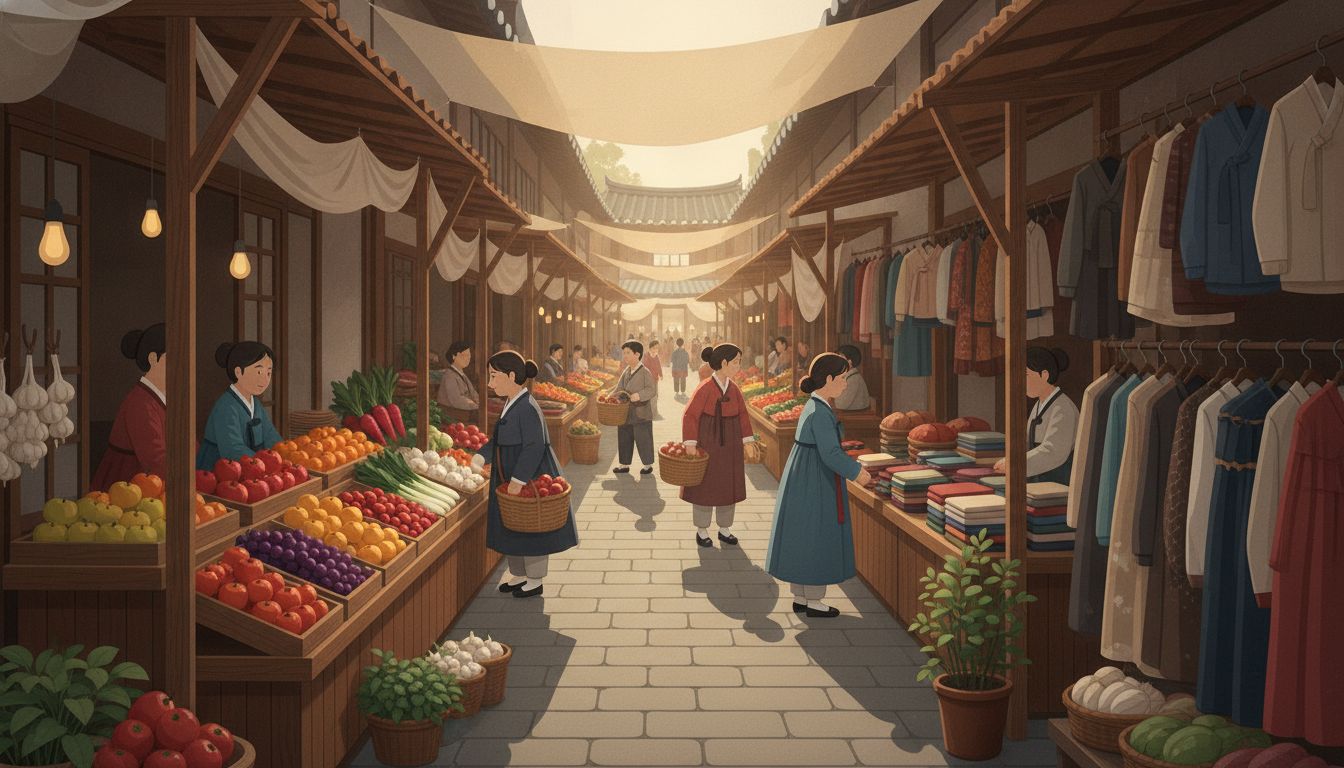
I remember going to a traditional market with my mom when I was a kid, and the haggling had its own rhythm. It wasn’t really about squeezing out the lowest number. It was more like friendly teasing between two people who already knew each other’s tricks. You’d ask, \”Sajangnim, how much for this?\” The seller names a price. You say something like, \”oh, that’s too expensive, please give me a discount, they sell it cheaper over there.\” The seller answers, \”we don’t make anything on this one.\” You say, \”oh, sajangnim~~\” in a sweet voice, and sometimes that’s enough to get a little more off. Both sides know the other stall probably isn’t cheaper, and the seller’s \”we don’t make anything\” line probably isn’t true either. Everyone plays along anyway. I even remember a vegetable seller giving extra because he said my mom had a nice face, though I’m not sure that kind of moment happens as much these days.
1. 이걸로 할게요 (i-geol-lo hal-ge-yo) – \”I’ll Take This One\”
The easiest way to end haggling is simple. Accept the price and buy it. Say 이걸로 할게요 (i-geol-lo hal-ge-yo), which means \”okay, I’ll take this one.\” This phrase is casual and warm at the same time. It works well with sellers close to your age or older.
When I buy from an older sajangnim, I don’t switch into extra-formal speech just because they’re older. I talk to them almost like I’d talk to a neighbor uncle or auntie, still polite, but relaxed. I might even ask with a bit of aegyo, \”sajangnim, please give me a little more~~,\” and that soft, friendly tone often gets me a bonus item thrown in. It’s less about being formally polite and more about matching the mood of the market itself. If you want to sound a bit more formal when you close the deal, add 감사합니다 (gam-sa-ham-ni-da), \”thank you,\” right after. That closes things on a warm note either way.
2. 조금만 더 까아주시면 살게요 (jo-geum-man deo kkak-a-ju-si-myeon sal-ge-yo) – \”If You Lower It a Bit More, I’ll Buy It\”
Sometimes you want to try one last time before closing. Say 조금만 더 까아주시면 살게요 (jo-geum-man deo kkak-a-ju-si-myeon sal-ge-yo), meaning \”if you lower it a bit more, I’ll buy it.\” This gives a clear condition, and it signals that this is close to your final offer.
That said, in my own experience, I don’t usually frame it that directly, like a business deal with a fixed final price. Instead of saying \”I’ll buy five for ten thousand won,\” I’d rather ask, \”sajangnim, could you throw one more in as a bonus?\” A market doesn’t feel like a place to squeeze out the best possible deal. It feels more like a place where you look at fresh vegetables with your own eyes, pick them yourself, and talk with the person selling them. I’m not sure if this is the same outside Korea, but there’s a certain warmth, what we call jeong, that keeps sellers from being too strict about price. Treating it like a cold negotiation with a fixed final number feels a little off to me, since the person on the other side of the stall is a person too, not just a business.
3. 다음에 다시 올게요 (da-eu-me da-si ol-ge-yo) – \”I’ll Come Back Another Time\”
Sometimes the price still feels too high, and you want to leave without buying. Say 다음에 다시 올게요 (da-eu-me da-si ol-ge-yo), meaning \”I’ll come back another time.\” This softens your no. It doesn’t shut the door completely.
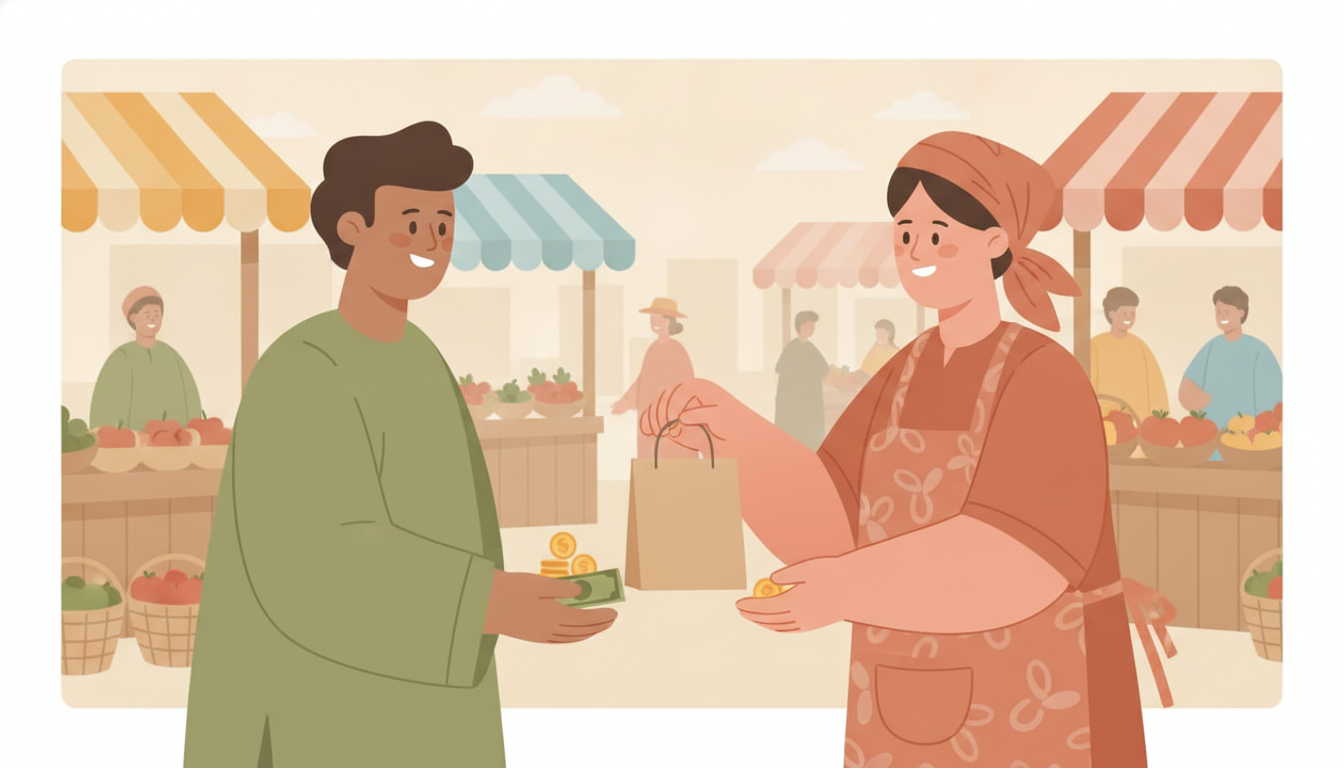
Think about it from the seller’s side for a moment. If a customer says \”this is too expensive, I’ll buy it somewhere else\” straight to your face, that stings a little. But if the customer says, cheerfully, \”I’ll look around a bit more and come back,\” it means close to the same thing, just said in a kinder way. Sellers hear this all the time, and most don’t take it personally. They know you’re probably comparing prices at another stall, but nobody says the blunt version out loud. That’s just how it works.
4. 조금 더 둘러보고 올게요 (jo-geum deo dul-leo-bo-go ol-ge-yo) – \”I’ll Look Around a Bit More\”
Maybe you’re not ready to say yes or no yet. Say 조금 더 둘러보고 올게요 (jo-geum deo dul-leo-bo-go ol-ge-yo), meaning \”I’ll look around a bit more.\” This buys you time without any pressure, and it sounds natural, not rude at all.
This is close to how I actually talk in this exact situation. I’ll say it loud enough for the seller to hear, something like, \”this one’s my top pick so far, but let me check a couple more stalls.\” I want the seller to know their item is my favorite right now, even though I haven’t decided yet. It’s my way of saying their stuff is good, I just haven’t looked at everything else. This is my personal experience, and other Koreans might handle it differently.
What Not to Do When You End Haggling in Korean
There’s one common mistake to avoid. Don’t just turn and walk away in silence. That can feel cold to the seller. Also try to avoid a blunt 안 사요 (an sa-yo), \”I’m not buying.\” It sounds too flat and direct for most markets. Korean market culture usually values a warm exchange, and even a no can come with a soft tone.
That said, I’ll admit I’m not always this gentle everywhere. At tourist-heavy food streets, like the dakgalbi alley in Chuncheon, the tteokbokki alley, or the clothing shops in Dongdaemun, sellers are competing hard for every customer walking by. They’ll often push hard, saying their food is the best or their prices are the lowest, in a way that can feel like a lot. With sellers like that, I’m more likely to ignore them or say no firmly, since there are usually dozens of similar shops around and I know it’s more of a sales pitch than a real connection. Honestly, I often just skip those streets and alleys altogether rather than deal with the pressure.
Key Expressions
- 이걸로 할게요 (i-geol-lo hal-ge-yo) – I’ll take this one.
Example: \”네, 이걸로 할게요.\” (\”Okay, I’ll take this one.\”)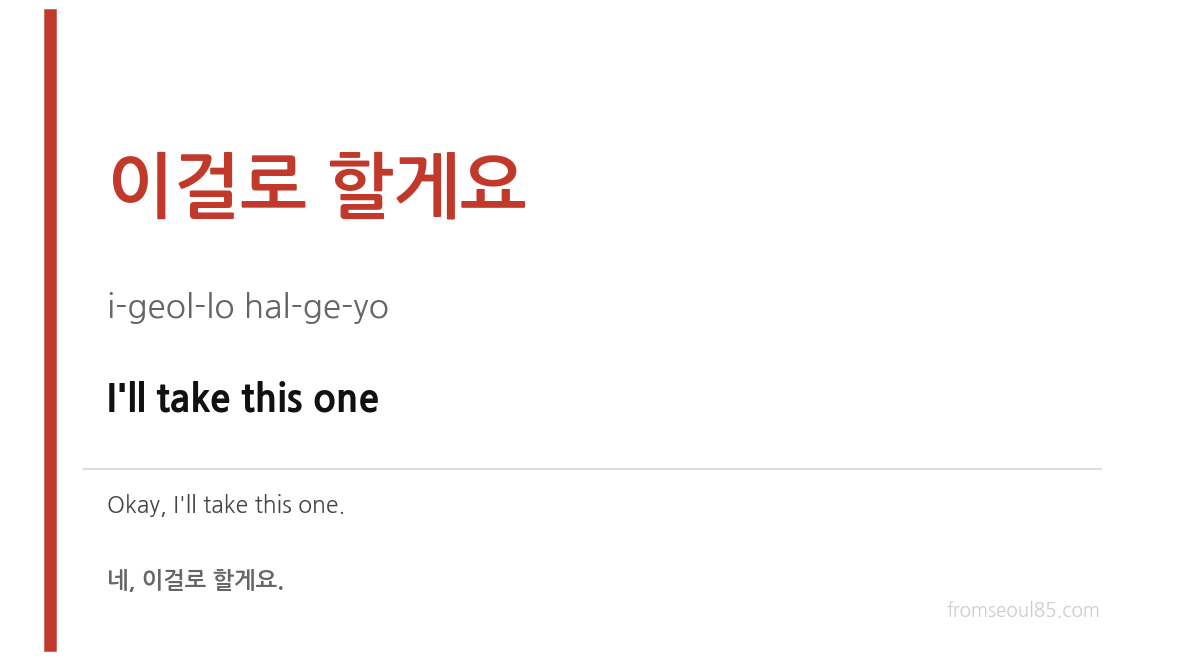
- 조금만 더 까아주시면 살게요 (jo-geum-man deo kkak-a-ju-si-myeon sal-ge-yo) – If you lower it a bit more, I’ll buy it.
Example: \”조금만 더 까아주시면 살게요.\” (\”If you lower it a bit more, I’ll buy it.\”)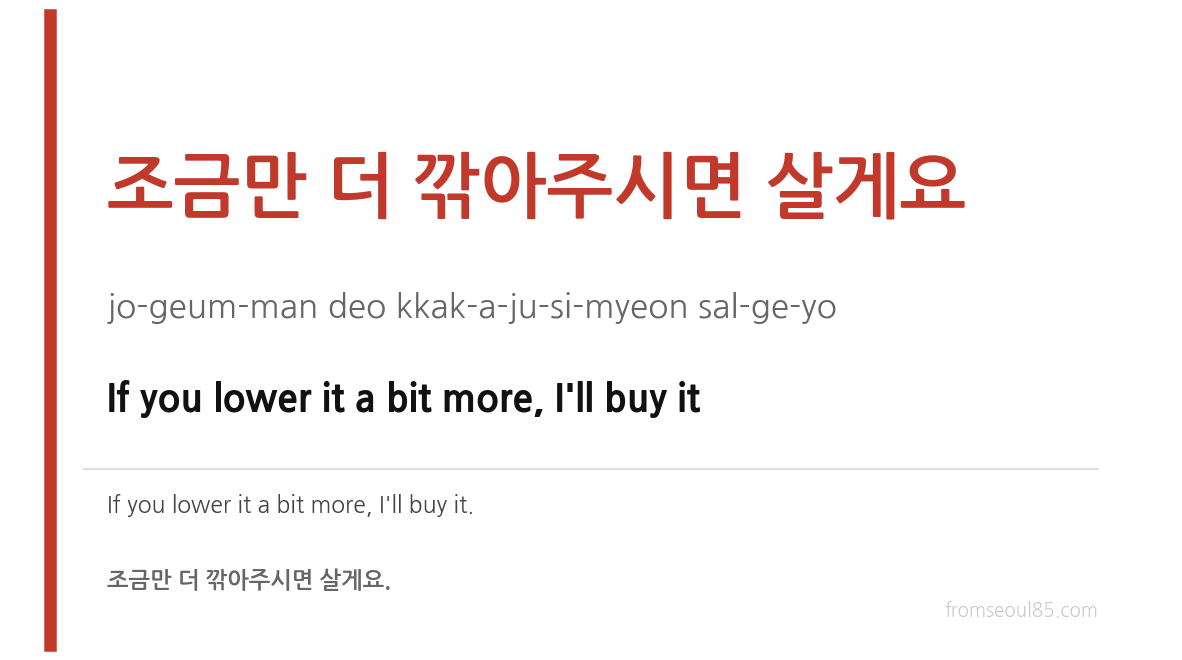
- 다음에 다시 올게요 (da-eu-me da-si ol-ge-yo) – I’ll come back another time.
Example: \”다음에 다시 올게요.\” (\”I’ll come back another time.\”)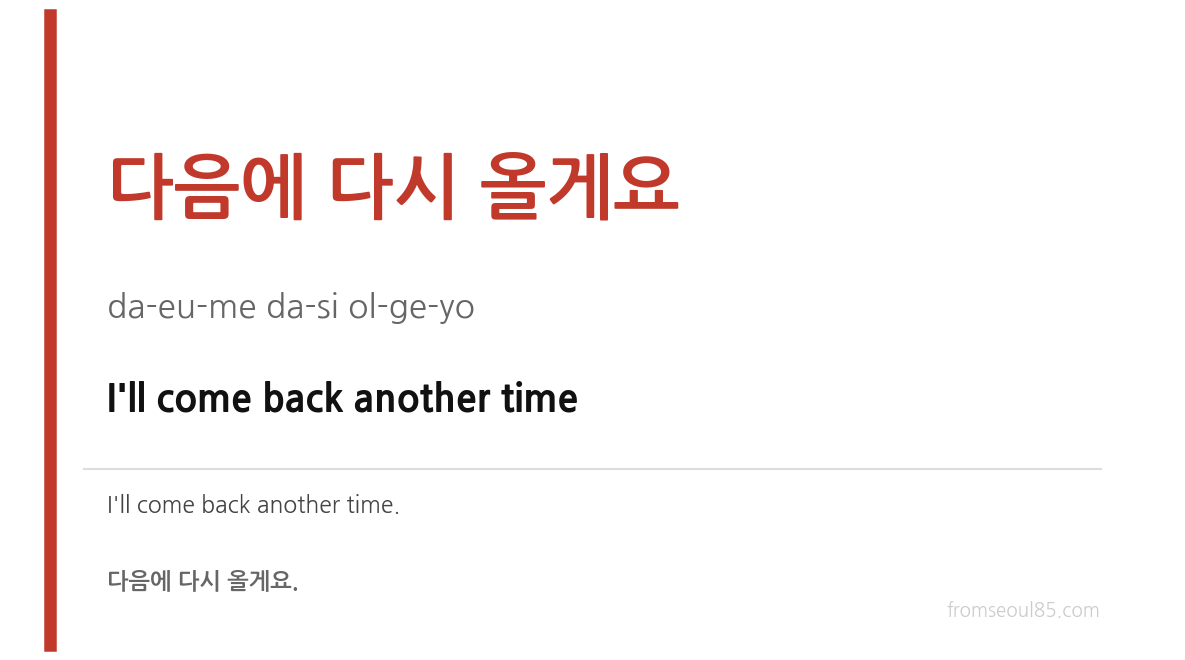
- 조금 더 둘러보고 올게요 (jo-geum deo dul-leo-bo-go ol-ge-yo) – I’ll look around a bit more.
Example: \”조금 더 둘러보고 올게요.\” (\”I’ll look around a bit more and come back.\”)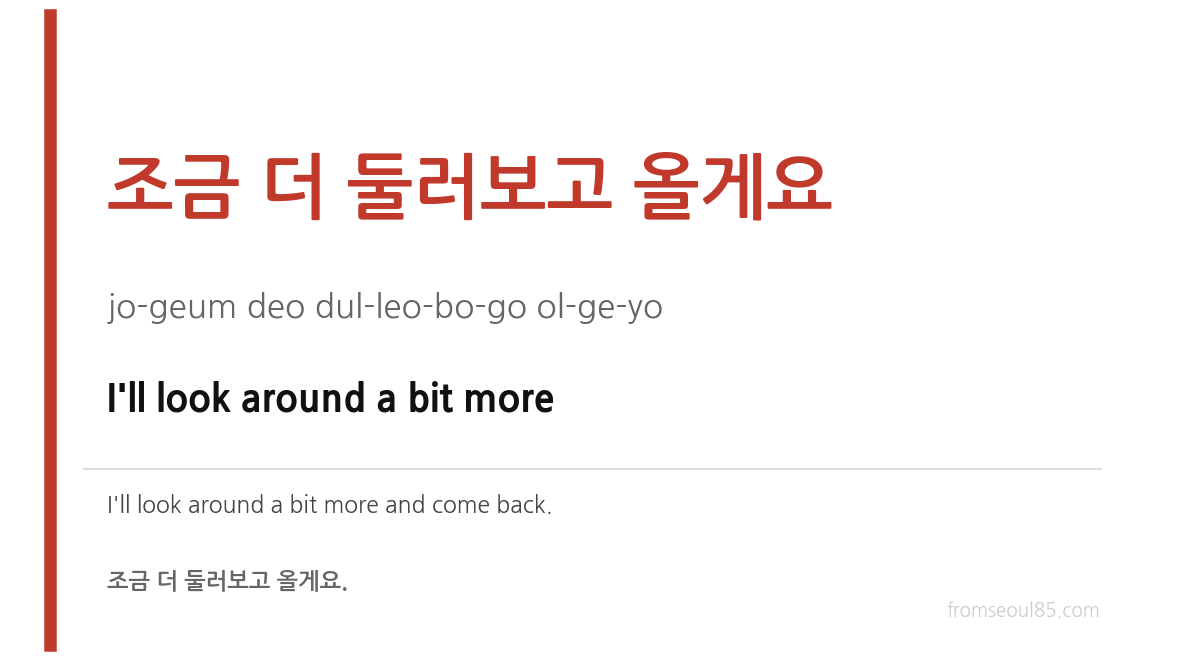
- 알겠습니다, 감사합니다 (al-get-sseum-ni-da, gam-sa-ham-ni-da) – Okay, thank you.
Example: \”알겠습니다, 감사합니다.\” (\”Okay, thank you.\”)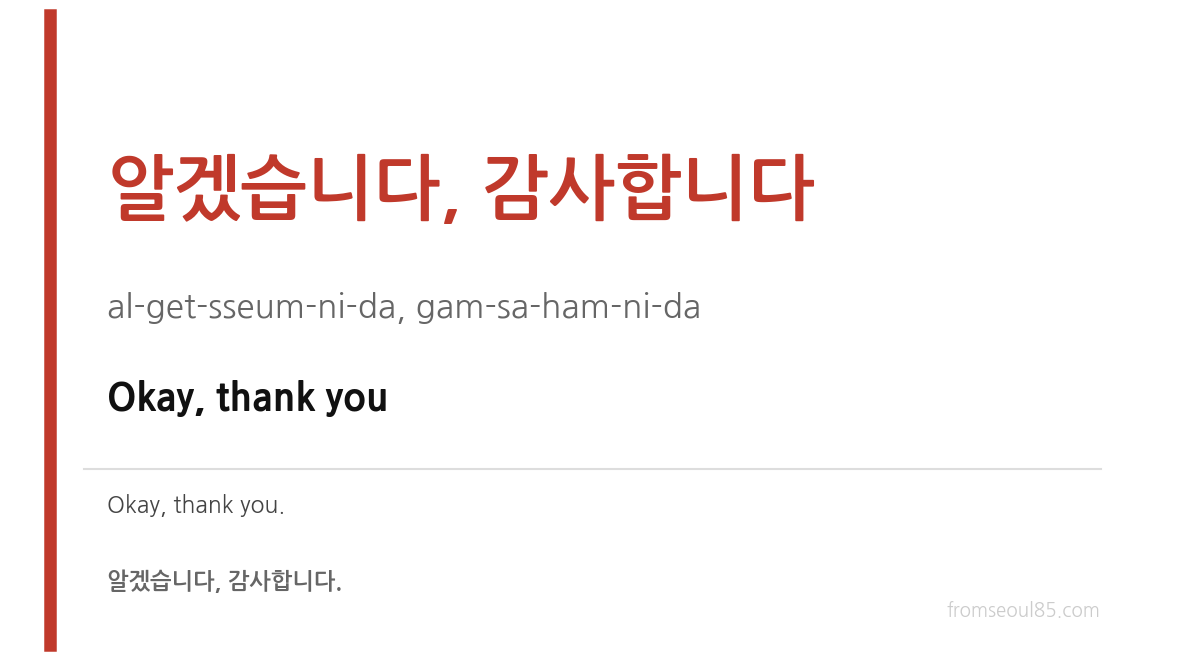
A Few Practical Tips
If I had to boil this down, I’d say two things matter most. First, match your tone to the phrase. 이걸로 할게요 works well in a light, friendly tone, while 조금만 더 까아주시면 살게요 needs a slightly more polite voice, since you’re asking for a favor. Second, leave the door open with a soft goodbye phrase, rather than silence or a flat no. Sellers remember a friendly customer, even one who didn’t buy anything that day.
If you want to see how Koreans soften a straightforward \”no\” in other everyday situations, check out this guide on how Koreans say yes and no without sounding blunt. For a deeper look at Korean honorific speech levels used with phrases like these, the National Institute of Korean Language has more detail available in English.
Written by a native Korean speaker born in Seoul in 1985. This is my personal experience. Other Koreans may see things differently.