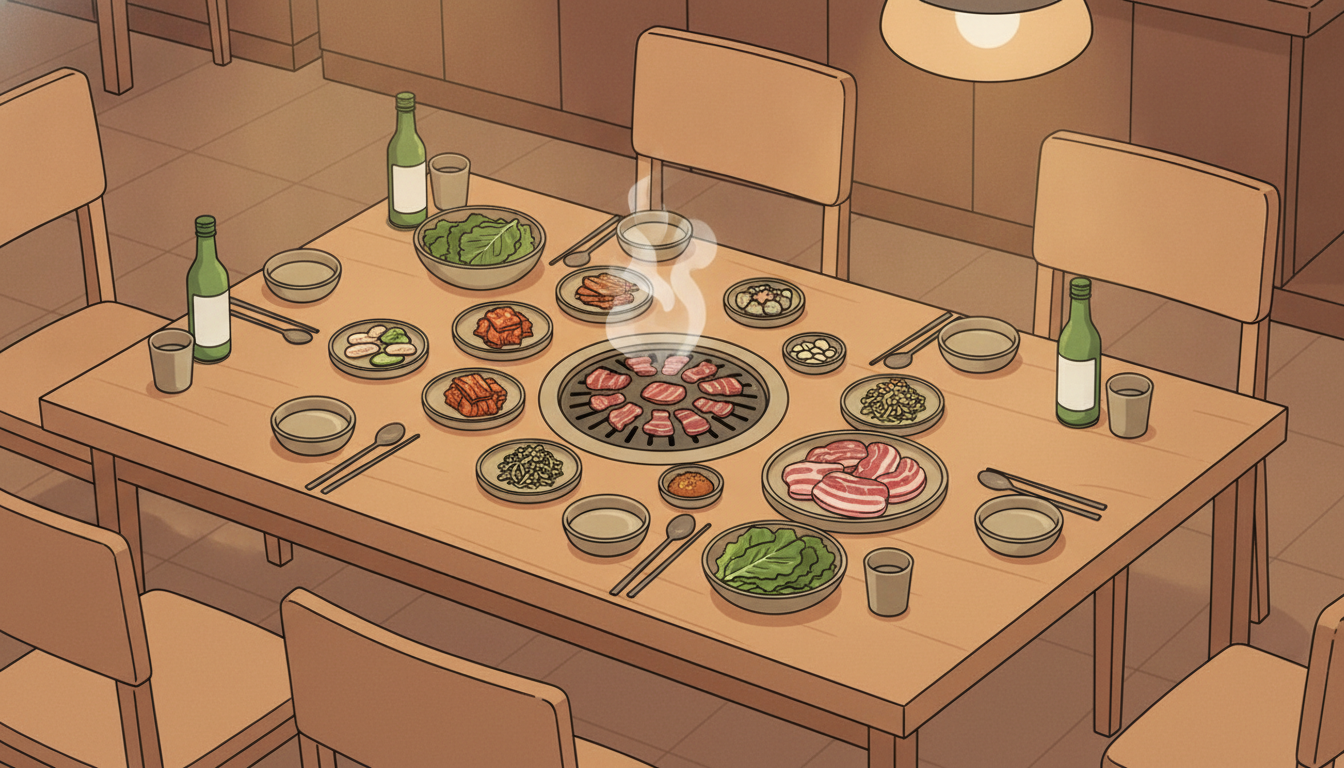
Picture this. It’s your company’s year-end dinner, a hoesik (회식 — hoe-sik: a work dinner or company gathering). This time, spouses and kids are invited too. You’re standing between your boss and your family, and every eye is on you. You already know basic Korean greetings, but this moment feels different. It feels more formal, and more personal at the same time. Your mind goes blank. Do you greet your boss first, or introduce your family first? In Korean workplace culture, both the order and the words you pick matter. This guide covers how to introduce your spouse in Korean, how to introduce your kids, and the exact phrases Koreans use in this exact moment.
My own company almost never held this kind of event. We had things like a sports day or a company workshop, and technically family could come along, but I never actually brought mine. So for me, this scene is more of a “what if” than a memory. Still, I know plenty of coworkers who went through exactly this, and the phrases below are what they actually said at the table.
Say Hello, Please: 인사드려 vs 인사해
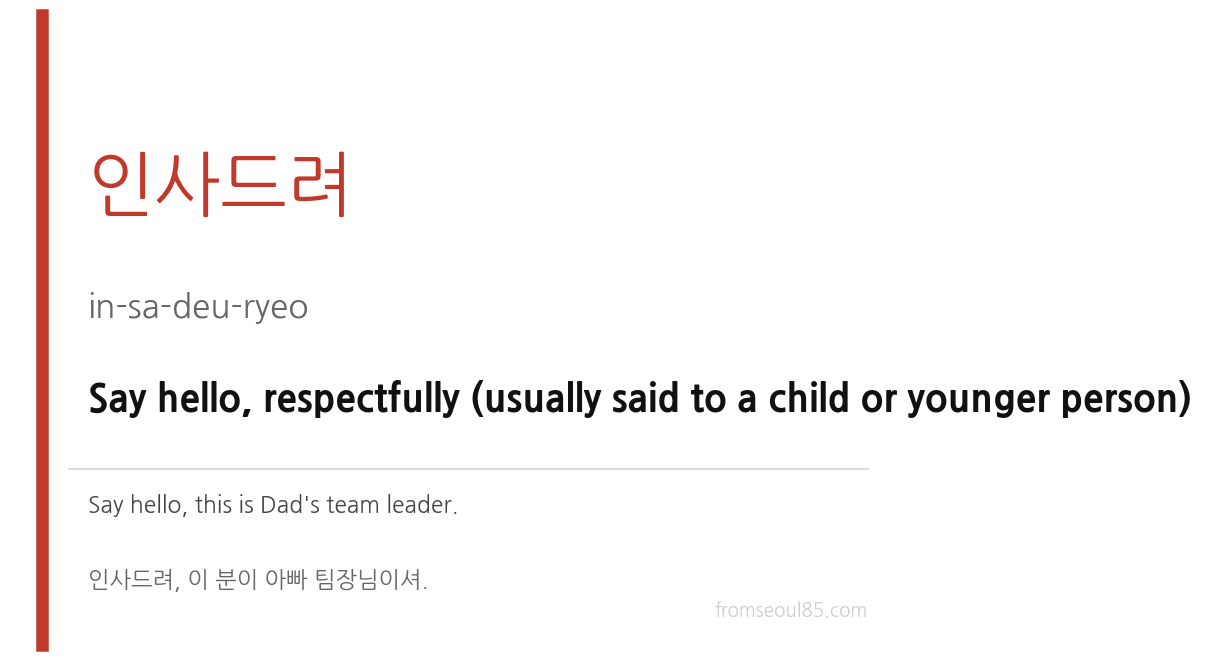
The first phrase you’ll likely hear is 인사드려 (in-sa-deu-ryeo — say hello, formally). Someone usually says this to a child or a younger family member. It means “go greet them respectfully.” A parent uses it to tell a kid to bow and say hello to someone senior. It’s a command, but a polite one. The verb 드리다 is the humble form of “give,” so the phrase leans toward “give a greeting.” You might hear a coworker say to their child, 인사드려, 이 분이 아빠 회사 사장님이셔 (in-sa-deu-ryeo, i bun-i a-ppa hoe-sa sa-jang-nim-i-syeo), which means “say hello, this is Dad’s company president.”
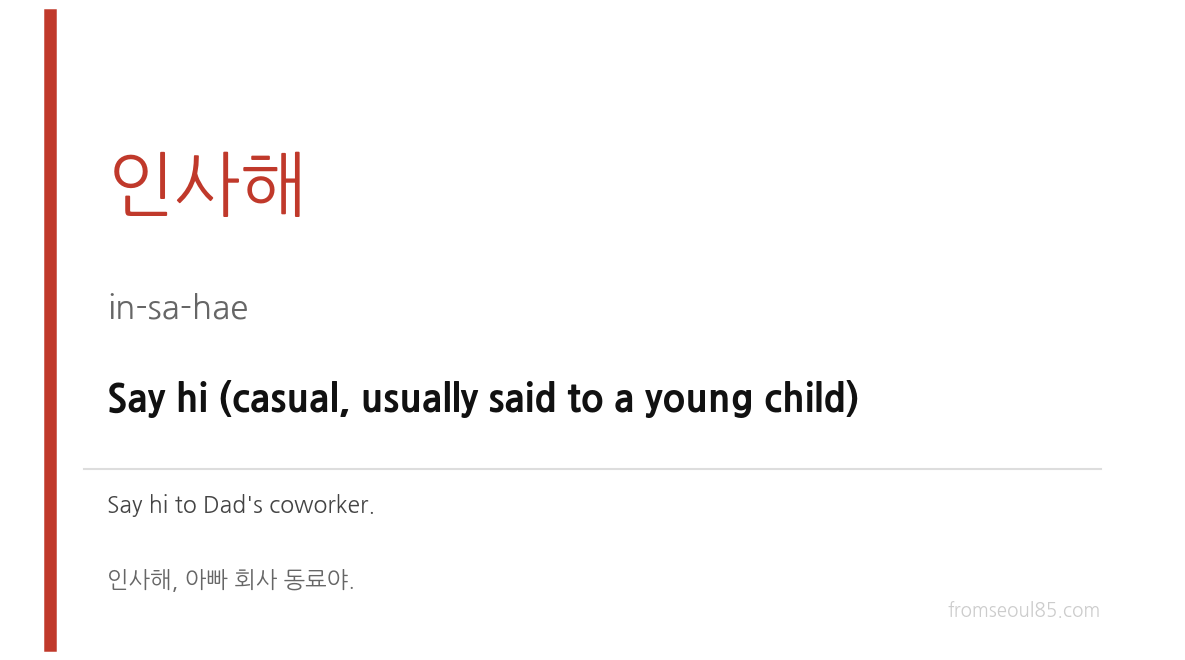
There’s a simpler cousin of this phrase, 인사해 (in-sa-hae — say hi, casual). As I see it, the rule is about direction. You use 인사드려 toward someone above you, and 인사해 toward someone below you. A parent tells a child 인사드려 for the boss, but might tell the same child 인사해 for a younger coworker’s kid at the same table.
A Small Twist: When Two People Above You Are Both in the Room
Here’s a detail that trips people up, including me at first. Say two coworkers are both senior to you, and you need to mention one while talking to the other. Call the more senior person A, the next one B, and yourself C. When A asks where B is, you don’t add an honorific to B, even though B outranks you too. You’d say something like “B cha-jang is in the restroom.” But if B asked where A is, you’d say “A cha-jang-nim just went to the restroom,” adding the honorific that time. The honorific level shifts based on who you’re speaking to, not just who you’re talking about. It’s a small rule, but it shapes almost every sentence at a hoesik. This kind of relative honorific shift is a real feature of the language, and you can read more background on it at Wikipedia’s overview of Korean honorifics.
Introducing Your Spouse in Korean
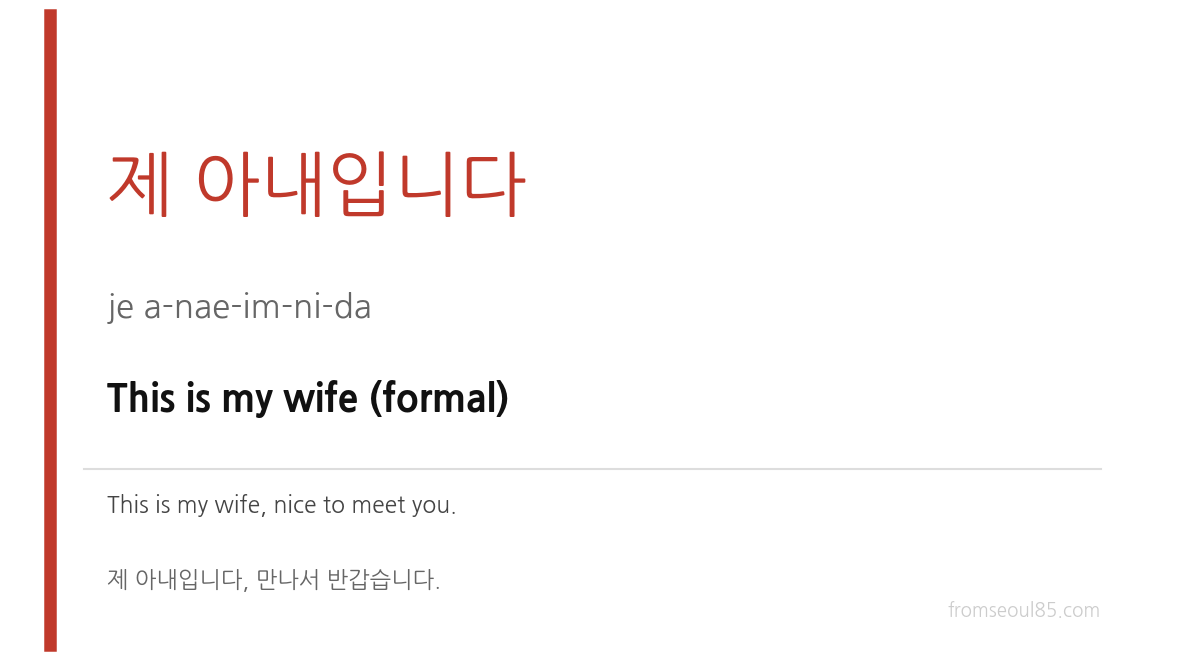
Next, you introduce your spouse. In front of your boss, say 제 아내입니다 (je a-nae-im-ni-da — this is my wife). For a husband, say 제 남편입니다 (je nam-pyeon-im-ni-da). The “ㅂ니다” ending sounds formal and respectful, and it’s the safest choice when your boss is standing right there.
Around close coworkers, the tone drops. When it’s just people I’m close to, I usually say something like “우리 와이프” (u-ri wa-i-peu, roughly “our wife,” meaning “my wife”), without adding 예요 or any polite ending at all. It’s short, it’s casual, and everyone at the table already knows who I mean. So the level you pick depends on who’s listening, not just who’s standing next to you. With the boss, use the full formal form. With close coworkers, a shorter, plainer phrase works fine.
How to Introduce Your Kids in Korean
Introducing kids works a bit differently. You’d say 우리 아들이에요 (u-ri a-deu-ri-e-yo — this is our son) or 우리 딸이에요 (u-ri ttal-i-e-yo — this is our daughter). Koreans often say 우리 (our) instead of 제 (my) when talking about family. This isn’t a strict grammar rule. It just feels warmer and more natural.
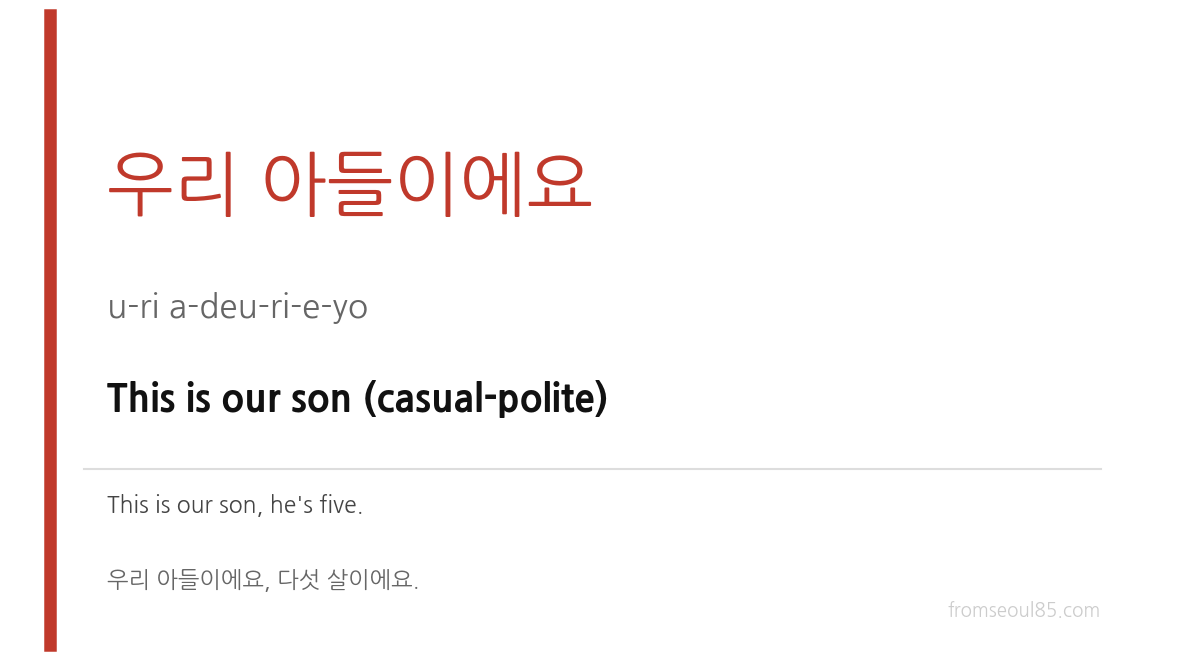
Some parents add the child’s age too, like 다섯 살이에요 (da-seot sal-i-e-yo — he’s five). I don’t usually bring up the age unless it comes up naturally in the conversation. If someone asks, I’ll answer, but I don’t add it as a default part of the introduction.
While writing this, one more thing came to mind about the word 우리. When Koreans talk about their own country, they always say 우리나라 (u-ri-na-ra — our country), never 저희 나라 (jeo-hui na-ra), even though 저희 is the humble form of 우리. The idea is that nothing outranks your own country, so there’s no one left to be humble toward. It’s the same word that shows up in “our son” and “our wife,” just applied to something bigger. This is my personal experience, and other Koreans may explain it slightly differently.
Sealing the Introduction: 쟐 부탁드립니다 Meaning
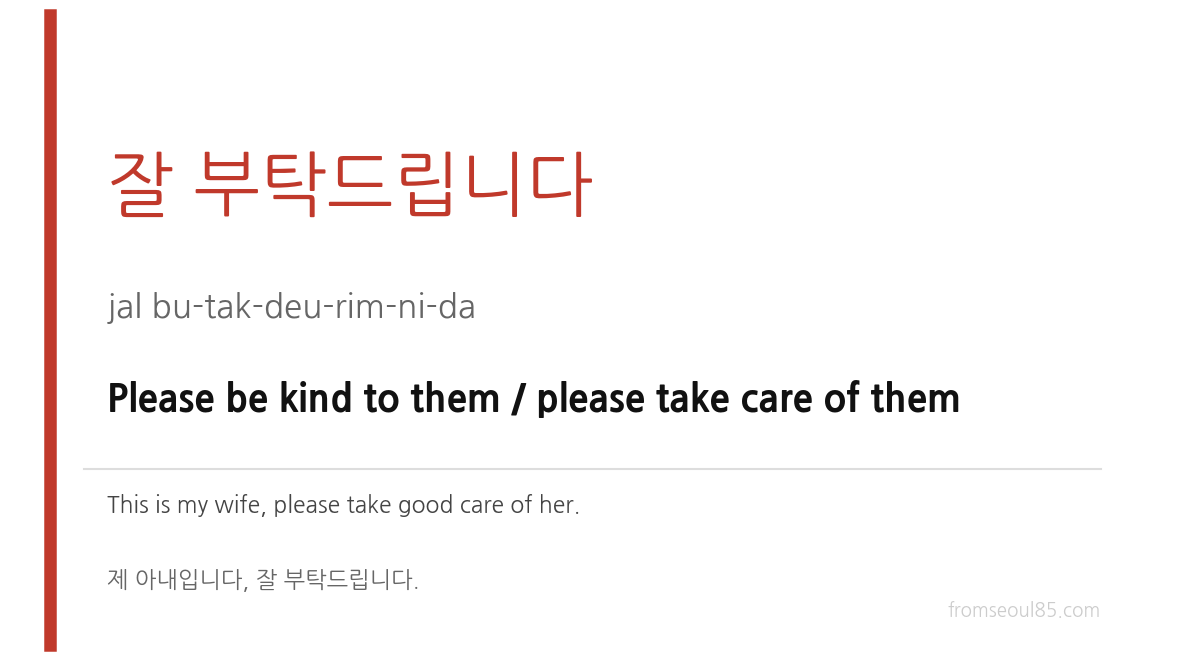
After the introduction, people often add 쟐 부탁드립니다 (jal bu-tak-deu-rim-ni-da). Literally, it means “please take care of this.” Here, it means something closer to “please be kind to my family.” You say it to coworkers or your boss, right after introducing your spouse or kid. Learning the jal butakdeurimnida meaning is worth it on its own, since it shows up far beyond family introductions too.
I use this phrase constantly, honestly. Whenever I introduce myself in a formal setting, or introduce someone close to me, I almost always close with 쟐 부탁드립니다. It’s become a kind of habit, a way of wrapping up an introduction on a respectful note. Your boss might reply with something like 네, 편하게 계세요 (ne, pyeon-ha-ge gye-se-yo), meaning “yes, make yourself comfortable.”
One Common Mistake to Avoid
One common mistake is letting your spouse greet your boss too casually. A simple 안녕하세요 (an-nyeong-ha-se-yo) works well in almost any situation. A casual 안녕! (an-nyeong) can feel awkward toward someone senior, since your spouse isn’t your boss’s friend. Their greeting should roughly match your own respect level. A small bow or nod also helps. It’s not required, but it’s a common, easy way to show respect.
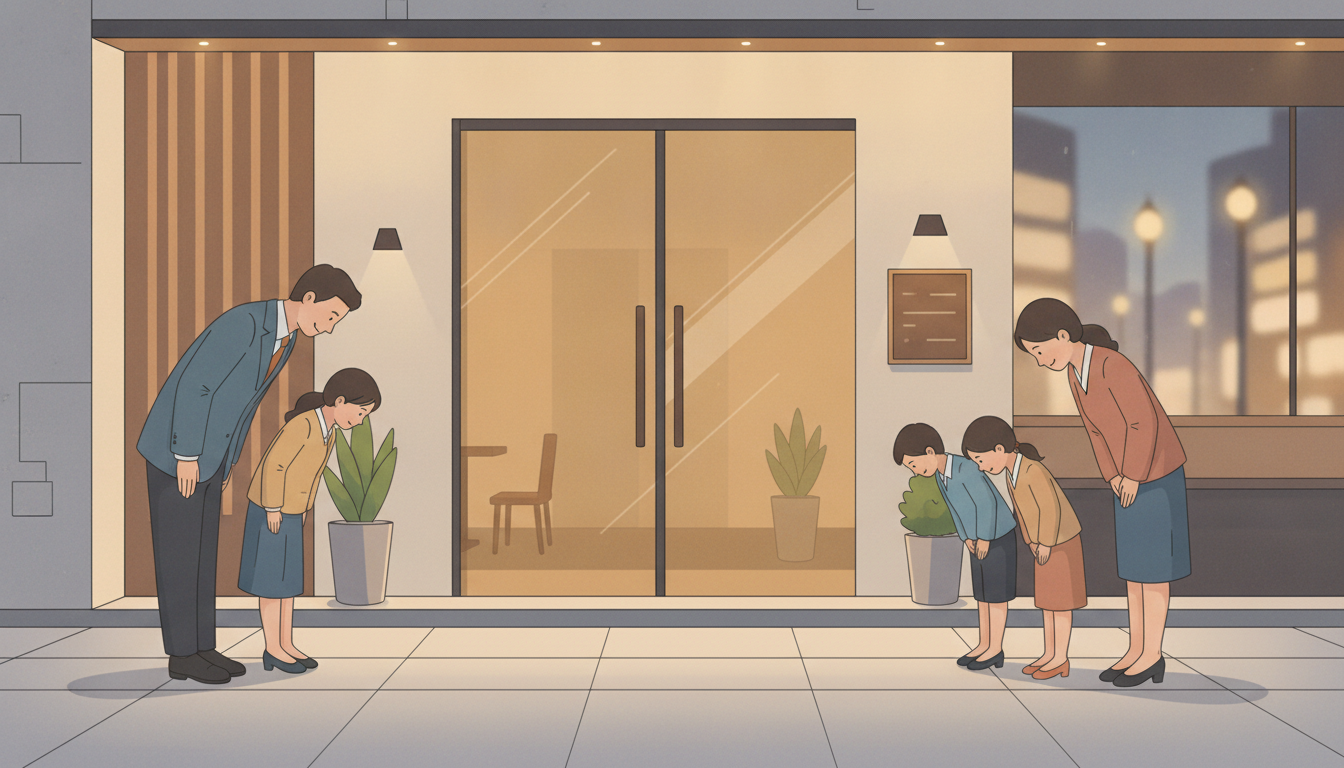
In my experience, being too casual, or simply not knowing the hierarchy yet, causes more awkwardness than being too formal. That awkwardness doesn’t usually last, though. The other person can tell it wasn’t done on purpose, so the stiff mood doesn’t stick around. Nobody expects your spouse or your kids to know office rank the way you do.
Quick Tips for These Moments
If you remember only two things, remember this. Match your spouse’s greeting level to your own, not to the mood of the room. And close a family introduction with 쟐 부탁드립니다, since it rarely sounds wrong even when you’re unsure about the finer honorific details. These few Korean phrases for meeting coworkers’ family will carry you through most year-end dinners and company workshops.
If you want to go deeper into how rank shapes everyday office speech, our guide on talking to your boss without awkward mistakes covers more of these patterns.
Key Expressions
- 인사드려 (in-sa-deu-ryeo — say hello, respectfully, usually said to a child or younger person). Example: “Say hello, this is Dad’s team leader.” (인사드려, 이 분이 아빠 팀장님이셔.)
- 제 아내입니다 (je a-nae-im-ni-da — this is my wife, formal). Example: “This is my wife, nice to meet you.” (제 아내입니다, 만나서 반겑습니다.)
- 우리 아들이에요 (u-ri a-deu-ri-e-yo — this is our son, casual-polite). Example: “This is our son, he’s five.” (우리 아들이에요, 다섯 살이에요.)
- 쟐 부탁드립니다 (jal bu-tak-deu-rim-ni-da — please be kind to them, please take care of them). Example: “This is my wife, please take good care of her.” (제 아내입니다, 쟐 부탁드립니다.)
- 인사해 (in-sa-hae — say hi, casual, usually said to a young child). Example: “Say hi to Dad’s coworker.” (인사해, 아빠 회사 동료야.)
Written by a native Korean speaker born in Seoul in 1985. This is my personal experience. Other Koreans may see things differently.