Picture this. You are at a crowded pharmacy counter. The pharmacist is busy helping someone else. You have one quick question, but people are waiting behind you. You freeze, unsure how to speak up without sounding rude. This moment trips up a lot of Korean learners. Knowing how to say excuse me in Korean the right way can save you from that kind of awkward pause.
In Korea, most counters use a number ticket system. I think walking up ahead of your turn just to ask something is not fair to the people already waiting. Sometimes, though, I am about to leave and realize I forgot to ask one small thing. If the next number gets called by then, I still go back and say sorry before asking my quick question. But if it is simply not my turn yet, I do not push in just because I am in a hurry.

Jeogiyo: The All-Purpose Way to Get Attention
The most basic word here is 저기요 (jeo-gi-yo — excuse me / hey there). It literally means “over there,” but Koreans use it to get someone’s attention first. You can say it to a staff member, a stranger, or a waiter at a restaurant. It works in almost any place where you need someone to look at you before you speak.
For me, the word I reach for depends on who I am talking to. With shop staff, I usually say 사장님 (sa-jang-nim — boss, owner), even if the person is not the actual owner. When I talk to someone younger than me, or close to my age, I tend to say 저기요, 죄송한데요 (joe-song-han-de-yo), or 실례합니다 (sil-lye-hamnida — excuse me, formal). But if I think the person is older than me, I am more likely to call them 사장님 instead, out of respect.
Jamsimanyo: How to Politely Interrupt in Korean
When you need to physically move past people or cut in for a moment, use 잠시만요 (jam-si-man-yo — just a moment, excuse me). The jamsimanyo meaning is close to “just for a moment,” and it signals that you will be quick. It works well at a counter, on a bus, or when you are squeezing through a crowd. It sounds polite and considerate, not pushy.
I do not usually add a hand gesture or a small bow when I say 잠시만요. In my experience, those two things happen in different situations. If I bow, it is usually while saying 안녕하세요 (an-nyeong-ha-se-yo — hello) and stating my reason for being there, not while asking someone to let me through. So for me, 잠시만요 mostly stands on its own, with no extra gesture attached.

Joesonghandeyo: A Softer Way to Ask a Quick Question
For a gentler opener, try 죄송한데요 (joe-song-han-de-yo — I’m sorry, but…). This adds a small cushion before your question. It shows that you know you are interrupting, and Koreans appreciate that. You might say 죄송한데요, 뭐 좀 여쭤봐도 될까요? (joe-song-han-de-yo, mwo jom yeo-jjwo-bwa-do doel-kka-yo — sorry, but can I ask something?). It feels warmer than jumping straight into your question.
From my own experience, asking a question with no cushion at all feels much rougher than adding 죄송한데요 first. Whenever I use one of these Korean phrases for asking a quick question, the other person’s reaction seems noticeably better. A few extra words at the front make the whole exchange feel smoother, and it costs nothing to add them.
Mwo Jom Yeojjwobwado Doelkkayo: The Formal Version
In more formal settings, like a government office or a bank, try 뭐 좀 여쭤봐도 될까요 (mwo jom yeo-jjwo-bwa-do doel-kka-yo — can I ask you something?). The verb 여쭤보다 (yeo-jjwo-bo-da) is the humble form of “to ask,” used toward someone you respect. It sounds more careful than the casual phrases above. This works well when the staff member looks especially busy or serious, and it is a solid choice for excuse me in Korean at a counter where the tone feels more official.
Korean grammar actually builds several levels of formality right into its verb endings. If you want to read more about this system, Wikipedia has a clear overview of Korean speech levels.
Since I mentioned convenience stores, I will be honest. This more formal phrase is the textbook-correct version, but with an actual convenience store part-timer, I usually just call them 사장님 anyway. It feels more natural to me in that setting, even though the formal phrase is technically the more polished choice.
What Not to Do
Avoid grabbing someone’s arm or waving your hand loudly without saying a word first. Also try not to blurt your question out with no opener at all. In my everyday life, silence before speaking feels more awkward than a small “excuse me.” A short cushion word almost always makes the moment smoother.
If someone touches me without saying anything, it does feel a little unpleasant. I think you should say something, or at least start a gesture that barely touches the person, before making contact. I notice that older people touch more often when trying to get someone’s attention. I do not think they mean anything rude by it. It feels like something that was simply more accepted in the past, especially among older generations. This is my personal experience. Other Koreans may see it differently.
If you want to practice more real counter conversations, check out this guide on ordering food like a local in Korean, which covers similar polite openers you will hear at restaurants and shops.
Key Expressions
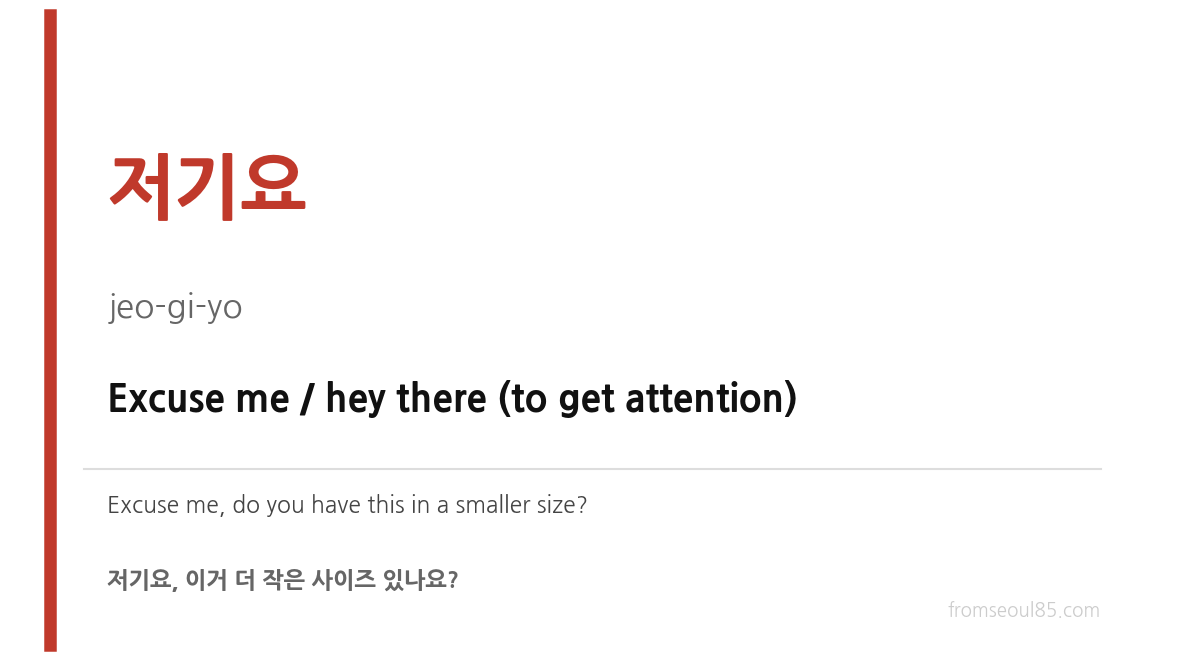 저기요 (jeo-gi-yo) — Excuse me / hey there, to get attention. Example: “Excuse me, do you have this in a smaller size?” (저기요, 이거 더 작은 사이즈 있나요?)
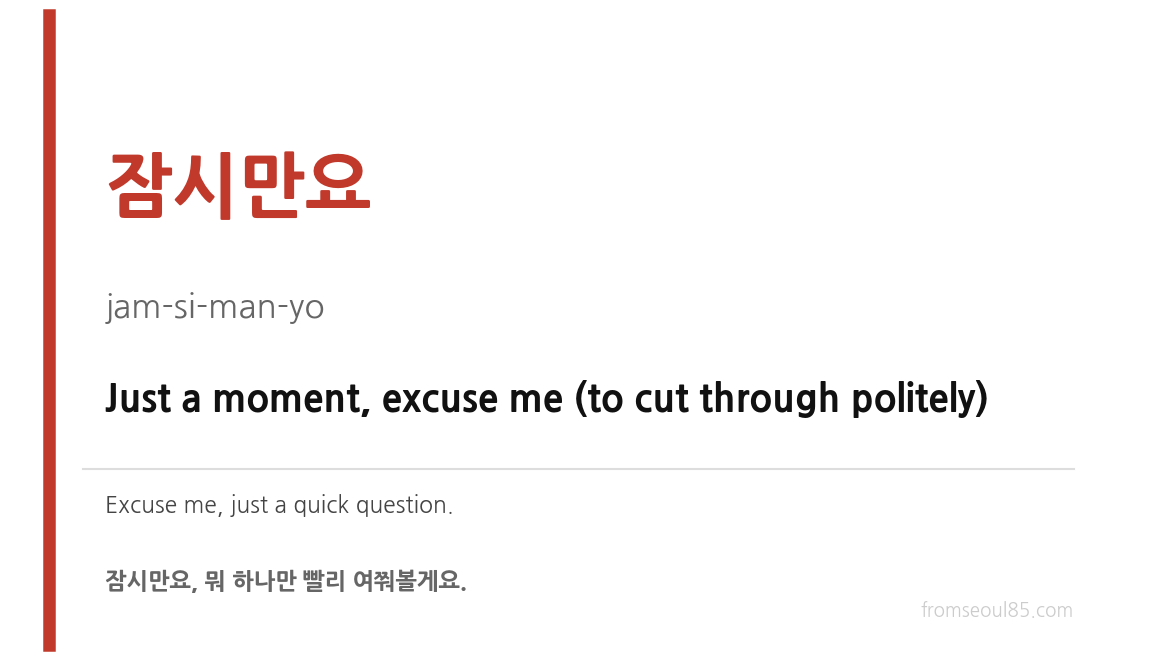 잠시만요 (jam-si-man-yo) — Just a moment, excuse me, used to cut through politely. Example: “Excuse me, just a quick question.” (잠시만요, 뭐 하나만 빨리 여쭤볼게요.)
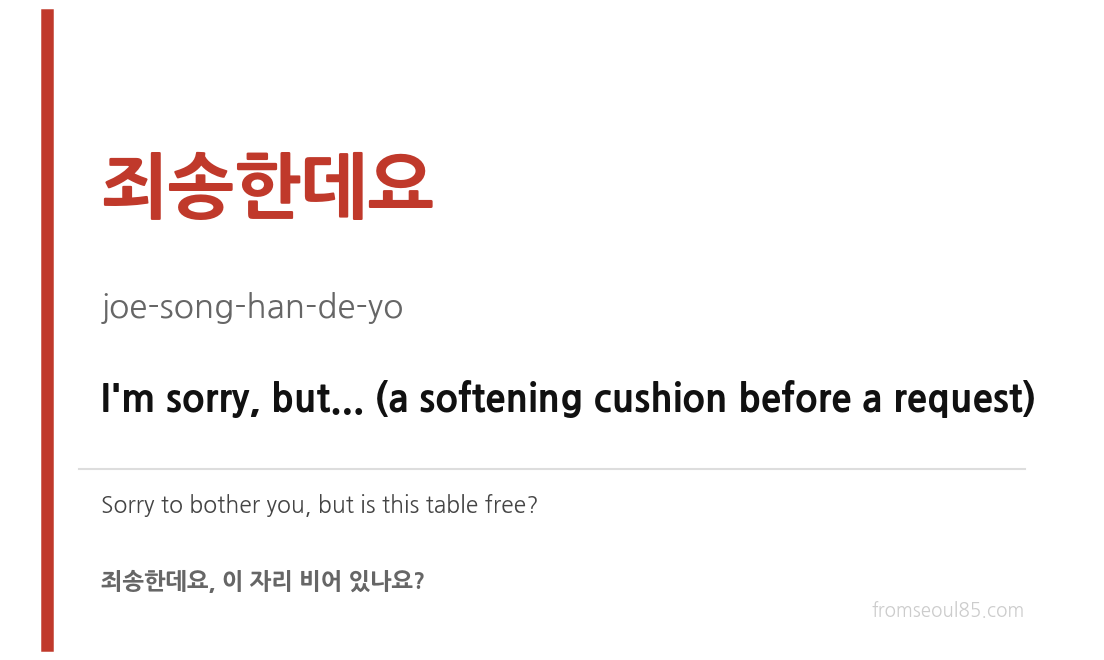 죄송한데요 (joe-song-han-de-yo) — I’m sorry, but…, a softening cushion before a request. Example: “Sorry to bother you, but is this table free?” (죄송한데요, 이 자리 비어 있나요?)
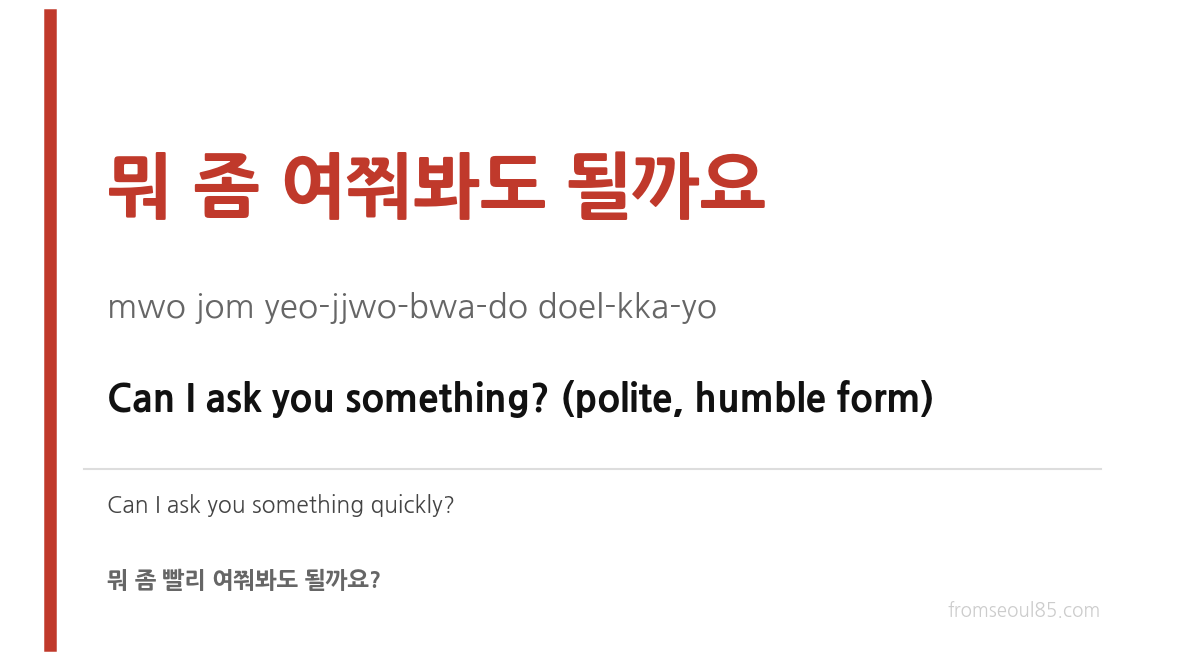 뭐 좀 여쭤봐도 될까요 (mwo jom yeo-jjwo-bwa-do doel-kka-yo) — Can I ask you something? A polite, humble form. Example: “Can I ask you something quickly?” (뭐 좀 빨리 여쭤봐도 될까요?)
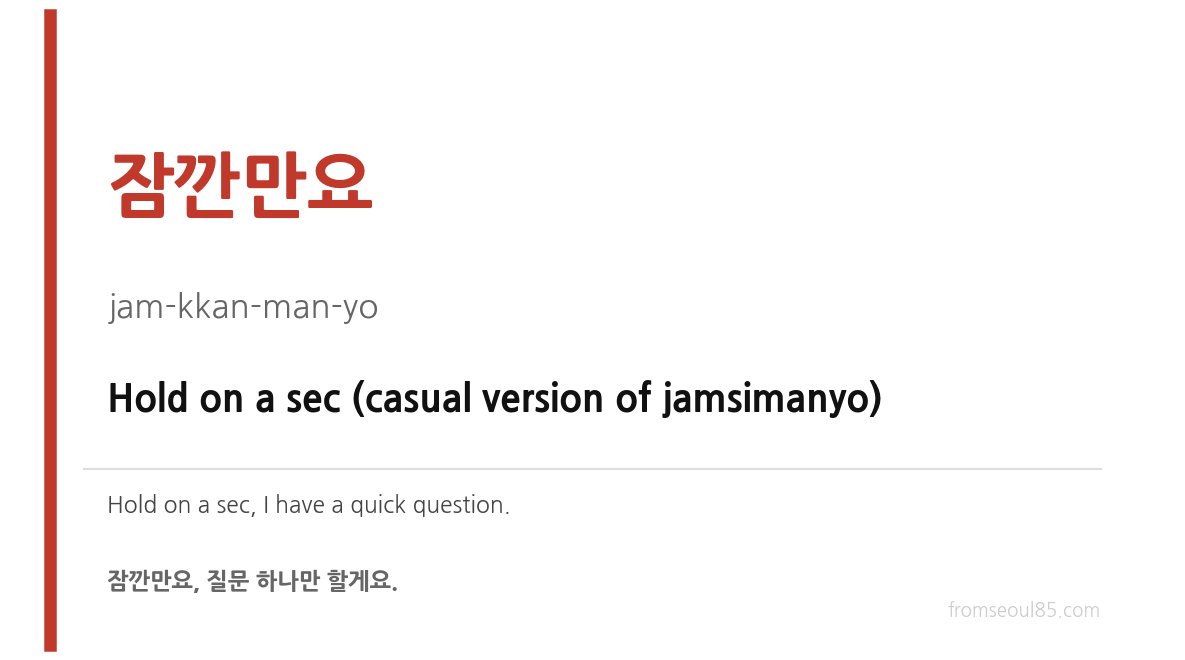 잠깐만요 (jam-kkan-man-yo) — Hold on a sec, the casual version of jamsimanyo. Example: “Hold on a sec, I have a quick question.” (잠깐만요, 질문 하나만 할게요.)
A Couple of Practical Tips
If you only remember one phrase, make it 저기요. It works almost everywhere and rarely sounds wrong. Once you get more comfortable, add 죄송한데요 in front of your question. That small cushion changes how the whole sentence lands, and it takes only two extra seconds to say.
Watch how the staff or person you are approaching is acting before you speak. If they look swamped or stressed, lean toward the more formal 뭐 좀 여쭤봐도 될까요. If it is a quick, casual moment, like squeezing past someone on a bus, 잠시만요 or 잠깐만요 will do the job just fine.
Written by a native Korean speaker born in Seoul in 1985. This is my personal experience. Other Koreans may see things differently.